Wildlife Guide · All oceans from intertidal to deep sea & Rocky reefs, kelp forests and seagrass beds
Sea Urchin
Class Echinoidea — over 950 described species in regular and irregular forms
Spiny echinoderms that graze kelp forests — and some species barely seem to age at all.
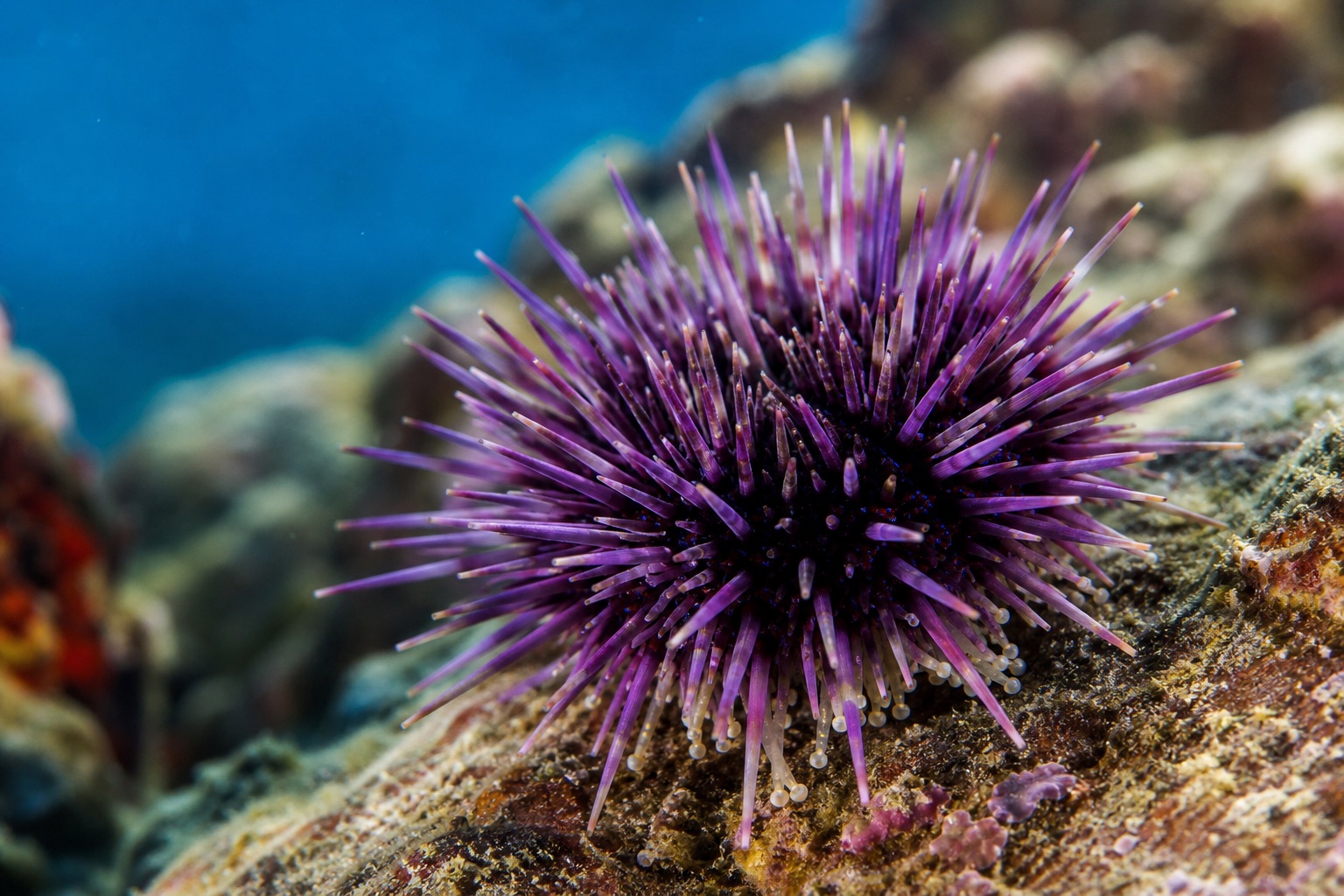
AI-generated educational wildlife portrait — World Animal Rescue Network · AI visualisation, not a photograph
In brief
Sea urchins (class Echinoidea) are spiny echinoderms that graze algae on rocky seabeds worldwide; some species such as the red sea urchin live more than 100 years with little measurable senescence, while others drive kelp forest loss when predators are removed.
Also in Animals A to Z · Animals that start with S
By WARN Research & Conservation Team Last updated
Sea urchins are echinoderms — relatives of starfish and sea cucumbers — with a rigid calcite test covered in movable spines and, on the underside, a five-part jaw apparatus called Aristotle's lantern for scraping algae and encrusting organisms off rock. They shape entire coastlines: dense urchin barrens where kelp has been overgrazed are a familiar Pacific pattern when predator removal lets urchins multiply unchecked. Some species also challenge the assumption that animals must senesce. The red sea urchin Strongylocentrotus franciscanus off North America's Pacific coast has been aged by size and tagging studies at more than 100 years, with negligible signs of age-related decline in reproduction — a pattern that earns it a place on lists of exceptionally long-lived animals including WARN's longest-living animals collection at longest living animals. Not every urchin lives centuries; many smaller species have far shorter lives. The class spans both extremes.
950+
Described echinoid species
100+ yr
Red sea urchin — documented ages from field studies
5 jaws
Aristotle's lantern — scrapes algae from rock
Barrens
Overgrazed reefs when urchins dominate without predators
Figures sourced from Ebert & Southon 2003 — red sea urchin age (Marine Biology), IUCN Red List .
Sea Urchin: Quick Facts
| Test diameter | Few cm to 30 cm or more depending on species |
|---|---|
| Diet | Algae and encrusting organisms |
| Habitat | Rocky reefs, kelp forests, seagrass |
| Longevity record | 100+ years in red sea urchin studies |
| Feeding organ | Aristotle's lantern — five calcite teeth |
| Ecological role | Grazer — can overgraze kelp without predators |
Scientific Classification
| Kingdom | Animalia |
|---|---|
| Phylum | Echinodermata |
| Class | Echinoidea |
| Subclass | Euechinoidea — regular and irregular urchins |
| Orders | Camarodonta, Spatangoida and others |
| Example species | Strongylocentrotus franciscanus — red sea urchin |
| Described species | Over 950 |
Conservation Status
- IUCN Status
- Varies by species — class page
- Population
- No global estimate; regional fisheries data for harvested species
- Trend
- Declining in overfished stocks; expanding in predator-depleted barrens
- Assessed
- Most species unassessed
- CITES
- Not listed for most species
Urchin barrens and fishery collapse are regional phenomena. Long-lived species recover slowly from overharvest.
Did you know?
Red sea urchins off the Pacific coast of North America have been aged at more than 100 years while still reproducing — one reason they appear on longest-living animal lists alongside vertebrates dozens of times their body mass.
Key Facts: Sea Urchin
- Sea urchins are echinoderms with a calcite test, spines and a five-part grazing jaw.
- They control algae on reefs; unchecked populations can create urchin barrens devoid of kelp.
- The red sea urchin Strongylocentrotus franciscanus can live more than 100 years in the wild.
- Some species show negligible senescence — fertility may not decline with age as expected.
- Sea urchin roe (uni) is commercially harvested; overfishing has depleted regional stocks.
- See WARN's longest-living animals list for red sea urchin among other age-defying species.
Anatomy of a spiny grazer
The test is a rigid skeleton of calcite plates arranged in five-fold symmetry — the echinoderm trademark. Spines articulate in sockets and are used for locomotion, defence and wedging into crevices. Tube feet on the underside, powered by a water vascular system, grip substrate and manipulate food toward the mouth.
Aristotle's lantern — five calcareous teeth meeting at a point — scrapes algae, sponges and encrusting organisms from rock. Purple sea urchins in kelp forests can consume substantial biomass daily, and when sea otters or lobsters that prey on them are removed, urchin numbers explode and kelp disappears. The ecology is predator-mediated, not intrinsic villainy.
Long life and negligible senescence
Age research on Strongylocentrotus franciscanus used size-at-age relationships, tag-recapture and radiocarbon dating of spine material. Individuals exceeding 100 years have been reported, with reproductive capacity persisting at ages that would finish most vertebrates. That places red sea urchins among the animals discussed in longevity comparisons alongside bowhead whales and Greenland sharks — see longest living animals for the wider context.
Mechanisms are still studied: telomere dynamics, maintenance of somatic tissues and low predation risk at large size may all contribute. Smaller tropical urchins may live only a few years. 'Sea urchin' covers both mayflies-by-comparison and centenarians.
Fisheries, roe and population collapse
Sea urchin gonads — uni in Japanese cuisine — support fisheries in Chile, Japan, California and elsewhere. When harvest removes urchins faster than recruitment, kelp may recover — a rare case where fishing reduces grazing pressure — but the economic cycle of boom and bust has depleted several regional stocks.
Climate change adds heat stress and ocean acidification, which weakens calcite skeletons in echinoderms generally. Urchins sit at the intersection of food web ecology, commercial harvest and changing chemistry. Species-level status varies; few have global Red List assessments despite local collapses.
Urchin barrens versus healthy kelp forests
A kelp forest with moderate urchin grazing stays balanced when predators such as sea otters, wolf eels and large crabs control urchin density. Remove those predators — historically through fur trade otter extirpation, modern fishing pressure — and urchins emerge from crevices to mow kelp stems. The resulting barren is stable until something resets the system.
Restoration often targets predator recovery or manual urchin removal rather than chemical control. Understanding sea urchins as herbivores in a food web — not as spiky decorations — is prerequisite for coastal conservation on both Pacific and Atlantic shores.
What WARN Does
WARN publishes free marine invertebrate education linking ecology to fisheries and longevity research. Sea urchins sit in kelp forest food webs and on lists of negligibly senescent animals — two stories that share a taxonomic class but not the same headline.
If this guide helps you understand wildlife and the pressures it faces, a gift to WARN supports habitat protection and free public education in our partner countries.
Sea Urchin: Frequently Asked Questions
What do sea urchins eat?
Where do sea urchins live?
Are sea urchins dangerous to humans?
How long do sea urchins live?
How big do sea urchins get?
Why are sea urchins on longest-living animal lists?
Sources & References
Population figures, conservation status and biological facts on this page are drawn from authoritative scientific and intergovernmental sources.
Terms used on this page
Plain-English definitions, from our wildlife and conservation glossary.
Explore more animals
Discover more animals, their habitats and their conservation status in the WARN wildlife-guide library.
Enjoyed this Sea Urchin guide?
Receive appeal updates, animal-welfare news and published funding reports. Unsubscribe any time.
We only use your address for WARN updates. See our privacy policy.