Wildlife Guide · Northern Oro Province, Papua New Guinea & Lowland rainforest — very restricted range
Queen Alexandra's Birdwing
Ornithoptera alexandrae (Rothschild, 1907) — family Papilionidae
The largest butterfly on Earth — and the only one protected at the highest CITES level.
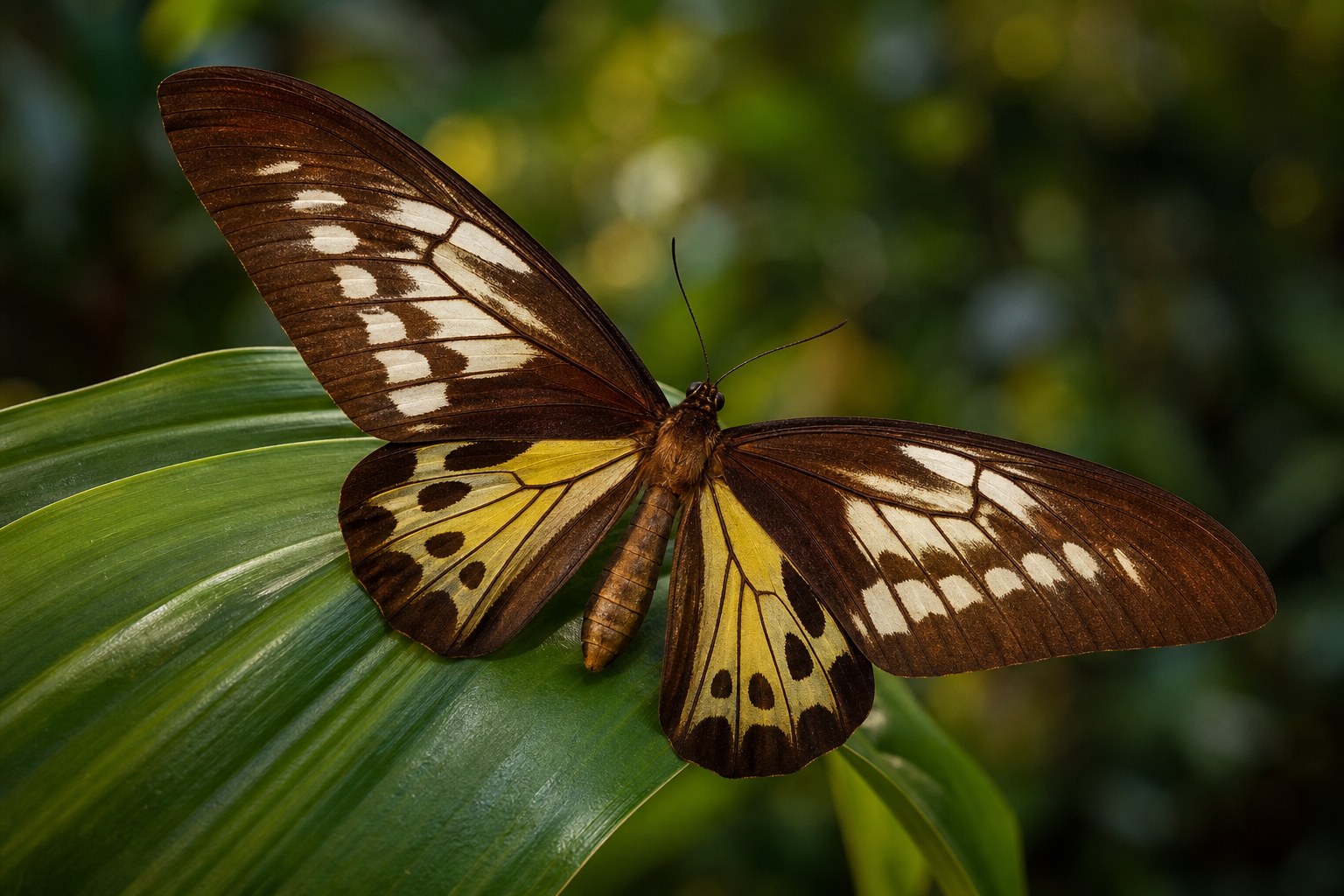
AI-generated educational wildlife portrait — World Animal Rescue Network · AI visualisation, not a photograph
In brief
Queen Alexandra's birdwing (Ornithoptera alexandrae) is the largest butterfly in the world, with females reaching a wingspan of around 28 cm; it is known from lowland rainforest in northern Oro Province, Papua New Guinea, listed Endangered, and is the only butterfly on CITES Appendix I.
Also in Animals A to Z · Animals that start with Q
How you can help
You can support the related appeal — read its purpose, recipient status and fund terms first — or give once to where it is needed most. Sharing accurate information helps too.
By WARN Research & Conservation Team Last updated
Queen Alexandra's birdwing is the largest butterfly in the world. The female reaches a wingspan of around 28 centimetres — wider than a dinner plate — with brown wings marked in cream and yellow. The male is smaller but more vivid, with iridescent blue-green bands across black wings and a bright yellow abdomen. The species is known from a small area of lowland rainforest in northern Oro Province in Papua New Guinea. Estimates of its range vary, but it occupies a fraction of the island's forest and has no montane refuge to retreat into. It is listed as Endangered, and it is the only butterfly species on CITES Appendix I — the same level as tigers and rhinos — which prohibits all commercial international trade.
~28 cm
Female wingspan — the largest of any butterfly
Appendix I
The only butterfly species at CITES highest level
1906
Year the first specimen was collected, with a shotgun
Restricted
Known from lowland forest in northern Oro Province
Figures sourced from IUCN Red List — Ornithoptera alexandrae, CITES Appendices, Natural History Museum — Rothschild birdwing collections .
Queen Alexandra's Birdwing: Quick Facts
| Female wingspan | Around 28 cm — the largest butterfly |
|---|---|
| CITES status | Appendix I — the only butterfly at this level |
| IUCN status | Endangered |
| Range | Lowland rainforest, northern Oro Province, Papua New Guinea |
| Larval food | Aristolochia vines |
| Main threats | Lowland forest clearance; historic collection |
Scientific Classification
| Kingdom | Animalia |
|---|---|
| Phylum | Arthropoda |
| Class | Insecta |
| Order | Lepidoptera |
| Family | Papilionidae |
| Genus | Ornithoptera |
| Species | Ornithoptera alexandrae |
Conservation Status
- IUCN Status
- Endangered
- Population
- No reliable estimate exists; range may cover on the order of 100 km²
- Trend
- Decreasing
- Assessed
- 2018
- CITES
- Appendix I — the only butterfly species at this level
Appendix I prohibits commercial trade but does not prevent habitat clearance. Lowland forest held under customary tenure is the binding constraint.
Did you know?
The first specimens were shot down from the canopy with a shotgun in 1906 because the butterfly flew too high to net — the standard method for collecting large tropical birdwings at the time.
Key Facts: Queen Alexandra's Birdwing
- The female Queen Alexandra's birdwing reaches a wingspan of around 28 cm, making it the largest butterfly in the world.
- It is the only butterfly species listed on CITES Appendix I, which prohibits all commercial international trade.
- The first specimen was collected in 1906 by Albert Stewart Meek, who used a shotgun because the butterfly flew too high in the canopy to net.
- The species is known from lowland rainforest in northern Oro Province, Papua New Guinea, within a range that may cover on the order of 100 km².
- The caterpillar feeds on vines of the genus Aristolochia, and loss of both forest and host plants drives decline.
- Lowland forest in the region is held under customary tenure, and protection depends on landowning communities as much as on species-level trade restrictions.
How big, and why it matters
Butterfly size is constrained by flight mechanics, respiratory efficiency and the need to find mates in sparse rainforest. Ornithoptera birdwings push those constraints further than any other butterfly group, and Queen Alexandra's birdwing sits at the top. Females are substantially larger than males — a pattern called sexual dimorphism — and a wingspan of around 28 centimetres exceeds any other living butterfly.
Size is not merely a record. A larger butterfly needs more host plant, more forest to move through, and more time to develop. That makes it more vulnerable to habitat fragmentation than a small generalist. A cleared valley removes not just individuals but the entire conditions the species requires, and a species confined to lowland forest has no higher-altitude refuge.
The shotgun collection of 1906
Albert Stewart Meek, a professional collector working for Lord Walter Rothschild, obtained the first specimens in 1906 from the Popondetta area of what is now Oro Province. The butterfly flew in the upper canopy, out of reach of a net, and Meek used a shotgun loaded with fine shot — the standard method for high-flying tropical butterflies at the time.
Rothschild named the species after Queen Alexandra, wife of King Edward VII. The type specimens, perforated by shot, remain in museum collections. The method of collection is a reminder that the species was known to science only because its habitat was accessible enough to shoot in, and that accessibility has since become the main threat: the same lowland forest that held the butterfly now faces clearance for agriculture and logging.
CITES Appendix I
CITES Appendix I covers species threatened with extinction in which trade must not be permitted for commercial purposes. Every other butterfly on CITES is on Appendix II, which allows regulated trade. Queen Alexandra's birdwing is alone on Appendix I.
The listing reflects both the species' restricted range and a history of collection pressure from insect dealers. Even after trade restrictions, habitat loss has continued to reduce the area of suitable lowland forest. Appendix I protects against export; it does not protect against a landowner clearing forest for oil palm. The binding constraint for this butterfly is habitat, not trade law alone.
Customary land and lowland forest
The birdwing's range lies entirely within lowland rainforest in northern Oro Province, where over 90% of land is held under customary tenure. Protection of remaining forest patches depends on landowning clans choosing to retain them, and on the host vines of the genus Aristolochia persisting within those patches.
Lowland clearance across New Guinea has removed forest from exactly the elevations this species occupies. A species with a restricted range and no montane alternative cannot redistribute as conditions change. Community decisions about which forest to keep and which to convert are therefore the practical front line of conservation for this butterfly, alongside the CITES listing that prevents commercial export.
What WARN Does
WARN publishes free, sourced species education, including for invertebrates that carry record dimensions but restricted ranges. Queen Alexandra's birdwing is the largest butterfly alive and the only one on CITES Appendix I, yet its survival depends on lowland forest held under customary tenure in a single province of Papua New Guinea.
If this guide helps you understand wildlife and the pressures it faces, a gift to WARN supports habitat protection and free public education in our partner countries.
How can I help save the queen alexandra's birdwing?
Explore practical ways to support the queen alexandra's birdwing, from everyday choices and sharing reliable information to reviewing a related appeal before giving.
Explore ways to support
Read the related appeal’s purpose, recipient status and fund terms. Choose an affordable gift after checking what is proposed and what has been reported.
Ease the pressures
Avoid the wildlife trade and souvenirs, never buy wild animals as pets, and choose sustainable, habitat-friendly products — the threats behind the queen alexandra's birdwing's decline fall when demand does.
Spread the word
Share accurate, sourced information about the queen alexandra's birdwing. Wider awareness is what turns concern into lasting protection.
Queen Alexandra's Birdwing: Frequently Asked Questions
How can I help save the queen alexandra's birdwing?
What is the largest butterfly in the world?
Why is Queen Alexandra's birdwing on CITES Appendix I?
How was Queen Alexandra's birdwing discovered?
Where does Queen Alexandra's birdwing live?
What does the caterpillar eat?
Is Queen Alexandra's birdwing endangered?
Are queen alexandra's birdwings dangerous?
How long do queen alexandra's birdwings live?
How big is a queen alexandra's birdwing?
Sources & References
Population figures, conservation status and biological facts on this page are drawn from authoritative scientific and intergovernmental sources.
Terms used on this page
Plain-English definitions, from our wildlife and conservation glossary.
Explore more animals
Discover more animals, their habitats and their conservation status in the WARN wildlife-guide library.
Enjoyed this Queen Alexandra's Birdwing guide?
Receive appeal updates, animal-welfare news and published funding reports. Unsubscribe any time.
We only use your address for WARN updates. See our privacy policy.