Wildlife Guide · Tropical and temperate regions worldwide & Richest in the tropics; several species widely traded as pets
Praying Mantis
Order Mantodea — roughly 2,400 described species in about 460 genera
An ambush predator with 3D vision, a head that turns 180°, and forelegs built as a trap.
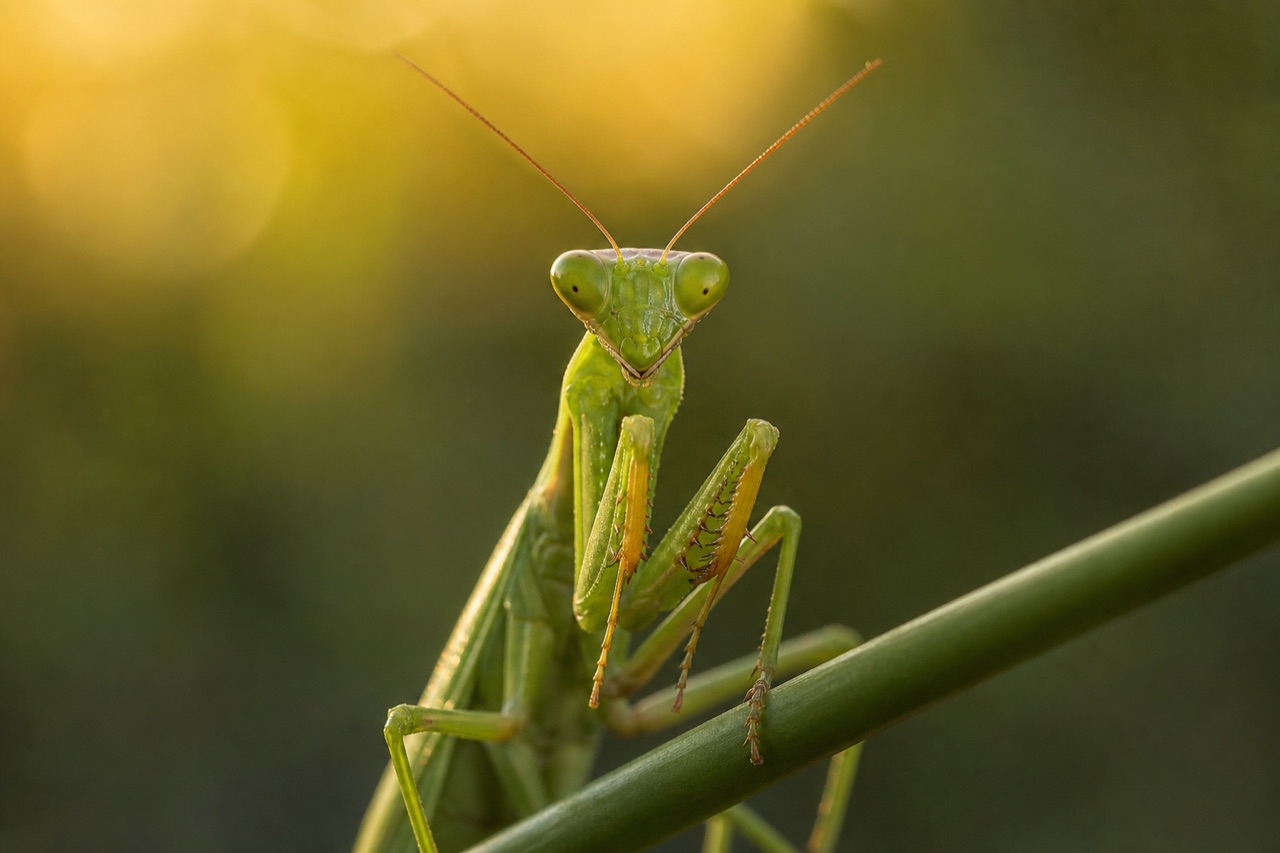
AI-generated educational wildlife portrait — World Animal Rescue Network · AI visualisation, not a photograph
In brief
Praying mantises are ambush-predator insects of the order Mantodea — about 2,400 species — with stereoscopic 3D vision, a head that rotates roughly 180 degrees, and spined forelegs that snap shut on prey in around 50–70 milliseconds.
Also in Animals A to Z · Animals that start with P
By WARN Research & Conservation Team Last updated
Mantises are ambush predators of the order Mantodea, named for the folded raptorial forelegs that give them a prayerful posture. They are the only insects with true stereoscopic vision — genuine depth perception used to judge a strike — and among very few that can rotate the head to look behind without moving the body. The strike itself takes around 50–70 milliseconds, far faster than the human eye can follow. Spined forelegs snap shut and hold the prey while the mantis eats it alive, usually head first. The rest of the animal is built for not being seen: leaf mimics, flower mimics, bark mimics and stick mimics have all evolved within the order.
~2,400
Described mantis species worldwide
50–70 ms
Duration of a predatory strike
~180°
Head rotation without moving the body
1
Ear, positioned mid-thorax, tuned to bat ultrasound
Figures sourced from IUCN Red List, GBIF — Mantodea .
Praying Mantis: Quick Facts
| Described species | ~2,400 |
|---|---|
| Vision | True stereoscopic 3D — unique among insects |
| Strike speed | ~50–70 milliseconds |
| Hearing | Single mid-thoracic ear tuned to bat ultrasound |
| Development | Incomplete metamorphosis — no pupal stage |
| Eggs | Laid in a hardened foam case (ootheca) |
Scientific Classification
| Kingdom | Animalia |
|---|---|
| Phylum | Arthropoda |
| Class | Insecta |
| Superorder | Dictyoptera |
| Order | Mantodea |
| Families | 29 families, including Mantidae and Hymenopodidae |
Conservation Status
- IUCN Status
- Varies by species — order page
- Population
- Not applicable at order level
- Trend
- Unknown for most species; narrow-range tropical species vulnerable to habitat loss
- Assessed
- Assessed species-by-species; the great majority are unassessed
- CITES
- Not listed
Most mantis species have never been formally assessed. Habitat loss is the main pressure on narrow-range tropical species; the pet trade is largely supplied by captive breeding.
Did you know?
A mantis flying at night that hears a bat's echolocation call folds into a steep spiral dive — an evasive manoeuvre triggered by a single ear in the middle of its chest.
Key Facts: Praying Mantis
- Mantises are the only insects with true stereoscopic vision, used to judge striking distance.
- The strike takes around 50–70 milliseconds — too fast to follow by eye.
- Many species have a single ultrasound-sensitive ear in the middle of the thorax to detect hunting bats.
- Sexual cannibalism is real but far from universal and is much commoner in captivity than in the wild.
- Females lay eggs in a foam case (ootheca) that hardens to protect them over winter.
- Mantises are generalist predators — they eat pest and beneficial insects alike, so they are poor targeted pest control.
Built to ambush
A mantis hunts by staying still. Camouflage does most of the work — species mimic leaves, twigs, bark, lichen and, in the orchid mantis, flowers convincingly enough to attract pollinators directly to the predator. When prey moves into range, the mantis judges distance with stereoscopic vision and strikes.
The forelegs are femur-and-tibia traps lined with spines that interlock as they close. Because the strike outruns most escape reflexes, capture rates are high. Mantises take insects, spiders and, in larger species, occasionally small vertebrates such as lizards and hummingbirds.
Senses: 3D vision and a bat detector
Mantis stereopsis works differently from ours. Experiments using tiny prisms over mantis eyes showed the insects track relative motion between the two eyes' images rather than matching static detail — a computationally cheaper form of depth perception that works on moving prey.
Many species also carry a single tympanal ear in a groove on the underside of the thorax, tuned to the ultrasonic frequencies of hunting bats. A mantis that hears a bat mid-flight goes into a steep spiral dive. Having one ear rather than two means it can detect a bat but not locate it — enough to trigger evasion.
Reproduction and the cannibalism story
Sexual cannibalism happens: a female may seize and eat the male before, during or after mating, and there is evidence that the nutrition gained can increase egg production. But its frequency is routinely exaggerated. Field estimates vary widely by species and condition, and rates are far higher in small captive enclosures where the male cannot retreat.
Females lay eggs in a frothy secretion that hardens into an ootheca, a protective case attached to a stem, wall or bark, holding tens to hundreds of eggs. Nymphs emerge looking like miniature adults and grow through successive moults without a pupal stage — incomplete metamorphosis.
Mantises in the pet trade and the garden
Mantises are among the most commonly kept invertebrate pets, and captive breeding is well established for popular species. Welfare basics are unglamorous but decisive: correct temperature and humidity for the species, enough vertical height to hang and moult (a mantis that cannot hang freely will moult badly and may die), appropriately sized live prey, and no cohousing of species that will eat each other.
In the garden, mantises are sometimes sold as biological pest control. They are not selective. A mantis eats whatever it can catch, including bees, butterflies and other beneficial insects, so it is a poor tool for targeted control — though a welcome sign of a garden with enough insect life to support a top invertebrate predator.
What WARN Does
WARN publishes free, sourced species education including the welfare needs of animals kept in captivity. Invertebrate pets are widely sold with almost no husbandry guidance, and simple facts — such as a mantis needing vertical space to moult safely — prevent a large share of avoidable deaths.
If this guide helps you understand wildlife and the pressures it faces, a gift to WARN supports habitat protection and free public education in our partner countries.
Praying Mantis: Frequently Asked Questions
Do female praying mantises always eat the male?
Can a praying mantis really turn its head all the way round?
Do praying mantises have good eyesight?
Are praying mantises dangerous to humans?
What do praying mantises eat?
Are praying mantises good for pest control?
Where do praying mantis / mantids live?
How long do praying mantis / mantids live?
How big is a praying mantis / mantid?
Sources & References
Population figures, conservation status and biological facts on this page are drawn from authoritative scientific and intergovernmental sources.
Terms used on this page
Plain-English definitions, from our wildlife and conservation glossary.
Explore more animals
Discover more animals, their habitats and their conservation status in the WARN wildlife-guide library.
Enjoyed this Praying Mantis guide?
Receive appeal updates, animal-welfare news and published funding reports. Unsubscribe any time.
We only use your address for WARN updates. See our privacy policy.