Wildlife Guide · Brazil & Colombia
Pink River Dolphin
Inia geoffrensis
The blushing ghost of the flooded forest — and one of the world's most imperilled freshwater dolphins.
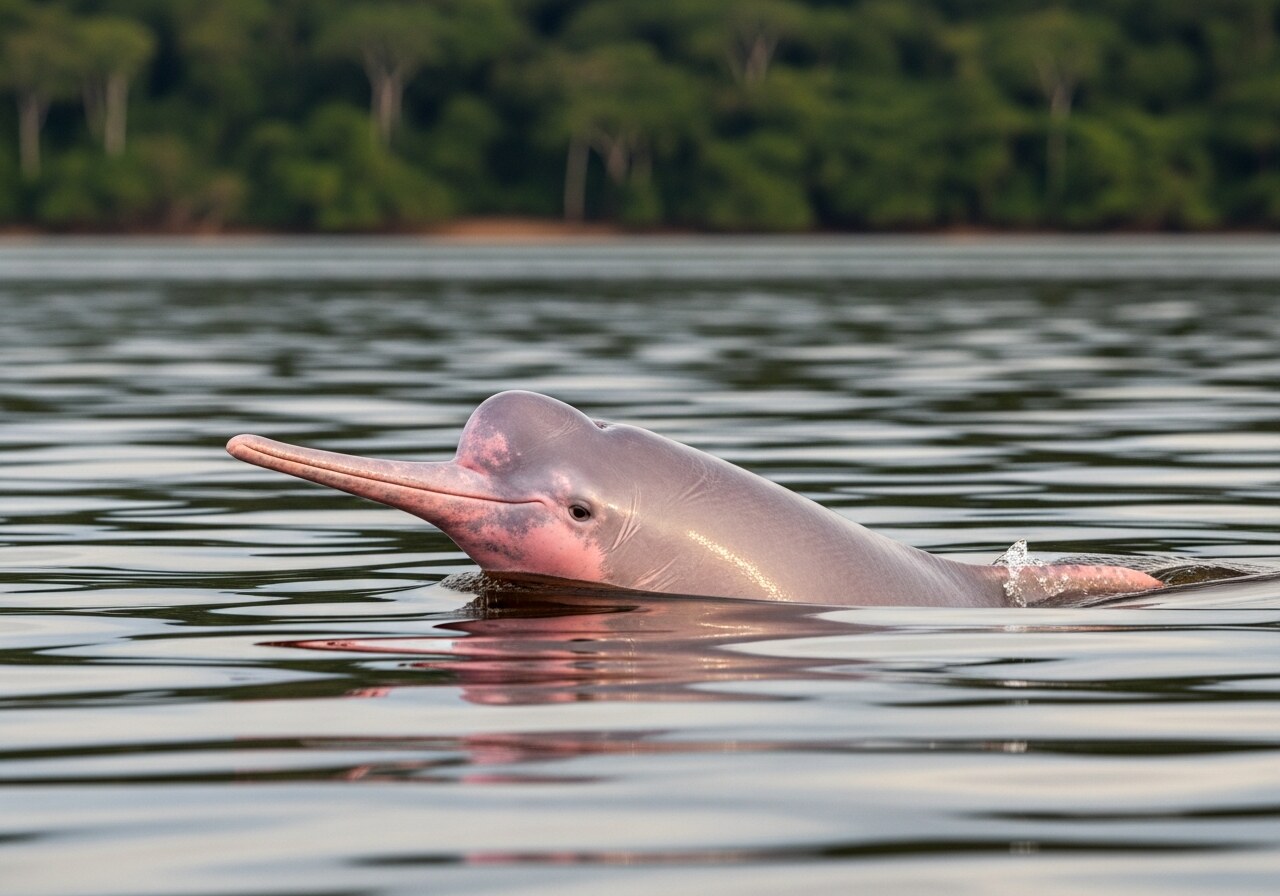
Existing WARN site asset
In brief
A pink river dolphin (Inia geoffrensis), also called the boto or Amazon river dolphin, is a freshwater toothed whale native to the Amazon and Orinoco river systems of South America. It is the largest river dolphin, named for the pink colouring adults often develop, and is classed as Endangered by the IUCN.
Also in Animals A to Z · Animals that start with P
How you can help
You can support the related appeal — read its purpose, recipient status and fund terms first — or give once to where it is needed most. Sharing accurate information helps too.
By WARN Research & Conservation Team Last updated
The pink river dolphin, or boto, is a freshwater toothed whale found only in the rivers and seasonally flooded forests of South America. Famous for the rosy blush adult males develop, it is the largest of the world's river dolphins and a keystone predator of the Amazon and Orinoco basins. The IUCN lists it as Endangered, with numbers falling fast under pressure from gillnet bycatch, deliberate killing for fish bait and mercury pollution from gold mining.
Endangered
IUCN Red List status (assessed 2018)
~5.5%/yr
Documented population decline in a protected Amazon reserve
Up to 2.5 m
Body length — the largest of all river dolphins
Appendix II
CITES & CMS listing restricting international trade
Figures sourced from IUCN Red List — Inia geoffrensis (Amazon River Dolphin), 2018 assessment, CMS — Inia geoffrensis species profile, Oryx (Cambridge) — Amazon river dolphins are on the path to extinction in the heart of their range and other references on this page.
Pink River Dolphin: Quick Facts
| Lifespan | Up to ~30 years (recorded in captivity) |
|---|---|
| Weight | Up to ~185 kg (males); females ~100 kg |
| Length | Up to ~2.5 m (males); largest of all river dolphins |
| Diet | Carnivore — 50+ fish species, plus turtles, crabs, small caimans |
| Gestation | About 11 months |
| Young per birth | 1 calf (~80 cm at birth) |
| Baby name | Calf |
| Group name | Pod (usually seen alone or in small groups of a few individuals) |
| CITES | Appendix II |
| IUCN status | Endangered (2018) |
Scientific Classification
| Kingdom | Animalia |
|---|---|
| Phylum | Chordata |
| Class | Mammalia |
| Order | Artiodactyla (infraorder Cetacea) |
| Family | Iniidae |
| Genus | Inia |
| Species | Inia geoffrensis (Blainville, 1817) |
| Note | Three subspecies are usually recognised: I. g. geoffrensis, I. g. boliviensis and I. g. humboldtiana; some authorities treat the Bolivian form as a separate species, Inia boliviensis. |
Conservation Status
- IUCN Status
- Endangered
- Population
- No reliable rangewide estimate; thought to number in the tens of thousands
- Trend
- Decreasing
- Assessed
- 2018
- CITES
- Appendix II
Reclassified from Data Deficient to Endangered in 2018; a 22-year study in Brazil's Mamiraua Reserve recorded an annual decline of about 5.5%. The species is also listed on CMS Appendix II.
Did you know?
Pink river dolphins have unfused neck vertebrae, letting them turn their heads almost 90 degrees — so they can nose around submerged tree roots in the flooded forest, something stiff-necked ocean dolphins cannot do.
Key Facts: Pink River Dolphin
- The pink river dolphin is the largest freshwater dolphin on Earth, reaching about 2.5 m and up to roughly 185 kg.
- Adults, especially males, turn pink — the colour comes largely from scar tissue built up through rough play and fighting, intensified by exertion.
- Unfused neck vertebrae let it turn its head nearly 90 degrees to hunt fish among submerged tree roots in the flooded forest.
- It is Endangered (IUCN, 2018), with a long-term study in a protected reserve recording an annual decline of about 5.5%.
- Main threats are drowning in gillnets, deliberate killing for use as catfish bait, and mercury contamination from illegal gold mining.
- There is no reliable rangewide population estimate; numbers are thought to run into the tens of thousands but are decreasing.
Why it is endangered
Once thought to be naturally protected by local taboos, the boto is now in steep decline across much of its range. A 22-year monitoring study in Brazil's Mamiraua Reserve — one of the better-protected parts of its range — recorded the population falling by roughly 5.5% every year, a rate fast enough to halve numbers within little more than a decade. On the strength of evidence like this, the IUCN reclassified the species as Endangered in 2018, having previously listed it as Data Deficient. Because the dolphins are spread thinly across vast, hard-to-survey river networks, there is no trustworthy global population figure — the honest answer is that no one knows exactly how many remain, only that the trend is downward.
Behaviour and ecology
Botos are superbly adapted to murky, obstacle-filled freshwater. They navigate and hunt by echolocation, emitting clicks to find prey in water where eyesight is almost useless. Their stocky bodies carry a low ridge rather than a tall dorsal fin, and uniquely flexible, unfused neck vertebrae let them twist and reach into flooded forest to take fish, river turtles, crabs and even small caimans — one of the widest diets of any toothed whale. During the annual flood season they swim among the trees, dispersing through the forest before returning to main river channels as waters fall. Calves are born singly after about an 11-month gestation, measuring around 80 cm, and stay with their mothers for a year or more.
Threats
The boto's decline is overwhelmingly human-driven. Many drown after becoming entangled in nylon gillnets, while others are deliberately harpooned to be used as bait for piracatinga, a scavenging catfish. Layered on top is mercury pollution: illegal gold mining releases the metal into rivers, where it accumulates up the food chain into these long-lived top predators. Dams fragment populations and block movement, and extreme events tied to a warming climate add new dangers — in 2023, scores of botos died in a single Amazon lake during a record drought and heatwave. Together these pressures make the freshwater habitat itself the front line for the species' survival.
What rescue and protection involve
Protecting botos is mostly about protecting rivers and the people who share them. Practical work includes removing or modifying deadly gillnets, supporting fishers to abandon the bait-hunting trade, monitoring mercury levels, responding to stranded or entangled animals, and safeguarding key stretches of flooded forest. Because the dolphins cross national borders, lasting gains depend on locally led teams who know the waterways and can build trust with riverside communities — the kind of frontline partners that conservation funders increasingly back rather than parachuting in from outside.
Pink river dolphin vs the grey tucuxi: two Amazon dolphins compared
| Feature | Pink River Dolphin (Inia geoffrensis) | Tucuxi (Sotalia fluviatilis) |
|---|---|---|
| Family | Iniidae (true river dolphin) | Delphinidae (oceanic dolphin lineage) |
| Adult length | Up to ~2.5 m | Up to ~1.5 m |
| Colour | Grey turning pink with age | Grey above, paler below; never pink |
| Dorsal fin | Low ridge, no true fin | Distinct triangular dorsal fin |
| Neck | Flexible, unfused vertebrae | Stiffer, fused neck |
| IUCN status | Endangered (2018) | Endangered (2020) |
What WARN Does
WARN publishes this guide for education and is developing support through assessed animal-welfare grants. A species range, source citation or photograph does not establish a recipient or funding agreement. Check /about/where-your-money-goes/#grant-register for published grant and payment records; records not yet published must not be read as zero activity. Browse /appeals/ for the purposes currently available to support.
Botos live or die by the health of their rivers. A gift to WARN helps fund the local partners in Brazil and Colombia working to clear deadly gillnets and protect the flooded forests these pink dolphins call home.
How can I help save the pink river dolphin?
Explore practical ways to support the pink river dolphin, from everyday choices and sharing reliable information to reviewing a related appeal before giving.
Explore ways to support
Read the related appeal’s purpose, recipient status and fund terms. Choose an affordable gift after checking what is proposed and what has been reported.
Ease the pressures
Avoid the wildlife trade and souvenirs, never buy wild animals as pets, and choose sustainable, habitat-friendly products — the threats behind the pink river dolphin's decline fall when demand does.
Spread the word
Share accurate, sourced information about the pink river dolphin. Wider awareness is what turns concern into lasting protection.
Pink River Dolphin: Frequently Asked Questions
How can I help save the pink river dolphin?
Are pink river dolphins dangerous to humans?
How many pink river dolphins are left?
Why are pink river dolphins pink?
What is a baby pink river dolphin called?
Where do pink river dolphins live?
What do pink river dolphins eat?
Sources & References
Population figures, conservation status and biological facts on this page are drawn from authoritative scientific and intergovernmental sources.
- IUCN Red List — Inia geoffrensis (Amazon River Dolphin), 2018 assessment
- CMS — Inia geoffrensis species profile
- Oryx (Cambridge) — Amazon river dolphins are on the path to extinction in the heart of their range
- PLOS ONE / NCBI — Sustained population declines of two Amazonian cetaceans over two decades
- Animal Diversity Web — Inia geoffrensis
- SeaWorld / United Parks — Boto (Amazon river dolphin) facts
- WWF — A new categorization for river dolphins in IUCN's Red List
Terms used on this page
Plain-English definitions, from our wildlife and conservation glossary.
Latest Pink River Dolphin Stories
Quick, fact-checked reads on the pink river dolphin — amazing facts, key questions and the threats it faces.
Species
11 Amazing Facts About the Pink River Dolphin (the Amazon's Blushing Boto)
From a head that swivels 90 degrees to a blush built from battle scars, here are 11 true facts about the Amazon's pink river dolphin, the largest freshwater dolphin on Earth.
Read the storySpecies
Pink River Dolphin vs Tucuxi: How to Tell the Two Amazon Dolphins Apart
Both swim the same Amazon waters, but the pink boto and the grey tucuxi are only distant cousins. Here is how to tell them apart at a glance.
Read the storySpecies
Why Are Pink River Dolphins Endangered — and What's Being Done?
Gillnets, bait-hunting, mercury and record heat are all pushing the Amazon's pink dolphin toward the edge. Here is why the boto is Endangered, and how its rivers can be protected.
Read the storyExplore more animals
Discover more animals, their habitats and their conservation status in the WARN wildlife-guide library.