Wildlife Guide · Thailand, Malaysia, Singapore, Indonesia including Borneo and Sumatra
Paradise Flying Snake
Chrysopelea paradisi (Boie & Boie, 1827) — family Colubridae
A snake that glides by flattening its body into a concave wing and undulating in mid-air.
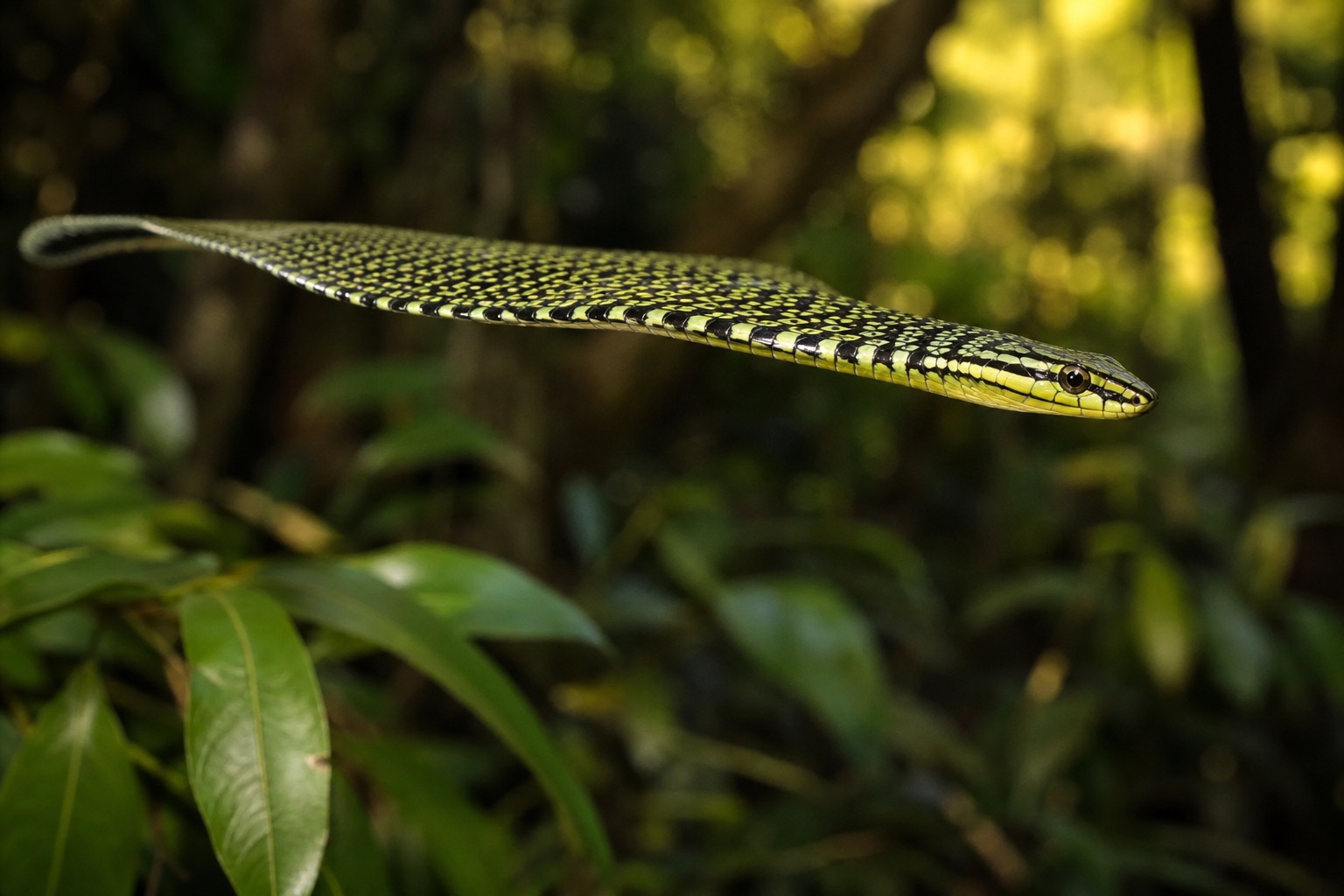
AI-generated educational wildlife portrait — World Animal Rescue Network · AI visualisation, not a photograph
In brief
The paradise flying snake (Chrysopelea paradisi) glides between trees by flattening its body into a concave aerofoil and undulating mid-air; it is Least Concern but loses connectivity as Sundaland forest converts for oil palm, pulpwood and mining.
Also in Animals A to Z · Animals that start with P
By WARN Research & Conservation Team Last updated
The paradise flying snake is a colubrid of Sundaland rainforest that moves between trees by gliding — not flying. It climbs high, launches from a branch, spreads its ribs to flatten the body into a concave cross-section, and undulates in the air to stabilise and steer. The profile behaves like a wing; the motion is active, not a passive fall. This is one of several species in the genus Chrysopelea, all capable of controlled glides of twenty metres or more. The paradise tree snake is among the most studied: black background, green spots, slightly larger than its relatives, and a glide trajectory that can include mild upward correction at the start if launch speed is high enough. Forest fragmentation from oil palm, pulpwood and mining breaks the canopy bridges these snakes rely on. They are not traded like hornbill casques, but they are vulnerable to the same landscape — continuous mid-storey for launch and landing, with nowhere to go when gaps exceed glide range.
Concave
Body cross-section during glide — rib-spreading
~20 m+
Typical glide distance
Undulation
Active mid-air stabilisation — not passive fall
Colubrid
Rear-fanged; mildly venomous to small prey
Figures sourced from IUCN Red List — Chrysopelea paradisi, Nature — flying snake biomechanics .
Paradise Flying Snake: Quick Facts
| Length | About 1–1.2 m |
|---|---|
| Glide | Concave body; active undulation |
| Pattern | Black with green spots |
| Venom | Mild; rear-fanged |
| IUCN status | Least Concern |
| Main threats | Oil palm, pulpwood, mining fragmentation |
Scientific Classification
| Kingdom | Animalia |
|---|---|
| Phylum | Chordata |
| Class | Reptilia |
| Order | Squamata |
| Family | Colubridae |
| Genus | Chrysopelea |
| Species | Chrysopelea paradisi |
Conservation Status
- IUCN Status
- Least Concern
- Population
- No estimate; widespread in remaining forest
- Trend
- Unknown; likely decreasing in converted regions
- Assessed
- 2012
- CITES
- Not listed
Listing reflects range in surviving forest, not security amid rapid Sundaland conversion.
Did you know?
Paradise flying snakes spread their ribs to form a concave wing and undulate mid-air — one of the few animals that steers actively while gliding without limbs.
Key Facts: Paradise Flying Snake
- Paradise flying snakes glide by spreading ribs to flatten the body into a concave wing and undulating to steer.
- Launch is from height; glides of twenty metres or more connect trees without descending to the ground.
- They are mildly venomous colubrids — rear-fanged, dangerous mainly to small prey, not a major medical threat to humans.
- Canopy continuity matters: oil palm, pulpwood and mining fragmentation strand snakes that cannot cross large cleared gaps.
- Several Chrysopelea species glide; paradise tree snake is among the best documented biomechanically.
- Gliding evolved independently in snakes, squirrels and colugos — convergent solutions to forest gaps.
How a snake becomes a wing
A paradise flying snake climbs using keeled scales and muscular loops, then selects a launch point with a drop beneath. At jump, it throws its body outward and spreads its ribs laterally, transforming a circular cross-section into a concave underside — a shape that generates lift at speed. Mid-air undulation — waves passing along the body — adjusts pitch and yaw.
High-speed video shows the snake is not falling flat; it is controlling trajectory well enough to land on a target trunk lower than the launch point but far horizontally. The biomechanics interest engineers as much as herpetologists: a flexible, undulating wing unlike any aircraft design.
Ecology of a canopy colubrid
Chrysopelea paradisi hunts lizards and bats in the forest mid-storey. Rear fangs deliver mild venom to small prey; bites to humans are rare and usually minor. Activity is diurnal; the green-spotted pattern breaks outline against dappled leaves.
Life in the canopy minimises ground predation but requires connectivity. A snake that glides twenty metres cannot cross a plantation block half a kilometre wide. Remaining forest patches become islands; gene flow stops even when local density looks healthy.
Plantations, mining and fragmented Sundaland
Lowland forest conversion for oil palm and pulpwood on Borneo and Sumatra removes the continuous mid-storey paradise flying snakes use. Mining and haul roads add linear gaps. The species is listed Least Concern because it remains widespread in surviving forest, but widespread is not secure when conversion rate exceeds reserve creation.
Southeast Asia's wildlife trade focuses on mammals and birds; gliding snakes appear occasionally in the pet trade but are not a primary driver. Habitat shape is the long-term pressure — the same pattern affecting colugos and hornbills at different canopy levels.
Snakes that glide versus snakes that climb
WARN's snake type pages group colubrids, pythons and vipers for identification; flying snakes belong among colubrid oddities — harmless to most humans, specialised for a niche other snakes solve by staying in one tree or descending to ground. Gliding is the colubrid answer to gaps.
Understanding paradise flying snakes clarifies that 'flying' in biology usually means controlled glide, whether in snakes, colugos or frogs. Sundaland holds all three; plantation conversion tests all three the same way — by measuring gap width against glide distance.
What WARN Does
WARN publishes free, sourced species education for reptiles whose biology surprises searchers. Paradise flying snakes glide on concave bodies — a biomechanical marvel that still needs continuous forest not carved into oil palm, pulpwood and mining estates.
If this guide helps you understand wildlife and the pressures it faces, a gift to WARN supports habitat protection and free public education in our partner countries.
Paradise Flying Snake: Frequently Asked Questions
Can paradise flying snakes fly?
How far can they glide?
Are paradise flying snakes venomous?
Where do they live?
How do they flatten their bodies?
What do paradise tree snakes eat?
Are paradise tree snakes dangerous?
How long do paradise tree snakes live?
How big is a paradise tree snake?
Sources & References
Population figures, conservation status and biological facts on this page are drawn from authoritative scientific and intergovernmental sources.
Terms used on this page
Plain-English definitions, from our wildlife and conservation glossary.
Explore more animals
Discover more animals, their habitats and their conservation status in the WARN wildlife-guide library.
Enjoyed this Paradise Flying Snake guide?
Receive appeal updates, animal-welfare news and published funding reports. Unsubscribe any time.
We only use your address for WARN updates. See our privacy policy.