Wildlife Guide · Northern and eastern Madagascar & Introduced to Réunion and Mauritius
Panther Chameleon
Furcifer pardalis (Cuvier, 1829) — family Chamaeleonidae
The chameleon whose colour change is about mood, not camouflage — and whose skin uses nanocrystals.
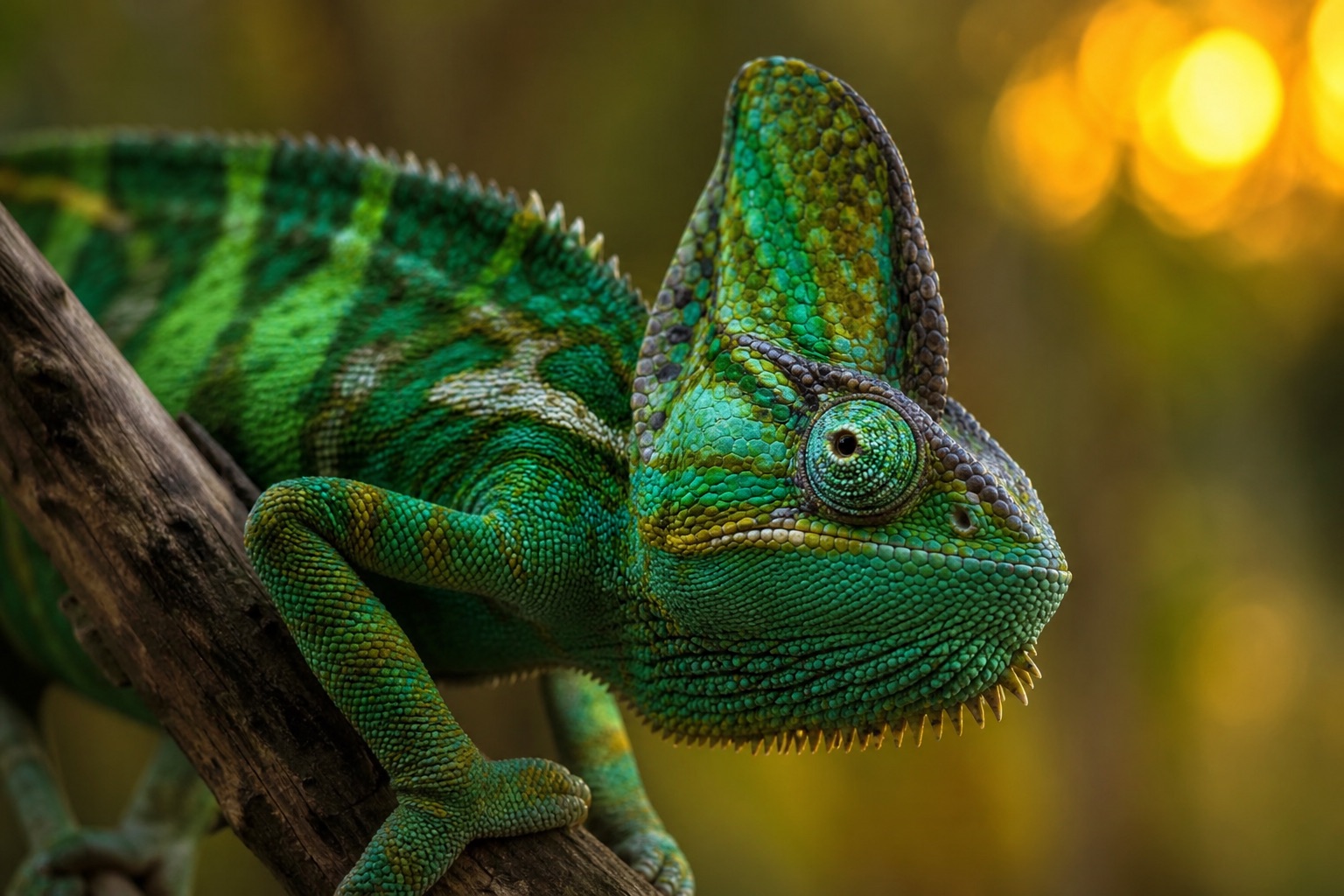
AI-generated educational wildlife portrait — World Animal Rescue Network · AI visualisation, not a photograph
In brief
The panther chameleon (Furcifer pardalis) is a large colourful chameleon of northern Madagascar whose males display vivid geographic colour morphs; colour change is driven by mood and signalling via nanocrystal structural colour, not camouflage, and the species is heavily traded despite Least Concern listing.
Also in Animals A to Z · Animals that start with P
By WARN Research & Conservation Team Last updated
The panther chameleon is among the most colourful reptiles on Earth. Males carry vivid bands of blue, green, red and orange that vary by population — Nosy Be males trend blue, Ambilobe males mix green and red — and females are typically tan or peach with less dramatic patterning. It is also the species most people picture when they think of chameleons, and the one most heavily traded as a pet. The popular belief that chameleons change colour to match their background is wrong for this species and for most chameleons. Colour change in the panther chameleon is driven chiefly by mood, temperature, social signalling and territorial display — not by background matching. The mechanism is structural: nanocrystals in the skin rearrange to reflect different wavelengths, producing shifts that can occur in minutes. Madagascar holds roughly 90% vertebrate endemism, and half the world's chameleon species live only there. An estimated 80–90% of the island's original forest has been lost, and wild collection for the pet trade adds pressure on top of tavy and charcoal production — both linked to rural poverty on an island with few affordable alternatives.
~90%
Share of Madagascar's vertebrates found nowhere else
~50 cm
Total length in large males — among the largest chameleons
Nanocrystals
Structural colour in skin — not pigment alone
Mood
Primary driver of colour change — not background matching
Figures sourced from IUCN Red List — Furcifer pardalis, Teyssier et al. (2015), Nature Communications — nanocrystal colour, CITES Appendices .
Panther Chameleon: Quick Facts
| Length | Up to about 50 cm total in large males |
|---|---|
| Colour mechanism | Nanocrystal structural colour in iridophores |
| Colour function | Mood, temperature and social signalling — not camouflage |
| Locale morphs | Geographic colour variants (Nosy Be, Ambilobe, Sambava) |
| CITES | Appendix II — regulated trade |
| Main threats | Pet trade collection; forest loss from tavy and charcoal |
Scientific Classification
| Kingdom | Animalia |
|---|---|
| Phylum | Chordata |
| Class | Reptilia |
| Order | Squamata |
| Family | Chamaeleonidae |
| Genus | Furcifer |
| Species | Furcifer pardalis |
Conservation Status
- IUCN Status
- Least Concern
- Population
- No reliable estimate; widely distributed
- Trend
- Decreasing locally through collection and habitat loss
- Assessed
- 2011
- CITES
- Appendix II
Least Concern reflects range size. Wild collection and forest loss — driven partly by rural poverty behind tavy and charcoal — are ongoing pressures.
Did you know?
Panther chameleons shift colour by rearranging nanocrystals in their skin — a structural colour system driven by mood, not by trying to match the branch they sit on.
Key Facts: Panther Chameleon
- The panther chameleon is one of the largest and most colourful chameleons, with male colour morphs varying by geographic population.
- Colour change is driven by mood, temperature and social signalling — not by matching the background.
- The mechanism uses nanocrystals in iridophore cells that rearrange to reflect different wavelengths — structural colour, not pigment alone.
- Madagascar holds roughly half the world's chameleon species and roughly 90% vertebrate endemism.
- An estimated 80–90% of Madagascar's original forest has been lost; the pet trade adds collection pressure on wild populations.
- Tavy and charcoal production follow the poverty-driven pattern seen across Madagascar — forest loss is the baseline threat.
Colour change is not camouflage
Chameleons are famous for changing colour, and the popular explanation — that they match their surroundings — is mostly incorrect. Panther chameleons shift between vivid greens, blues, reds and dark bands in response to stress, courtship, territorial disputes and temperature regulation. A male confronting a rival flushes dramatically; a calm male at rest shows his locale's typical colours regardless of the branch beneath him.
Background matching exists in some chameleon species to a limited degree, but it is not the primary function in Furcifer pardalis. What you see in a panther chameleon is a social and physiological display system, not an invisibility cloak. Correcting this myth matters because it shapes how people understand both the animal and the conservation pressure: collectors want vivid males, not invisible ones.
Nanocrystals and structural colour
The colours in a panther chameleon's skin are produced largely by structural rather than pigment-based mechanisms. Iridophore cells contain nanocrystals of guanine arranged in lattices. When the chameleon relaxes or tenses the skin, the lattice spacing changes, altering which wavelengths reflect back — blue, green or red — without any change in pigment chemistry.
Research published in Nature Communications demonstrated this mechanism directly in panther chameleons. The shift can occur in minutes. It is one of the most sophisticated structural colour systems in vertebrates, and it explains why the same male can look dramatically different within a single hour as his mood and temperature change.
Locale morphs and the pet trade
Male panther chameleons from different parts of northern Madagascar show distinct colour patterns — Nosy Be blues, Ambilobe rainbows, Sambava reds. These locale morphs are genetically based and prized in the captive trade, which drives collection of wild males for export and breeding stock.
The species is listed Least Concern because it remains widespread, but the listing describes range rather than security. Wild collection is legal under CITES Appendix II with permits, but enforcement on Madagascar is weak and illegal export is common. Forest loss from tavy and charcoal production removes the trees chameleons need; collection removes the breeding males. Both pressures operate on an island where an estimated 80–90% of original forest is already gone — and where tavy is driven by rural poverty, not by choice alone.
Madagascar's chameleon diversity
Roughly half of the world's roughly 200 chameleon species live only in Madagascar. The island's isolation produced an endemic radiation alongside lemurs, tenrecs and fossas — part of the roughly 90% vertebrate endemism that defines Malagasy biodiversity.
Panther chameleons are the flagship, but they are one species in a larger crisis. Every forest-dependent chameleon loses ground when tavy clears understorey and charcoal production removes canopy. Conservation that works protects forest, regulates collection, and addresses the poverty behind land clearing — cookstoves, community forestry income and tenure rights — rather than treating subsistence farmers as the sole cause.
What WARN Does
WARN publishes free, sourced species education that corrects persistent myths. Panther chameleons do not change colour primarily to camouflage — they signal mood and territory through nanocrystal structural colour, on an island where roughly 90% of vertebrates occur nowhere else and an estimated 80–90% of original forest is already lost.
If this guide helps you understand wildlife and the pressures it faces, a gift to WARN supports habitat protection and free public education in our partner countries.
Panther Chameleon: Frequently Asked Questions
Do panther chameleons change colour to match their background?
How does panther chameleon colour work?
Why do male panther chameleons look different in different places?
Are panther chameleons endangered?
Where do panther chameleons live?
Are panther chameleons dangerous?
How long do panther chameleons live?
Sources & References
Population figures, conservation status and biological facts on this page are drawn from authoritative scientific and intergovernmental sources.
Terms used on this page
Plain-English definitions, from our wildlife and conservation glossary.
Explore more animals
Discover more animals, their habitats and their conservation status in the WARN wildlife-guide library.
Enjoyed this Panther Chameleon guide?
Receive appeal updates, animal-welfare news and published funding reports. Unsubscribe any time.
We only use your address for WARN updates. See our privacy policy.