Wildlife Guide · Worldwide except Antarctica & Forest litter, caves and soil — greatest diversity in tropics
Millipede
Class Diplopoda — over 12,000 described species; Eumillipes persephone Marek, 2021 holds the leg record
Two pairs of legs per segment, detritivore not predator — and no species had 1,000 legs until 2021.
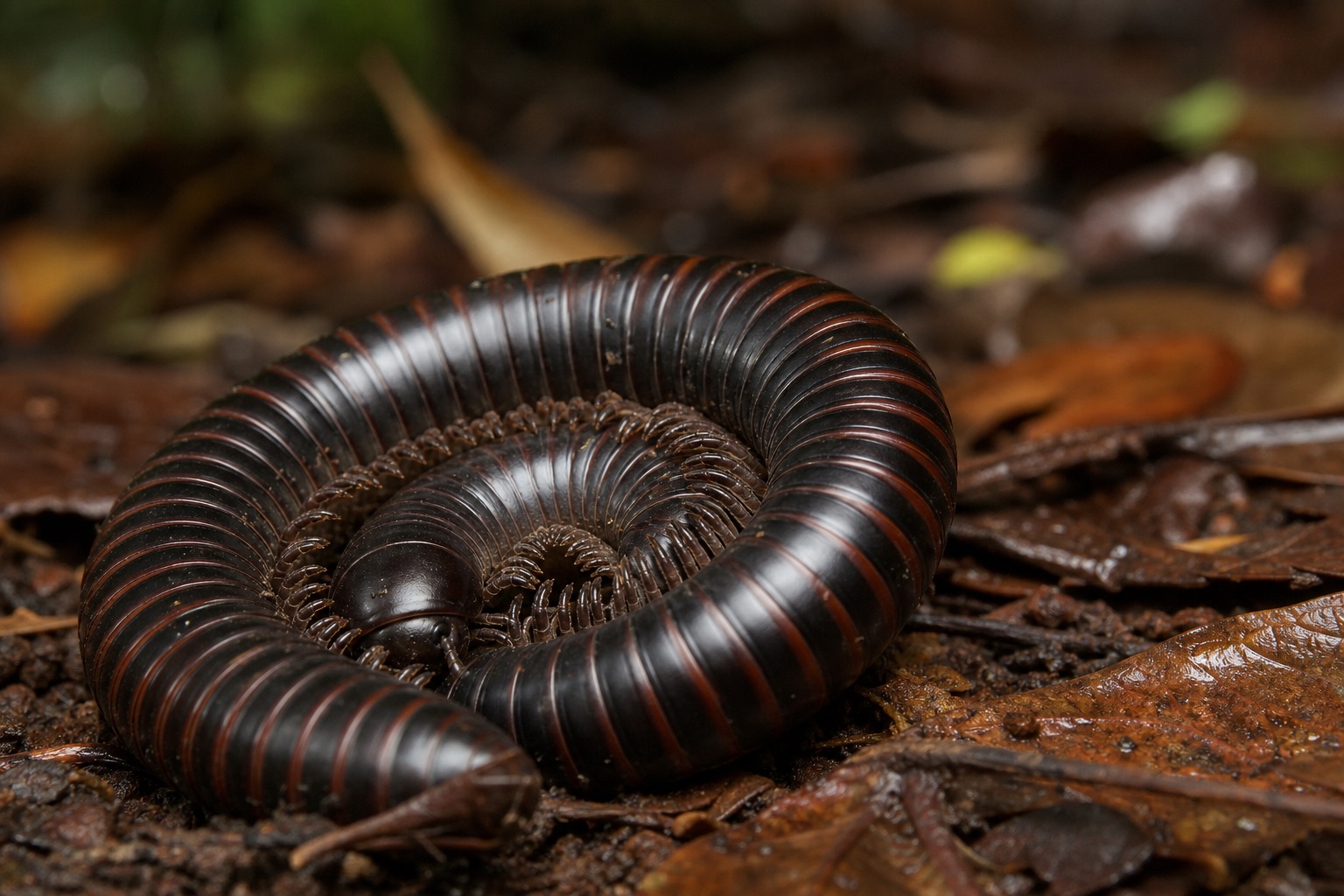
AI-generated educational wildlife portrait — World Animal Rescue Network · AI visualisation, not a photograph
In brief
Millipedes (class Diplopoda) are slow detritivorous myriapods with two pairs of legs on most body segments; they break down dead plant material in soil and leaf litter, and differ from predatory centipedes, which have one leg pair per segment and run fast.
Also in Animals A to Z · Animals that start with M
By WARN Research & Conservation Team Last updated
Millipedes are myriapods in the class Diplopoda: slow, cylindrical detritivores that process dead leaves and rotting wood into soil. Each body segment behind the head is typically a diplosegment formed by the fusion of two segments, which is why most carry two pairs of legs per visible ring — the single clearest field mark separating them from centipedes, which have one pair per segment, a flattened body and a predatory bite. The name promises a thousand feet. No millipede had been confirmed with that many until Eumillipes persephone was described from deep caves in Western Australia in 2021 with 1,306 legs — the current record. Common garden millipedes have far fewer, often a few dozen to a few hundred depending on species. When people lift a log and find a coiled, hard-bodied cylinder that curls defensively rather than sprinting away, they have a millipede, not a centipede.
12,000+
Described diplopod species
1,306
Legs on Eumillipes persephone — the current record (2021)
2 pairs
Legs per diplosegment — the centipede confusion pair
Detritivore
Eats decaying plant matter — not live prey
Figures sourced from Marek et al. 2021 — Eumillipes persephone (Scientific Reports), IUCN Red List .
Millipede: Quick Facts
| Length | Few mm to over 30 cm depending on species |
|---|---|
| Diet | Decaying leaves, wood and detritus |
| Habitat | Damp soil, litter, logs and caves |
| Leg pattern | Two pairs per diplosegment |
| Defence | Coiling plus chemical secretions |
| Confusion pair | Centipede — one leg pair per segment, predator |
Scientific Classification
| Kingdom | Animalia |
|---|---|
| Phylum | Arthropoda |
| Subphylum | Myriapoda |
| Class | Diplopoda |
| Orders | Polydesmida, Spirobolida, Julida and others |
| Record holder | Eumillipes persephone — 1,306 legs (2021) |
| Species | Over 12,000 described |
Conservation Status
- IUCN Status
- Not Evaluated
- Population
- Not applicable at class level
- Trend
- Unknown; cave and island endemics likely declining with habitat disturbance
- Assessed
- Most species unassessed
- CITES
- Not listed
Common garden millipedes appear secure. Specialist cave and forest litter species may disappear locally without ever being assessed.
Did you know?
Until Eumillipes persephone was described from Western Australian caves in 2021, no millipede species had been confirmed with 1,000 legs — despite a name that literally promises a thousand feet.
Key Facts: Millipede
- Millipedes (Diplopoda) eat decaying plant material and are essential decomposers in soil and litter.
- Most segments bear two pairs of legs — the reliable contrast with centipedes (one pair per segment).
- Centipedes are flat, fast predators with venomous forcipules; millipedes are rounder, slower and curl when threatened.
- Eumillipes persephone from Western Australian caves has 1,306 legs — the first species confirmed beyond 1,000.
- Many millipedes secrete defensive chemicals that can irritate skin; they do not bite with venom like centipedes.
- The name 'millipede' is aspirational — leg counts vary widely and most species have far fewer than 1,000.
Millipede versus centipede — the confusion pair
Centipedes (Chilopoda) and millipedes (Diplopoda) are both myriapods but occupy opposite ecological roles. A centipede has one pair of legs per segment, a flattened body built for speed, forcipules that inject venom, and a hunting lifestyle. A millipede has two pairs of legs on most segments (diplosegments), a rounded or cylindrical body, and jaws adapted for grinding decaying vegetation.
Under a log, behaviour settles it quickly: centipedes run; millipedes trundle and coil. Bite risk sits with centipedes. Millipede defence is chemical — many secrete benzoquinones or other compounds that stain skin and smell acrid. The centipede guide on this site covers the predator side of the pair; this page covers the decomposer side.
The 1,306-leg species and what 'millipede' actually means
Eumillipes persephone was described in 2021 from millipede specimens collected up to 60 m deep in caves on the Nullarbor Plain in Western Australia. At 1,306 legs it exceeded any previously counted myriapod. The animal is pale, thread-like and cave-adapted — nothing like the chunky garden millipede most people recognise.
That discovery updated a standing joke: 'millipede' from Latin mille pedes means thousand feet, but scientists had never verified a species at that count. Leg number varies by species and age; counting every leg on a live animal is impractical. Body plan and diet remain the useful identification marks, not arithmetic.
Role in soil and forest systems
Millipedes fragment leaf litter and consume decaying wood, returning nutrients to soil and creating pore space as they burrow. In temperate forests they can be among the most abundant macro-invertebrates in litter layers. Some species specialise on particular tree species or microhabitats; tropical rainforests hold the greatest diversity.
Because they depend on moisture and undisturbed litter, drought, compaction and removal of dead wood reduce populations. Pesticides and metaldehyde slug pellets — aimed at gastropods — can poison decomposers indirectly. A garden with healthy millipede numbers usually has damp refuges and organic matter left in place.
Defensive chemistry and human contact
When handled, many millipedes coil tightly and secrete defensive fluids from lateral glands. The compounds deter ants and birds; on human skin they can cause brown staining, odour and irritation, particularly if rubbed into eyes or broken skin. Washing hands after contact is sufficient precaution.
Millipedes are not venomous in the centipede sense. Large tropical species may nip with their jaws if provoked, but the primary defence is chemical. Confusing them with centipedes drives unnecessary fear — and unnecessary killing of a decomposer that was doing no harm under the log.
What WARN Does
WARN publishes free invertebrate education that names confusion pairs honestly. Millipede versus centipede is one of the most common myriapod misidentifications; getting the leg count and diet right prevents fear-driven killing of harmless decomposers.
If this guide helps you understand wildlife and the pressures it faces, a gift to WARN supports habitat protection and free public education in our partner countries.
Millipede: Frequently Asked Questions
What do millipedes eat?
Where do millipedes live?
Are millipedes dangerous?
How long do millipedes live?
How big do millipedes get?
What is the difference between a millipede and a centipede?
Sources & References
Population figures, conservation status and biological facts on this page are drawn from authoritative scientific and intergovernmental sources.
Explore more animals
Discover more animals, their habitats and their conservation status in the WARN wildlife-guide library.
Enjoyed this Millipede guide?
Receive appeal updates, animal-welfare news and published funding reports. Unsubscribe any time.
We only use your address for WARN updates. See our privacy policy.