Wildlife Guide · Freshwater worldwide & Rivers and lakes with clean, well-oxygenated water
Mayfly
Order Ephemeroptera — about 3,000 described species worldwide
The insect whose adult life can be measured in hours — and the only one that moults after growing wings.
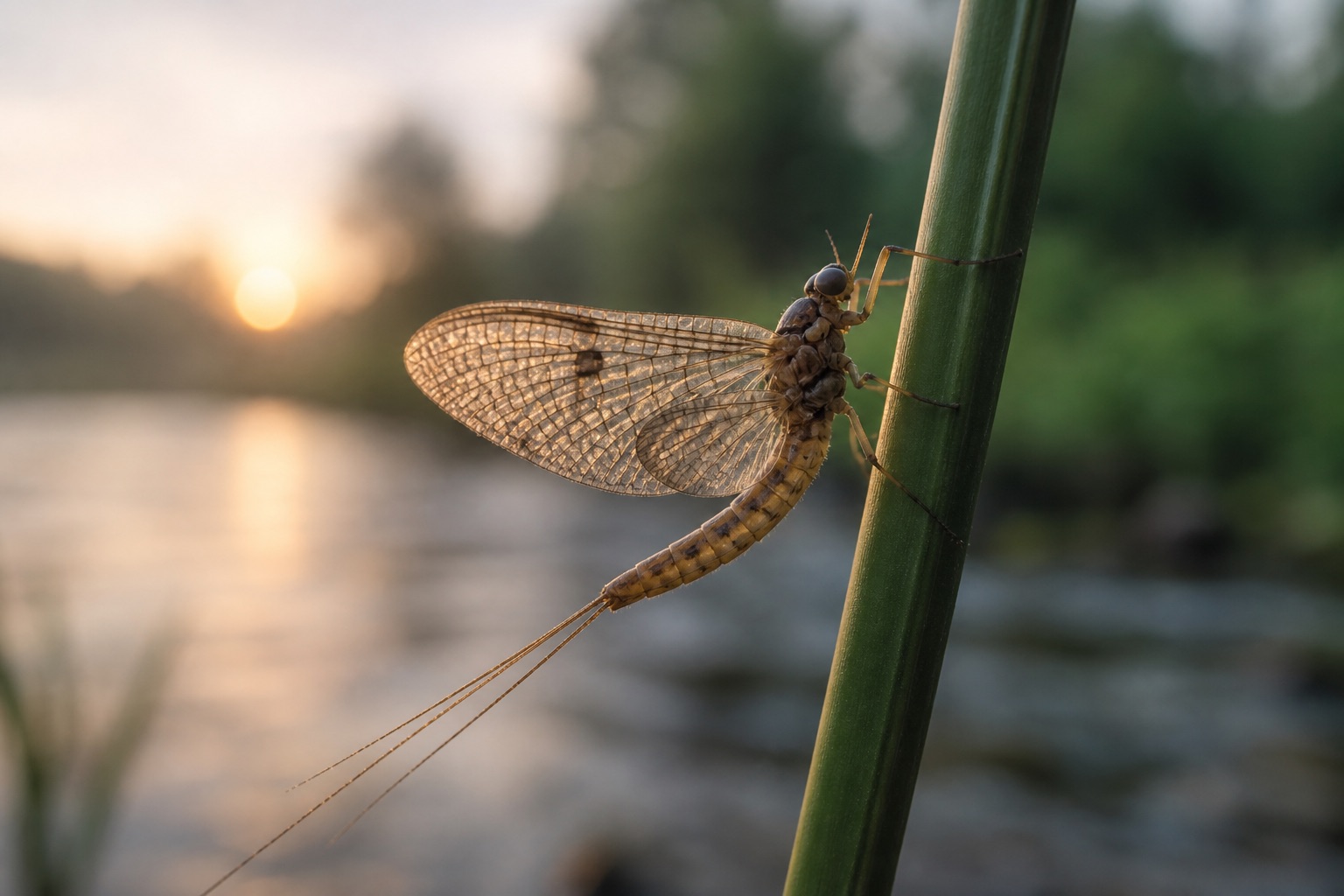
AI-generated educational wildlife portrait — World Animal Rescue Network · AI visualisation, not a photograph
In brief
Mayflies (order Ephemeroptera) are freshwater insects whose nymphs live underwater for months to years and whose winged adults typically survive only hours to a few days; they are the only insects that moult after gaining wings and are indicators of clean rivers.
Also in Animals A to Z · Animals that start with M
By WARN Research & Conservation Team Last updated
Mayflies are aquatic insects whose adult stage exists only to mate and die. Nymphs live months to years underwater in rivers and lakes, then emerge, moult one final time into a winged adult — the only insects that moult after developing functional wings — and often survive just hours to a day or two. Mouthparts are reduced; many adults do not feed at all. Their presence indicates clean, oxygenated water. Anglers imitate mayflies closely because trout and other fish feed heavily on emergences. Pollution, dams and sedimentation remove mayfly nymphs long before most people notice the river has changed.
Hours
Typical adult lifespan for many species
1 moult
After wings — unique among insects (subimago to imago)
3,000
Described species worldwide
Clean water
Nymphs require well-oxygenated rivers and lakes
Figures sourced from Buglife — Mayflies, Environment Agency — River fly monitoring, Animal Diversity Web — Ephemeroptera .
Mayfly: Quick Facts
| Adult lifespan | Often hours to two days |
|---|---|
| Nymph habitat | Clean freshwater rivers and lakes |
| Wings | Held upright at rest; two pairs |
| Tail | Two or three long filaments (cerci) |
| Indicator value | Sensitive to pollution and low oxygen |
| Unique moult | Only insects that shed skin after winged |
| IUCN status | Not Evaluated for most species |
Scientific Classification
| Kingdom | Animalia |
|---|---|
| Phylum | Arthropoda |
| Class | Insecta |
| Order | Ephemeroptera |
| Unique trait | Moult after wings (subimago → imago) |
| Described species | About 3,000 worldwide |
| Aquatic stage | Nymph — months to years |
Conservation Status
- IUCN Status
- Not Evaluated
- Population
- Not applicable at order level
- Trend
- Declining locally with water pollution and hydrological alteration
- Assessed
- Most species not assessed
- CITES
- Not listed
Mayfly loss from a river is an early warning. Restoration of clean, flowing water brings them back when pollution is reduced.
Did you know?
Mayflies are the only insects that moult after their wings work — the first winged stage lasts briefly, then the final moult produces the breeding adult that may have only hours left.
Key Facts: Mayfly
- Mayfly nymphs are aquatic for months to years; winged adults often live only hours to a couple of days.
- Adults undergo a final moult from subimago to imago after wings develop — unique among insects.
- Many adult mayflies do not feed; mouthparts are vestigial and the stage exists for reproduction.
- Upright wings and two or three long tail filaments (cerci) help identification.
- Nymphs are sensitive to pollution, low oxygen and sediment — their absence signals river degradation.
- Mass emergences synchronise mating and overwhelm fish predators — a key event for anglers and ecologists.
Two lives in one animal
Mayfly ecology splits sharply between nymph and adult. Nymphs have gills and live on stones, vegetation or burrowed in silt, feeding on algae and detritus or filtering particles. They moult repeatedly underwater until ready to emerge.
The winged subimago climbs out, flies weakly, then moults again into the sexually mature imago with clearer wings and fuller colour. That post-wing moult is unknown elsewhere in insects. Adult mayflies swarm over water, mate in flight or on the surface, females lay eggs, and both sexes die — often within 24 hours for many species.
Why rivers without mayflies are sick
Ephemeroptera nymphs need oxygen-rich water and stable substrates. Agricultural runoff, sewage, dam fluctuation and fine sediment smother gills and food. When mayflies disappear from a reach that once had them, the change usually predates visible algal blooms or fish kills.
Biomonitoring programmes index mayfly abundance alongside stoneflies and caddisflies as clean-water signals. Restoration that brings mayflies back — reduced pollution, natural flow regimes — is measurable success.
The angler's hatch
Fly fishers name mayfly species and stages precisely because trout rise to emergences predictably. The dun (subimago) and spinner (imago) stages have different silhouettes on the water. Mass hatches can bring every fish in a pool to the surface simultaneously.
That cultural visibility belies fragility. The same river prized for fishing may lose hatches silently when water quality slips. Mayflies connect sport, ecology and water policy more directly than most insects.
Status and assessment gaps
Most mayfly species are Not Evaluated individually on the IUCN Red List. Extinction risk concentrates on endemic species tied to single streams or lakes — isolated spring runs, mountain torrents — rather than on common river species still abundant where water is clean.
Climate change alters flow timing, which can desynchronise emergence from fish feeding peaks. Dams block drift and alter temperature downstream. The order-level story is water quality and hydrology, not a single species trade.
What WARN Does
WARN publishes free education for indicator species whose disappearance signals environmental damage before most people notice. Mayflies are standard river-health witnesses — when they vanish, the problem is already in the water.
If this guide helps you understand wildlife and the pressures it faces, a gift to WARN supports habitat protection and free public education in our partner countries.
Mayfly: Frequently Asked Questions
What do mayflies eat?
Where do mayflies live?
Are mayflies dangerous?
How long do mayflies live?
How big are mayflies?
Why do mayflies die so quickly?
Are mayflies endangered?
Sources & References
Population figures, conservation status and biological facts on this page are drawn from authoritative scientific and intergovernmental sources.
Terms used on this page
Plain-English definitions, from our wildlife and conservation glossary.
Explore more animals
Discover more animals, their habitats and their conservation status in the WARN wildlife-guide library.
Enjoyed this Mayfly guide?
Receive appeal updates, animal-welfare news and published funding reports. Unsubscribe any time.
We only use your address for WARN updates. See our privacy policy.