Wildlife Guide · Tropical and temperate regions worldwide & Most diverse in rainforests; several species widespread in gardens
Mantis
Family Mantidae — largest mantis family; roughly 2,300 species in order Mantodea worldwide
The family that named the order — ambush predators with forelegs built as spring-loaded traps.
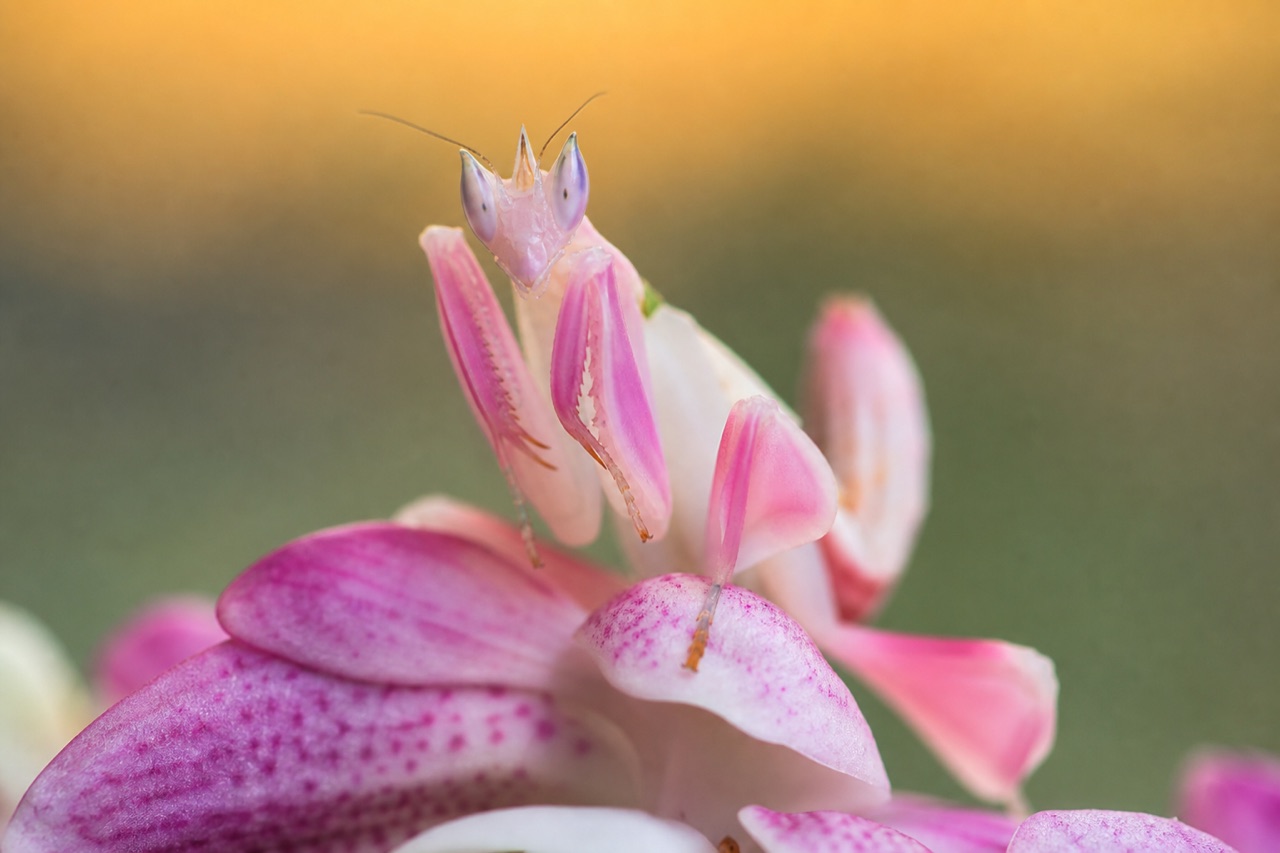
AI-generated educational wildlife portrait — World Animal Rescue Network · AI visualisation, not a photograph
In brief
Mantids (family Mantidae) are the largest mantis family — roughly 2,300 ambush-predator species with spined raptorial forelegs — and the group most people mean when they say 'praying mantis'; WARN's praying mantis page covers the full order Mantodea.
Also in Animals A to Z · Animals that start with M
By WARN Research & Conservation Team Last updated
Mantidae is the largest family within the order Mantodea — the mantises. When early naturalists wrote of 'mantids', they usually meant this family: elongated bodies, triangular heads on flexible necks, and enlarged spined forelegs folded as if in prayer that snap shut on prey. The family holds roughly half of all described mantis species, from the familiar European mantis of Mediterranean gardens to huge tropical genera such as Hierodula and Sphodromantis. This page is the Mantidae family overview. WARN's separate praying mantis guide covers the order Mantodea as a whole — stereoscopic vision, strike speed, bat-detecting ears and the full diversity of flower mantises, ground mantises and bark mimics across 29 families. Mantidae is the core of that radiation: the generalist ambush predators people most often photograph, keep as pets and encounter in vegetable plots. Mantids are sit-and-wait hunters. They do not chase; they hold position with camouflage aligned to grass, bark or leaves and strike when prey enters range. The strike takes tens of milliseconds — faster than human reaction — driven by specialised thoracic muscles. What follows is predation without venom: spines hold the prey while the mantis eats it alive, usually from the head inward.
~2,300
Species in family Mantidae
50–70 ms
Typical predatory strike duration
29
Mantis families in order Mantodea — Mantidae is the largest
Generalist
Most mantids eat any invertebrate they can overpower
Figures sourced from IUCN Red List, Mantodea Species File .
Mantis: Quick Facts
| Family size | ~2,300 species |
|---|---|
| Hunting method | Ambush — spined forelegs |
| Strike speed | ~50–70 milliseconds |
| Eggs | Laid in foam ootheca |
| Metamorphosis | Incomplete — nymphs resemble adults |
| Main threats | Habitat loss; pesticides for narrow-range species |
Scientific Classification
| Kingdom | Animalia |
|---|---|
| Phylum | Arthropoda |
| Class | Insecta |
| Order | Mantodea |
| Family | Mantidae |
| Example genera | Mantis, Hierodula, Sphodromantis, Tenodera, Stagmomantis |
Conservation Status
- IUCN Status
- Varies by species — family page
- Population
- Not applicable at family level
- Trend
- Unknown for most species; island endemics vulnerable
- Assessed
- Assessed species-by-species; most are unassessed
- CITES
- Not listed
Common garden Mantidae species are widespread and secure where habitat persists. Conservation concern concentrates on narrow-range tropical endemics with no formal assessment.
Did you know?
A single mantid ootheca on a garden cane can release a hundred nymphs in spring — all cannibalistic if prey is scarce, which is why only a few survive to adulthood.
Key Facts: Mantis
- Mantidae is the largest mantis family — the 'classic' praying mantis body plan.
- WARN's praying mantis guide covers the full order Mantodea; this page focuses on the Mantidae family specifically.
- Mantids are ambush predators — camouflage and patience, then a strike too fast to follow by eye.
- They are generalists: bees, butterflies, crickets and other mantids are all taken if reachable.
- Females lay eggs in hardened foam cases (oothecae) attached to stems, walls or bark.
- Sexual cannibalism occurs in some species but is far less universal than popular accounts suggest.
The Mantidae body plan
A typical mantid in Mantidae has an elongated prothorax — the first thoracic segment is unusually long, which increases reach when the forelegs strike. The head is triangular, with large compound eyes and three simple eyes on top, mounted on a flexible neck that allows scanning without body movement. The forelegs are femur-and-tibia traps lined with spines; when folded, they give the prayer posture that supplies the common name.
Wings vary. Many temperate and tropical Mantidae fly well as adults; males are often smaller and more agile fliers than females. Some island and high-altitude species are brachypterous — short-winged or wingless — reflecting reduced need for dispersal in stable habitats. Colour is frequently green or brown, tuned to vegetation, but tropical Mantidae include pink, yellow and banded species that match flowers or bark.
Size spans orders of magnitude within the family. Small mantids of a few centimetres hunt springtails and flies; large Hierodula and Tenodera species take crickets, moths and occasionally small vertebrates. The body plan scales because the hunting method — sit, strike, hold — does not require pursuit speed.
Ambush ecology in gardens and forests
Mantids choose perches where prey traffic is high: flower heads, unmown grass stems, shrub surfaces facing open light. They orient toward movement using compound eyes; some species slowly rock forward and back, a behaviour that may improve depth perception by motion parallax before a strike.
Prey capture success is high because the strike outruns most escape reflexes. Mantids cannot chew; they use mandibles to bite off pieces of soft tissue from living prey. A mantid on a pollinator-rich flower eats pollinators — which is why releasing mantids for pest control is imprecise. Aphids are taken, but so are bees and butterflies at equal or greater rates.
Population dynamics track prey abundance and temperature. Mantids are ectothermic — activity requires warm conditions — and generation time is one season in temperate climates. Oothecae overwinter where seasons are cold; dozens to hundreds of nymphs emerge in spring and disperse, eating each other if other prey is scarce.
Reproduction: oothecae and the cannibalism myth
Mating in Mantidae follows a pattern common across insects but sensationalised in mantids. Males approach females cautiously; in some species the female consumes the male before, during or after copulation. Nutritional benefit to egg production is documented in laboratory conditions. Field rates vary enormously by species, population and whether the male can escape — cannibalism is consistently higher in small captive enclosures than in open habitat.
After mating, the female deposits eggs in a frothy secretion moulded around a stem or flat surface. The foam hardens into an ootheca — a protective capsule resisting desiccation and some predators. European mantis oothecae are familiar objects on garden canes; each may hold a hundred or more eggs. Nymphs hatch together and disperse; incomplete metamorphosis means they resemble small adults and grow through successive moults.
Pet trade supply for common Mantidae — Hierodula, Sphodromantis, Tenodera — is largely captive-bred. Welfare requirements are straightforward but non-negotiable: vertical space for moulting, live prey of appropriate size, humidity matched to species origin, and no co-housing except briefly for mating.
Mantidae versus the wider mantis order
Mantodea contains 29 families, and not all fit the classic Mantidae silhouette. Flower mantises in Hymenopodidae mimic orchids and attract pollinators as prey. Ground mantises in Tarachodidae run on bare soil. Boxer mantises in Hestiasulidae have shortened bodies and powerful strikes. The order-level diversity is why WARN maintains both this Mantidae family page and a separate praying mantis order guide.
Conservation pressure on Mantidae is habitat loss at the local scale — drainage of wet grassland, pesticide-heavy agriculture, fire suppression that changes savanna structure. Few Mantidae species have formal IUCN assessments; those that do tend to be island or single-site endemics. Widespread garden species such as Mantis religiosa are secure in suitable climate zones and have even expanded range with horticultural trade.
For gardeners, a mantid is a sign of insect-rich habitat rather than a precision tool. For naturalists, Mantidae is the accessible entry point to a predatory insect order whose specialisations — 3D vision in the wider order, flower mimicry in allied families, ultrasonic hearing in night-flying groups — reward reading beyond the single family.
Regional Mantidae you might meet
Mantis religiosa — the European mantis — has spread beyond native Mediterranean range through horticultural trade and climate matching, appearing in North American gardens and temperate Asia. Stagmomantis species occupy similar niches in the Americas. Hierodula and Tenodera are large Asian genera common in the pet trade and, where escaped, in subtropical gardens.
Recognition is straightforward: triangular head, elongated prothorax, raptorial forelegs. Colour varies green to brown within species by environment. Nymphs lack wings but show the same posture. Oothecae on stems and fences persist through winter in temperate climates — a sign the next generation is already queued.
Regional guides matter because not every long insect in a garden is a mantid — stick insects, grasshoppers and leaf-footed bugs are routinely misidentified. Correct ID prevents unnecessary killing of harmless species and directs curiosity toward the animal actually present.
What WARN Does
WARN publishes free, sourced species education including family-level guides that sit beneath order overviews. Mantidae is what most people photograph; Mantodea is what ecologists study — both deserve accurate, distinct coverage.
If this guide helps you understand wildlife and the pressures it faces, a gift to WARN supports habitat protection and free public education in our partner countries.
Mantis: Frequently Asked Questions
What is the difference between mantis and praying mantis?
Do mantids always eat their mates?
What is an ootheca?
Are mantids good for pest control?
What do mantis eat?
Where do mantis live?
Are mantis dangerous?
How long do mantis live?
How big are mantis?
Sources & References
Population figures, conservation status and biological facts on this page are drawn from authoritative scientific and intergovernmental sources.
Terms used on this page
Plain-English definitions, from our wildlife and conservation glossary.
Explore more animals
Discover more animals, their habitats and their conservation status in the WARN wildlife-guide library.
Enjoyed this Mantis guide?
Receive appeal updates, animal-welfare news and published funding reports. Unsubscribe any time.
We only use your address for WARN updates. See our privacy policy.