Wildlife Guide · Tropical and subtropical shallow seas worldwide & Reefs, rubble and burrows in soft sediment
Mantis Shrimp
Order Stomatopoda — around 500 species, including Odontodactylus scyllarus
A punch that boils water, and eyes that see in ways nothing else does.
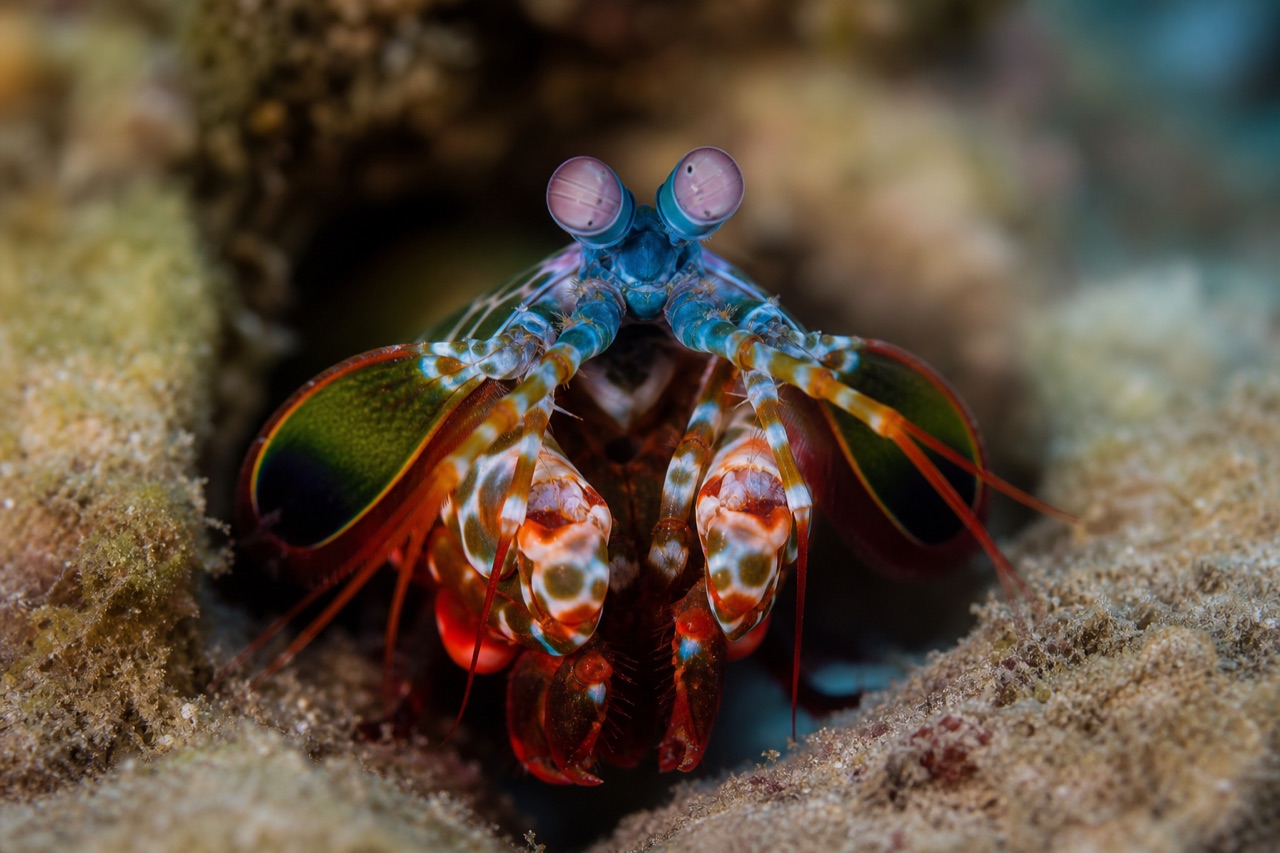
AI-generated educational wildlife portrait — World Animal Rescue Network · AI visualisation, not a photograph
In brief
Mantis shrimp are stomatopod crustaceans whose raptorial strike is fast enough to vaporise water and produce a cavitation shockwave, and whose eyes carry up to sixteen photoreceptor types plus polarised-light vision.
Also in Animals A to Z · Animals that start with M
By WARN Research & Conservation Team Last updated
Mantis shrimp are stomatopod crustaceans, not shrimp, with two of the most extraordinary systems in the animal world. Their raptorial appendages strike so fast that the water beside them briefly vaporises, producing a cavitation bubble whose collapse delivers a second shockwave — so the prey is hit twice, and a mantis shrimp can break aquarium glass. Their eyes are equally unusual. Where humans have three colour receptor types, mantis shrimp have up to sixteen, along with the ability to detect polarised light. Counterintuitively, this does not make them better at discriminating colours than we are — the current evidence suggests they trade discrimination for speed, recognising colour directly rather than comparing signals.
~500
Stomatopod species described
23 m/s
Recorded strike speed of a smasher's club
16
Photoreceptor types — humans have three
Cavitation
The strike creates a bubble whose collapse hits prey a second time
Figures sourced from Smithsonian Ocean — Invertebrates, IUCN Red List .
Mantis Shrimp: Quick Facts
| Described species | ~500 |
|---|---|
| Strike speed | ~23 m/s in water |
| Secondary effect | Cavitation bubble collapse |
| Photoreceptors | Up to 16 types |
| Polarised light | Detects both linear and circular |
| Two forms | Smashers and spearers |
Scientific Classification
| Kingdom | Animalia |
|---|---|
| Phylum | Arthropoda |
| Class | Malacostraca |
| Order | Stomatopoda |
| Notable species | Odontodactylus scyllarus (peacock mantis shrimp) |
Conservation Status
- IUCN Status
- Varies by species — order page
- Population
- Not applicable at order level
- Trend
- Unknown for most species
- Assessed
- Very few species assessed
- CITES
- Not listed
Reef degradation and collection for the aquarium trade are the documented pressures, though most species have never been formally assessed.
Did you know?
The mantis shrimp's club is studied by materials scientists — its layered helical structure survives thousands of impacts that would shatter engineered composites.
Key Facts: Mantis Shrimp
- Mantis shrimp are stomatopods, not true shrimp.
- The strike is fast enough to vaporise water, producing a second shockwave on bubble collapse.
- Smashers club hard-shelled prey; spearers impale soft prey.
- They have up to sixteen photoreceptor types and see polarised light.
- More receptors does not mean finer colour discrimination — evidence points to faster recognition instead.
The strike
Smasher mantis shrimp store energy in a saddle-shaped spring in the appendage and release it in a latch-mediated snap. The club accelerates at a rate comparable to a small-calibre bullet, reaching around 23 metres per second in water.
The speed drops local pressure enough to vaporise water, forming a cavitation bubble. When that bubble collapses it releases a second burst of energy, along with light and heat. Prey is therefore struck twice — once by the club, once by the implosion — which is how a mantis shrimp opens crab shells and, in aquariums, cracks glass.
Two toolkits
Stomatopods split into two broad strategies. Smashers carry blunt clubs for battering hard-shelled prey: crabs, snails and molluscs. Spearers carry barbed, folding appendages for impaling soft prey such as fish and shrimp, striking with the same latch mechanism but a different tip.
The club is a material of considerable engineering interest. Its layered, helical structure resists the enormous repeated impacts without shattering, and it has been studied directly as a model for impact-resistant composites.
The eyes, accurately described
Mantis shrimp eyes are mounted on stalks, move independently, and each eye has trinocular depth perception on its own. They carry up to sixteen photoreceptor types spanning ultraviolet into the visible range, and can detect both linear and circular polarised light — the only animals known to do the latter.
The popular claim that they therefore see unimaginably rich colour appears to be wrong. Behavioural tests showed they discriminate similar wavelengths less finely than humans do. The favoured explanation is that they recognise colour directly at each receptor rather than by comparing across receptors, trading precision for speed — useful for an ambush predator that must identify a target instantly.
Behaviour and keeping
Many species are territorial and hold burrows, and some form long-term monogamous pairs. They are intelligent by invertebrate standards, learning to recognise individual neighbours by sight and smell.
In the aquarium trade they are prized and problematic in equal measure: a smasher can break tank glass, and they will kill tankmates. Responsible keeping means a species-appropriate solo tank with acrylic or thick glass, which is a specialist commitment rather than a casual one.
What WARN Does
WARN publishes free, sourced species education including where popular claims and the underlying research diverge. The mantis shrimp's colour vision is one of the most confidently repeated wrong facts on the internet, and correcting it is more interesting than the myth.
If this guide helps you understand wildlife and the pressures it faces, a gift to WARN supports habitat protection and free public education in our partner countries.
Mantis Shrimp: Frequently Asked Questions
How powerful is a mantis shrimp punch?
Can mantis shrimp see more colours than humans?
Are mantis shrimp actually shrimp?
What is the difference between smashers and spearers?
What do mantis shrimp / stomatopods eat?
Where do mantis shrimp / stomatopods live?
Are mantis shrimp / stomatopods dangerous?
How long do mantis shrimp / stomatopods live?
How big is a mantis shrimp / stomatopod?
Sources & References
Population figures, conservation status and biological facts on this page are drawn from authoritative scientific and intergovernmental sources.
Terms used on this page
Plain-English definitions, from our wildlife and conservation glossary.
Explore more animals
Discover more animals, their habitats and their conservation status in the WARN wildlife-guide library.
Enjoyed this Mantis Shrimp guide?
Receive appeal updates, animal-welfare news and published funding reports. Unsubscribe any time.
We only use your address for WARN updates. See our privacy policy.