Wildlife Guide · Eastern Australia & Tasmania (introduced superb lyrebird)
Lyrebird
Menura spp. — family Menuridae
The bird that copies chainsaws, camera shutters and car alarms with unsettling accuracy.
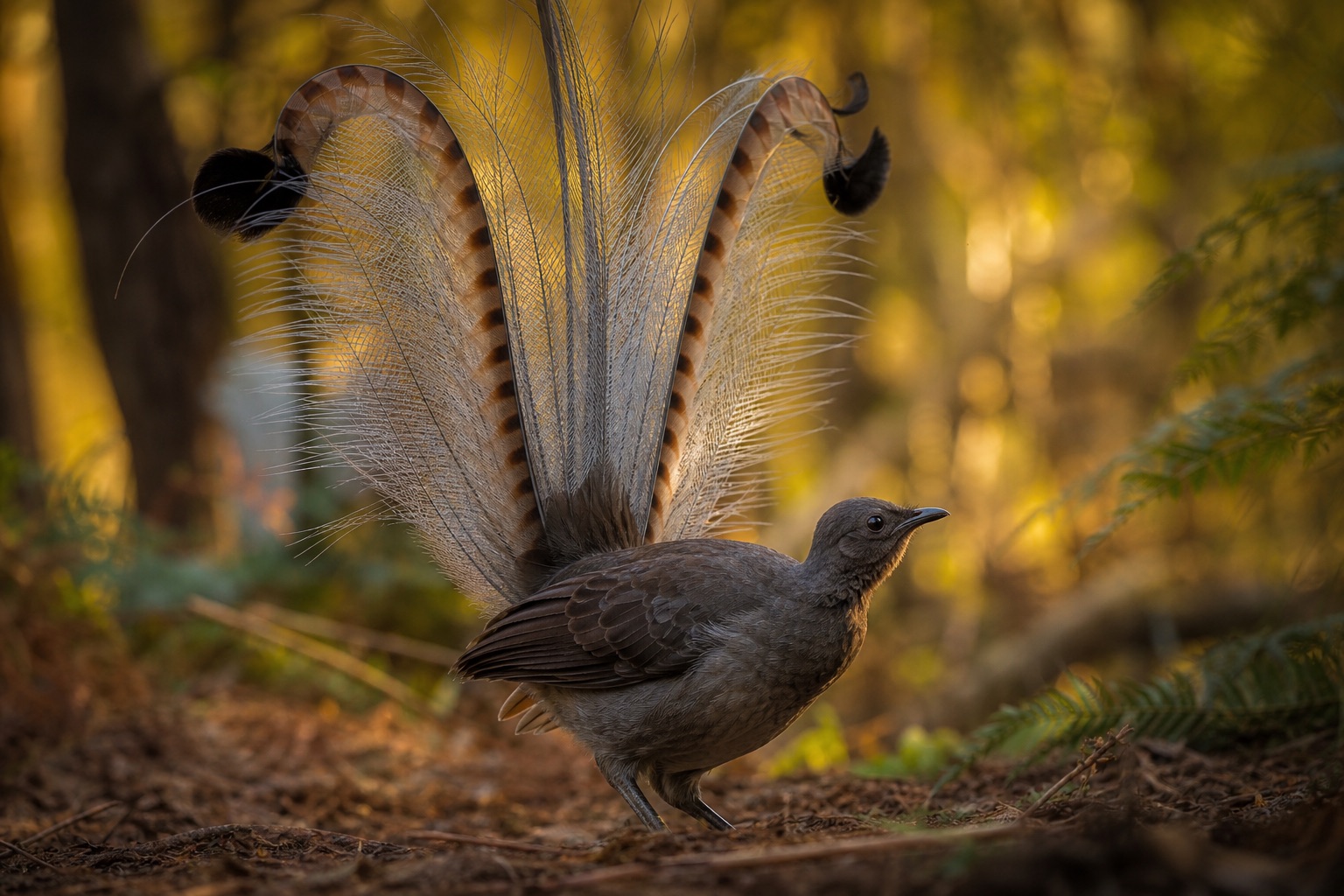
AI-generated educational wildlife portrait — World Animal Rescue Network · AI visualisation, not a photograph
In brief
The lyrebird (Menura) is a large Australian songbird and one of the world's most accomplished vocal mimics, with males combining elaborate tail displays on forest-floor mounds with songs that accurately copy other birds and human-made sounds such as chainsaws and camera shutters.
Also in Animals A to Z · Animals that start with L
By WARN Research & Conservation Team Last updated
Lyrebirds are large ground-dwelling songbirds of Australia's wet forests. Two species exist: the superb lyrebird (Menura novaehollandiae) of Victoria, New South Wales and Queensland, and Albert's lyrebird (M. alberti) of a smaller range in southern Queensland and northern New South Wales. The male superb lyrebird carries tail feathers shaped like a lyre when raised — two outer ribbon plumes and fine filamentary central feathers — and clears a display mound on the forest floor where he sings for hours in winter. The song is the reason most people search the name. Lyrebirds are among the most accomplished vocal mimics of any animal. A male's performance weaves his own whistles and clicks with imitations of other forest birds — and, where forest meets suburbia or logging, human-made sounds. Recordings document chainsaws, camera motor drives, car alarms, mobile phone rings and construction noise woven into display song. Mimicry is not a party trick; it appears to function in mate choice and territory defence, with more complex repertoires associated with older, dominant males.
2
Species — superb and Albert's lyrebird
80 cm
Approximate total length of a displaying male superb lyrebird
Mound
Cleared earth platform where males sing for hours
Mimicry
Other birds, plus human machinery and alarms in altered forest
Figures sourced from IUCN Red List — Menura novaehollandiae, IUCN Red List — Menura alberti, Cornell Lab of Ornithology — Birds of the World (lyrebirds) .
Lyrebird: Quick Facts
| Species | Superb lyrebird and Albert's lyrebird |
|---|---|
| Display | Mound cleared on forest floor; male sings for hours |
| Tail | Lyre-shaped plumes in male superb lyrebird |
| Diet | Ground invertebrates and litter fauna |
| Mimicry | Birds, mammals and human-made sounds |
| IUCN status | Least Concern (superb); Near Threatened (Albert's) |
Scientific Classification
| Kingdom | Animalia |
|---|---|
| Phylum | Chordata |
| Class | Aves |
| Order | Passeriformes |
| Family | Menuridae |
| Genus | Menura |
| Species | M. novaehollandiae and M. alberti |
Conservation Status
- IUCN Status
- Least Concern (Menura novaehollandiae); Near Threatened (M. alberti)
- Population
- No global estimate — superb lyrebird widespread
- Trend
- Stable overall for superb lyrebird; decreasing locally with habitat loss
- Assessed
- 2018
- CITES
- Not listed
Fire, logging and urban expansion at the forest edge alter both habitat and the soundscape males learn from — a subtle pressure on display behaviour as well as on population numbers.
Did you know?
A male superb lyrebird may sing for four hours on a winter morning from a single display mound — most of it mimicry layered with his own whistles.
Key Facts: Lyrebird
- Two lyrebird species live in eastern Australia — the widespread superb lyrebird and the range-restricted Albert's lyrebird.
- Male superb lyrebirds display on cleared mounds, raising lyre-shaped tail feathers while singing complex songs that can last hours.
- Lyrebirds copy other species' calls and, near human activity, machinery and electronic sounds — chainsaws, cameras and car alarms appear in verified recordings.
- Mimicry is thought to signal male quality in mate choice; older males with larger repertoires often dominate display territories.
- Lyrebirds are ground foragers that turn over leaf litter with strong feet, playing a role in soil turnover similar to thrushes elsewhere.
- The superb lyrebird is Least Concern globally, but severe bushfires and forest fragmentation reduce local populations — Albert's lyrebird is Near Threatened with a smaller range.
How lyrebird mimicry works
Songbirds learn vocalisations. Lyrebirds take that capacity further than almost any other species. Young males acquire calls from their acoustic environment — forest birds, but also sounds from campsites, logging operations and suburbs at the forest edge. The syrinx, the bird vocal organ, allows rapid switching between timbres, so a single continuous performance can move from a kookaburra laugh to a whipbird crack to the whine of a power tool.
Research on superb lyrebirds suggests mimicry of other species' alarm and mobbing calls may also be used tactically during courtship and copulation to manipulate female attention — a layer beyond simple impression. Whether every human sound in a repertoire is actively selected or passively absorbed is still discussed, but the accuracy is not in dispute. Playback experiments show females respond to more elaborate song, which keeps selection pressure on repertoire size.
The display mound
A male superb lyrebird maintains a display territory through winter breeding season. He clears leaf litter from a patch of ground — the mound — and sings from perches above it and from the mound itself. When a female approaches, he raises his tail over his head, the lyre-shaped plumes framing his body while he dances and sings.
The tail is not permanent ornament year-round. Lyre-shaped feathers take years to grow; subadult males may display with simpler tails until full plumes develop. Females are brown and cryptic, without the elaborate tail — the same pattern seen in birds-of-paradise and many pheasants, where choosy females and displaying males drive extreme male ornament.
Ecology and forest dependence
Lyrebirds require moist forest with deep leaf litter for feeding and mound display sites. They eat invertebrates, snails, small vertebrates and occasionally seeds, scratching through litter with strong legs. Their foraging disturbs soil and may aid seed burial — an ecological function sometimes compared to that of wild pigs or large thrushes, though quantification varies by forest type.
Large wildfires remove litter and mid-storey cover for years. The superb lyrebird recovered in many burnt areas after the 2019–2020 Australian fire season, but local extirpation occurs when habitat is converted to agriculture or plantation without regrowth. Albert's lyrebird occupies a smaller altitudinal band in rainforest and is more exposed to range contraction.
Albert's lyrebird and status
Albert's lyrebird lacks the full lyre tail shape of the superb species but shares the mimicry talent and mound display. Its range is restricted to a strip of rainforest and wet sclerophyll between roughly Bundaberg and the New South Wales border ranges. The IUCN lists it as Near Threatened because habitat clearing and stochastic fire risk concentrate in that limited area.
The superb lyrebird is Least Concern with a broad range, including an introduced population in Tasmania that stems from nineteenth-century releases. Least Concern does not mean unaffected — local declines track logging intensity and fire frequency — but the species remains widespread in suitable forest along the Great Dividing Range.
What WARN Does
WARN publishes free, sourced bird education. Lyrebirds attract clicks for mimicry clips; explaining why males copy machinery — forest edge acoustics shaping learned song — is more durable content than a novelty recording alone.
If this guide helps you understand wildlife and the pressures it faces, a gift to WARN supports habitat protection and free public education in our partner countries.
Lyrebird: Frequently Asked Questions
What do lyrebirds eat?
Where do lyrebirds live?
Are lyrebirds dangerous to humans?
How long do lyrebirds live?
How big is a lyrebird?
Can lyrebirds really mimic chainsaws?
Sources & References
Population figures, conservation status and biological facts on this page are drawn from authoritative scientific and intergovernmental sources.
Terms used on this page
Plain-English definitions, from our wildlife and conservation glossary.
Latest Lyrebird Stories
Quick, fact-checked reads on the lyrebird — amazing facts, key questions and the threats it faces.
Species
12 Amazing Facts About Koalas (They Are Not Bears, and They Have Fingerprints)
Fingerprints indistinguishable from ours, 20 hours of sleep a day, and a diet that would poison most animals. Twelve koala facts.
Read the storySpecies
12 Amazing Facts About Platypuses (Venomous, Egg-Laying, and They Glow)
Electroreception, venomous spurs, milk without nipples, ten sex chromosomes and fur that fluoresces. Twelve verified facts.
Read the storyExplore more animals
Discover more animals, their habitats and their conservation status in the WARN wildlife-guide library.
Enjoyed this Lyrebird guide?
Receive appeal updates, animal-welfare news and published funding reports. Unsubscribe any time.
We only use your address for WARN updates. See our privacy policy.