Wildlife Guide · Southern Ocean around Antarctica & Krill orders also occur in all other oceans
Krill
Order Euphausiacea — Antarctic krill Euphausia superba dominates Southern Ocean biomass
The crustacean swarm that feeds the whale — and the fishery that watches the same stock.
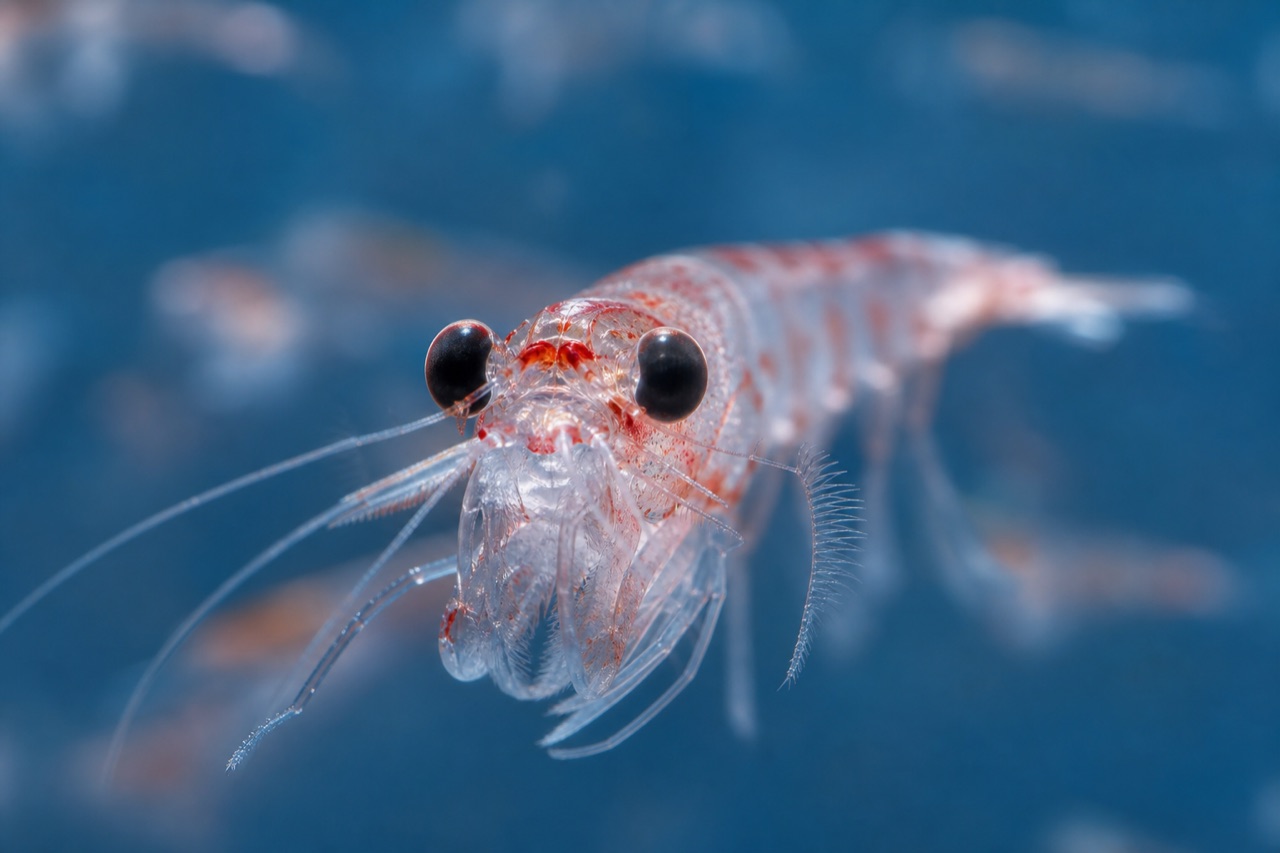
AI-generated educational wildlife portrait — World Animal Rescue Network · AI visualisation, not a photograph
In brief
Krill (order Euphausiacea) are small crustaceans whose Antarctic species Euphausia superba underpins the Southern Ocean food web; the species is Least Concern but faces fishing pressure and climate-driven sea-ice loss.
Also in Animals A to Z · Animals that start with K
By WARN Research & Conservation Team Last updated
Krill are small, shrimp-like crustaceans of the order Euphausiacea. They are not true shrimp — different anatomy, different order — but occupy a similar ecological tier as filter-feeding mesozooplankton that convert microscopic phytoplankton into flesh large predators can use. In the Southern Ocean, Antarctic krill (Euphausia superba) forms swarms so dense they discolour the sea and are visible from space. The standing biomass is among the largest of any wild animal population on Earth. That biomass underpins the Southern Ocean food web. Baleen whales, penguins, seals, squid, fish and seabirds depend directly or indirectly on krill. Blue whales can consume tonnes of krill daily during feeding season. Adélie and chinstrap penguin breeding success tracks krill availability near colonies. Remove krill and the ecosystem does not rearrange gracefully — it collapses upward through the food chain. Commercial krill fishing operates in the same waters. Fleets harvest krill for aquaculture feed, omega-3 supplements and pet food. Catch is regulated by the Commission for the Conservation of Antarctic Marine Living Resources, but fishing overlaps spatially with predator foraging grounds, and climate change is altering sea ice — a critical nursery habitat for larval krill — faster than management frameworks adjust. Other oceans hold krill species too — North Pacific euphausiids support salmon, seabirds and whales — but none match the biomass concentration or political visibility of Antarctic E. superba. What happens in the Southern Ocean is watched as a template for ecosystem-based fisheries management worldwide. Satellite sensors can detect large krill swarms indirectly through chlorophyll and sea-surface patterns, linking ocean colour to prey availability for fisheries managers. The science is young but improving yearly as acoustic and remote tools merge.
E. superba
Antarctic krill — keystone Southern Ocean species
Swarms
Can contain millions of individuals per cubic metre
Sea ice
Critical nursery for larval krill under ice algae
CCAMLR
International body regulating Antarctic krill fishery
Figures sourced from IUCN Red List — Euphausia superba, CCAMLR .
Krill: Quick Facts
| Key species | Euphausia superba — Antarctic krill |
|---|---|
| Role | Keystone prey in Southern Ocean |
| Feeding | Phytoplankton and ice-algae filter feeder |
| Fishery regulator | CCAMLR |
| Climate link | Sea-ice loss affects larval nursery habitat |
| IUCN status | Least Concern (E. superba) |
Scientific Classification
| Kingdom | Animalia |
|---|---|
| Phylum | Arthropoda |
| Class | Malacostraca |
| Order | Euphausiacea |
| Species | Euphausia superba (Antarctic krill) |
| Related orders | Krill occur in all oceans; Euphausiacea is cosmopolitan |
Conservation Status
- IUCN Status
- Least Concern
- Population
- Hundreds of millions of tonnes biomass estimated for E. superba — figures vary by survey
- Trend
- Suspected decline in parts of the Southwest Atlantic; uncertain globally
- Assessed
- 2016
- CITES
- Not listed
Least Concern reflects large current biomass. Sea-ice loss, localised fishing pressure and ecosystem dependence by predators justify continued precaution.
Did you know?
Antarctic krill swarms can be so dense they discolour the sea surface — and the standing biomass is large enough to feed the entire Southern Ocean whale and penguin assemblage each season.
Key Facts: Krill
- Antarctic krill (Euphausia superba) is among the most abundant wild animal biomass on Earth.
- Krill convert phytoplankton into food for whales, penguins, seals, fish and seabirds.
- Larval krill depend on sea ice and ice-algae — both declining with climate warming.
- Commercial krill fishing is regulated but overlaps with predator foraging areas.
- Krill fishing supplies aquaculture feed and omega-3 products globally.
- Ecosystem-based management — leaving enough krill for predators — is the conservation test.
Southern Ocean food web: krill at the centre
Antarctic krill feed on phytoplankton and ice-algae, packing energy into lipid-rich bodies that sustain cold-water predators through lean seasons. Swarms can extend for kilometres and move vertically in the water column — deep by day, surface by night — following food and avoiding visual predators.
Baleen whales are the iconic krill consumers. Humpback, minke, fin and blue whales feed heavily on krill in Antarctic waters during austral summer, building fat reserves for migration and breeding. Fish such as Antarctic silverfish and icefish depend on krill; so do squid taken by albatrosses and seals. The food web is short and efficient: algae to krill to vertebrate predator, with little redundancy if krill abundance falls.
Land-based predators connect through the coast. Penguin colonies require krill within commuting distance during chick-rearing. When krill is scarce — whether from oceanographic shift, sea-ice loss or local depletion — chick survival drops and colonies decline. The krill link is measurable in breeding statistics, not speculation.
Sea ice as nursery
Krill life history ties to sea ice. Larvae feed on algae growing on the underside of ice — a food source available when open-water phytoplankton blooms are absent. Ice also provides shelter from predators. Winter sea-ice extent around Antarctica has shown long-term decline in many sectors; the ice season shortens and the algae association weakens.
Adult krill can live several years and store lipids, buffering short bad seasons. Larval stages are more vulnerable — a failed ice-algae season reduces recruitment for years afterward because cohorts are missing. Climate models project continued ice loss; krill distribution may shift southward or contract to refugia where ice persists.
Ocean acidification adds pressure. Krill exoskeleton formation and larval development may be affected as carbonate chemistry changes, though field evidence is still accumulating compared with the clearer ice-habitat signal.
The krill fishery
Commercial harvesting of Antarctic krill began at scale in the 1970s and is concentrated in the Southwest Atlantic sector of the Southern Ocean — the same area supporting major penguin and seal colonies. Products include krill meal for aquaculture, krill oil for human supplements and pet food ingredients.
CCAMLR sets catch limits based on estimated biomass and applies a precautionary approach relative to total stock. Current catches are a fraction of the regulated limit, but spatial concentration matters: fishing in small areas near colonies can locally deplete swarms predators rely on during breeding. Ecosystem-based fisheries management — accounting for predator needs, not just sustainable yield to the fleet — is the stated goal but hard to enforce in practice.
Bycatch and processing waste are lesser concerns than allocation. The political question is whether growing demand for aquaculture feed will push catches toward limits as ice habitat contracts simultaneously — a squeeze from above and below on the same population.
Managing a keystone stock
Krill conservation is fisheries management plus climate policy. No marine protected area network in the Southern Ocean is complete without considering krill distribution and predator foraging ranges. Proposals for large MPAs in the Weddell Sea and East Antarctica have stalled repeatedly in CCAMLR politics, leaving the regulatory picture fragmented.
Monitoring uses acoustic surveys estimating swarm biomass, krill-dependent predator breeding success at index colonies, and satellite observation of sea-ice trends. Integrated models linking ice, krill recruitment and penguin survival are the tool for setting spatial fishing restrictions — closed zones near colonies during chick-rearing, for example.
For consumers, krill oil supplements connect everyday purchases to Antarctic ecology. Supply-chain scrutiny — certification, catch location, company reporting — is one lever. The larger lever is climate mitigation: without sea ice, krill recruitment suffers regardless of fishing restraint. Antarctic krill is Least Concern on the IUCN list today; the Southern Ocean ecosystem it supports is not guaranteed that stability tomorrow.
Whales, penguins and the krill link
Humpback whales recovering in the Southwest Atlantic after whaling moratoria now compete for krill with industrial trawlers and with penguins breeding on the same peninsula coastlines. Adélie penguin declines in some areas correlate with krill scarcity near colonies during chick-rearing — a direct food-chain signal, not a abstract food-web diagram.
Fur seals and leopard seals consume krill directly or via fish that eat krill. The short food chain means krill abundance ripples quickly. A year of poor recruitment from ice failure affects predators two trophic levels up within the same breeding season.
Whale-watching tourism and krill fishing both claim sustainable use of the same stock. Resolution requires spatial zoning — fishing away from choke-point foraging grounds during predator breeding — rather than assuming a global catch limit alone protects ecosystem function.
What WARN Does
WARN publishes free, sourced species education for keystone species whose decline would cascade through ecosystems most people never see. Krill is the Southern Ocean in miniature — algae, ice, whales and fisheries all meeting in a two-centimetre crustacean.
If this guide helps you understand wildlife and the pressures it faces, a gift to WARN supports habitat protection and free public education in our partner countries.
Krill: Frequently Asked Questions
What is krill?
Are krill endangered?
What eats krill?
Why is sea ice important for krill?
What do krills eat?
Where do krills live?
Are krills dangerous?
How long do krills live?
How big is a krill?
Sources & References
Population figures, conservation status and biological facts on this page are drawn from authoritative scientific and intergovernmental sources.
Terms used on this page
Plain-English definitions, from our wildlife and conservation glossary.
Explore more animals
Discover more animals, their habitats and their conservation status in the WARN wildlife-guide library.
Enjoyed this Krill guide?
Receive appeal updates, animal-welfare news and published funding reports. Unsubscribe any time.
We only use your address for WARN updates. See our privacy policy.