Wildlife Guide · New Zealand — predator-free offshore islands only & Extinct across the mainland
Kakapo
Strigops habroptilus (Gray, 1845) — family Strigopidae
The world's only flightless parrot: nocturnal, booming, and managed bird by bird.
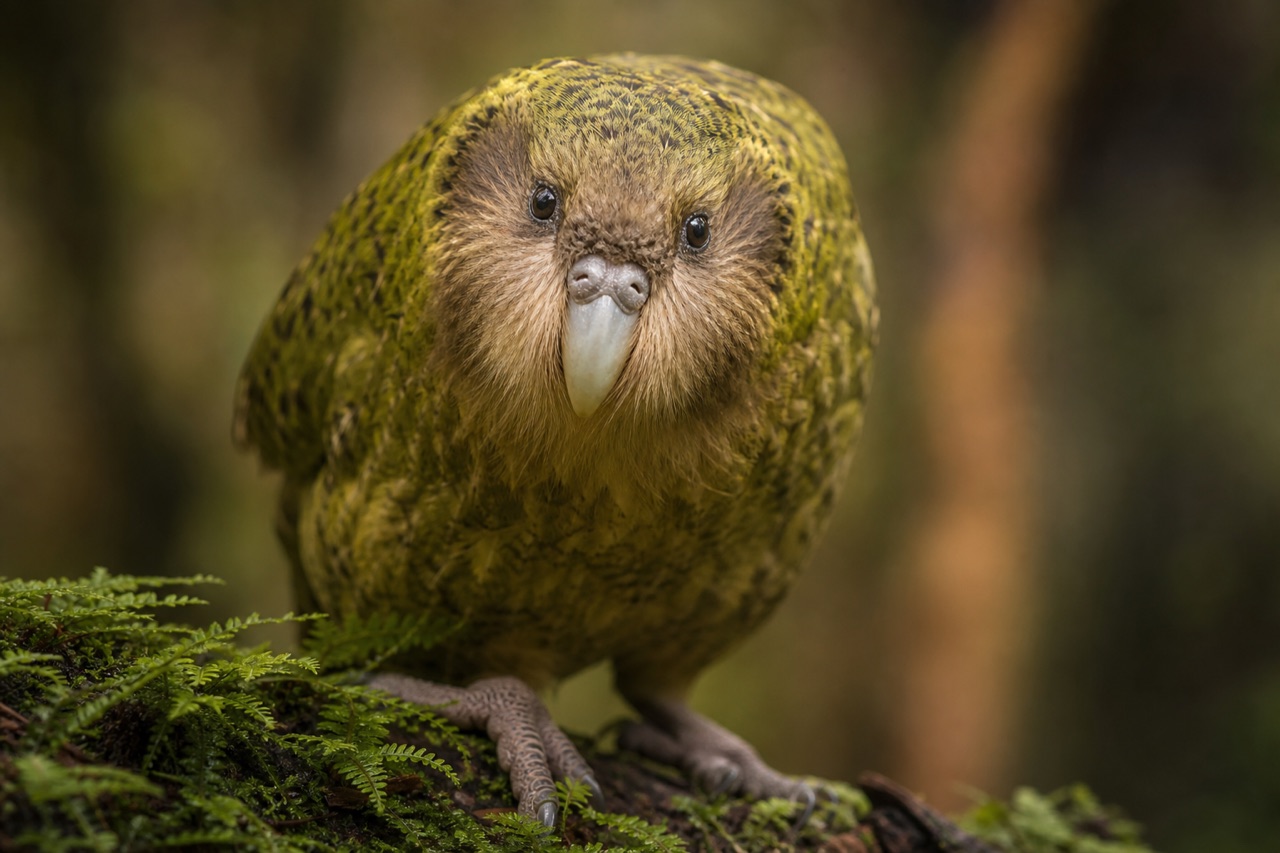
AI-generated educational wildlife portrait — World Animal Rescue Network · AI visualisation, not a photograph
In brief
The kākāpō (Strigops habroptilus) is the world's only flightless parrot and the heaviest, a nocturnal New Zealand species now confined to predator-free offshore islands where every individual bird is named, microchipped and monitored.
Also in Animals A to Z · Animals that start with K
How you can help
You can support the related appeal — read its purpose, recipient status and fund terms first — or give once to where it is needed most. Sharing accurate information helps too.
By WARN Research & Conservation Team Last updated
The kākāpō is the world's only flightless parrot, the heaviest parrot alive, and among the longest-lived birds known. It is nocturnal, smells strongly of something like old honey, and freezes when threatened — a defence that worked perfectly against the aerial predators of prehistoric New Zealand and failed completely against introduced stoats, cats and rats. Today every living kākāpō is individually named, microchipped and monitored. The population is measured in hundreds, not thousands, and survives only on predator-free offshore islands. It is one of the most intensively managed wild populations of any species on Earth.
Only one
The world's sole flightless parrot
~4 kg
Weight of a large male — the heaviest parrot alive
2–4 years
Interval between breeding, tied to rimu masting
Every bird
Individually named and tracked
Figures sourced from IUCN Red List — Strigops habroptilus, CITES Appendices .
Kakapo: Quick Facts
| Weight | Up to ~4 kg — heaviest parrot |
|---|---|
| Flight | Flightless — the only such parrot |
| Activity | Nocturnal |
| Mating system | Lek — males boom, females choose |
| Breeding trigger | Rimu mast fruiting, every 2–4 years |
| Range | Predator-free New Zealand offshore islands only |
Scientific Classification
| Kingdom | Animalia |
|---|---|
| Phylum | Chordata |
| Class | Aves |
| Order | Psittaciformes |
| Family | Strigopidae |
| Genus | Strigops |
| Species | Strigops habroptilus |
Conservation Status
- IUCN Status
- Critically Endangered
- Population
- A few hundred individuals, all individually known
- Trend
- Increasing under intensive management
- Assessed
- 2021
- CITES
- Appendix I
Genetic diversity is critically low. Recovery is limited less by breeding success than by the availability of predator-free islands large enough to hold more birds.
Did you know?
Every living kākāpō has a name, and the genome of essentially the whole species has been sequenced — the population is small enough for that to be practical.
Key Facts: Kakapo
- Kākāpō are the only flightless parrots and the heaviest parrot species alive.
- Males 'boom' from excavated bowls to attract females — a lek mating system unique among parrots.
- Breeding is tied to mast fruiting of rimu trees, so it happens only every two to four years.
- Freezing when threatened worked against aerial hunters and failed against introduced mammals.
- The entire species lives on predator-free offshore islands under intensive management.
- Every living kākāpō is named, microchipped and individually monitored.
Booming: a lek in the dark
Male kākāpō dig shallow bowls in the ground, position them where the acoustics carry, and inflate a thoracic air sac to produce a deep, resonant boom repeated for hours through the night. The low frequency travels several kilometres across valleys but is notoriously hard to locate, which is part of the point.
Females walk in from a distance, assess the displaying males, and choose. This is a lek system — males cluster and display, females select and then raise the chicks alone — and no other parrot in the world does it.
Breeding on the rimu cycle
Kākāpō breed only when rimu trees mast-fruit, which happens every two to four years. Females need that fruit glut to raise chicks, and in non-mast years they simply do not breed.
That evolutionary caution is sensible for a long-lived bird in a stable environment and disastrous for a species in crisis: recovery can only proceed in bursts. Conservation managers now supplement food to trigger and support breeding, monitor nests continuously, and hand-rear chicks where necessary — measures that would be extreme for almost any other species and are routine here.
Why the defence failed
New Zealand's land birds evolved with no mammalian predators. The threats were aerial, so freezing and relying on cryptic green plumage was an excellent strategy. Then people arrived, bringing rats, cats, stoats and possums.
Against mammals that hunt by scent, a strongly scented bird that freezes on the ground and cannot fly is close to defenceless — and a nesting female leaves eggs and chicks unattended while feeding. Kākāpō disappeared from the mainland entirely. Every surviving bird was eventually relocated to islands cleared of introduced predators.
Managed to the individual
The recovery programme tracks every bird by transmitter, records genetics across the whole population, supplements food, monitors nests with cameras, and intervenes when a chick is failing. Genetic diversity is critically low — the entire species descends from a small remnant — so pairings are managed to preserve what variation remains, and the genome of essentially every individual has been sequenced.
The population has grown from a low point of a few dozen to a few hundred. It remains Critically Endangered, and the constraint is now space: predator-free islands large enough to hold more birds are scarce, which makes further predator eradication the central task.
What WARN Does
WARN publishes free, sourced species education including the extreme end of conservation practice. The kākāpō shows both what is achievable when a species is managed bird by bird, and how expensive and precarious recovery becomes once a population falls that far.
If this guide helps you understand wildlife and the pressures it faces, a gift to WARN supports habitat protection and free public education in our partner countries.
How can I help save the kakapo?
Explore practical ways to support the kakapo, from everyday choices and sharing reliable information to reviewing a related appeal before giving.
Explore ways to support
Read the related appeal’s purpose, recipient status and fund terms. Choose an affordable gift after checking what is proposed and what has been reported.
Ease the pressures
Avoid the wildlife trade and souvenirs, never buy wild animals as pets, and choose sustainable, habitat-friendly products — the threats behind the kakapo's decline fall when demand does.
Spread the word
Share accurate, sourced information about the kakapo. Wider awareness is what turns concern into lasting protection.
Kakapo: Frequently Asked Questions
How can I help save the kakapo?
Can kākāpō fly?
How many kākāpō are left?
What is kākāpō booming?
Why do kākāpō breed so rarely?
Why did kākāpō become so endangered?
Sources & References
Population figures, conservation status and biological facts on this page are drawn from authoritative scientific and intergovernmental sources.
Terms used on this page
Plain-English definitions, from our wildlife and conservation glossary.
Explore more animals
Discover more animals, their habitats and their conservation status in the WARN wildlife-guide library.
Enjoyed this Kakapo guide?
Receive appeal updates, animal-welfare news and published funding reports. Unsubscribe any time.
We only use your address for WARN updates. See our privacy policy.