Wildlife Guide · Amazon and Orinoco basins & Guiana Shield wetlands
Hoatzin
Opisthocomus hoazin (Müller, 1776) — family Opisthocomidae
The only bird that ferments leaves in its crop — and the chicks have claws on their wings.
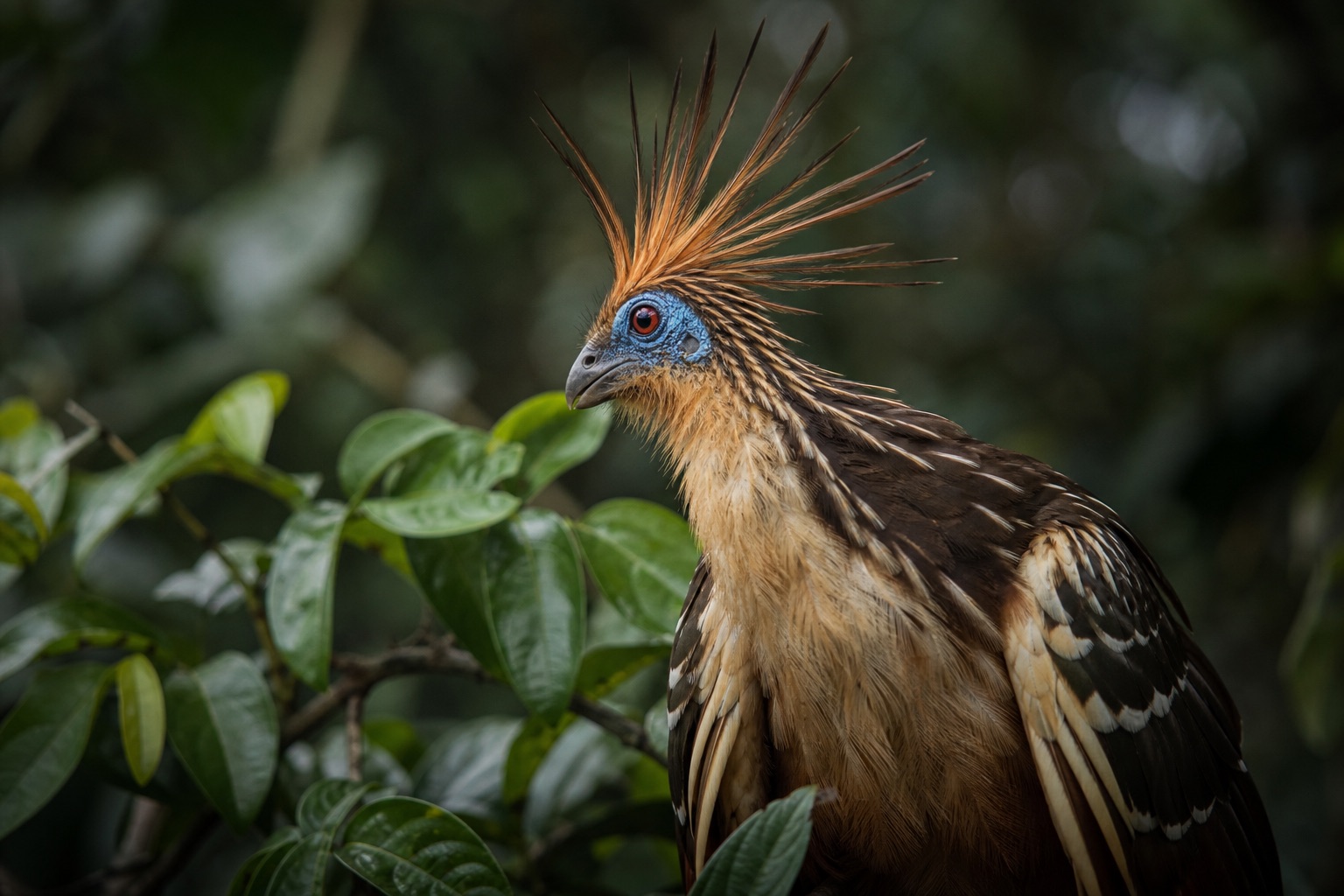
AI-generated educational wildlife portrait — World Animal Rescue Network · AI visualisation, not a photograph
In brief
The hoatzin (Opisthocomus hoazin) is a pheasant-sized bird of Amazon and Orinoco wetlands that digests leaves through foregut fermentation like a ruminant; chicks bear functional wing claws for climbing, and adults are weak fliers tied to riverside forest.
Also in Animals A to Z · Animals that start with H
By WARN Research & Conservation Team Last updated
The hoatzin is one of the strangest birds in the Neotropics. It eats almost nothing but leaves, ferments them in an enlarged crop using bacteria in the same way cattle ferment grass in a rumen, and smells strongly enough that local names translate as 'stinkbird'. Adults are poor fliers with small wings relative to body size; they clamber through riverside vegetation like arboreal chickens. Chicks hatch with two functional claws on each wing — not the reduced vestigial spurs some birds carry, but hooks strong enough to climb back into the nest after dropping into the water to escape predators. The claws are lost as the wings develop for flight. Taxonomists have argued over the hoatzin's relationships for decades; it sits alone in its own family and order, a living puzzle with no close modern relatives agreed upon.
~65 cm
Total length including long tail
2
Functional claws on each wing in chicks
Leaves
Almost the entire adult diet
Sole
Living species in its family and order
Figures sourced from IUCN Red List — Opisthocomus hoazin, Cornell Lab of Ornithology — Hoatzin, Animal Diversity Web — Opisthocomus hoazin .
Hoatzin: Quick Facts
| Length | About 61–66 cm including tail |
|---|---|
| Mass | Roughly 700–900 g |
| Diet | Leaves — fermented in the crop |
| Habitat | Riverside forest and wetlands of the Amazon and Orinoco |
| Chick feature | Two functional claws per wing for climbing |
| Flight | Weak — mostly climbs through vegetation |
| IUCN status | Least Concern |
Scientific Classification
| Kingdom | Animalia |
|---|---|
| Phylum | Chordata |
| Class | Aves |
| Order | Opisthocomiformes |
| Family | Opisthocomidae |
| Genus | Opisthocomus |
| Species | Opisthocomus hoazin |
Conservation Status
- IUCN Status
- Least Concern
- Population
- No reliable global estimate; locally common along undisturbed rivers
- Trend
- Decreasing in areas of riparian forest loss
- Assessed
- 2016
- CITES
- Not listed
The listing reflects current wide distribution, not insulation from Amazon wetland clearance. The hoatzin is the only species in its order — range contraction has no redundancy.
Did you know?
Hoatzin chicks drop into the water when threatened, swim away, and then climb back to the nest using two hooks on each wing — behaviour that has made the species a touchpoint in debates about early bird evolution.
Key Facts: Hoatzin
- Hoatzins ferment leaves in an enlarged crop using symbiotic bacteria — foregut fermentation rare among birds and convergent with ruminant mammals.
- Chicks have two claws on each wing used to climb back to the nest after escaping into water; the claws disappear as adult flight feathers develop.
- The species is the only living member of the family Opisthocomidae and order Opisthocomiformes — its evolutionary relationships remain disputed.
- Adults smell strongly of fermented vegetation; local names such as 'stinkbird' reflect the odour.
- Hoatzins are weak fliers and spend most of their time clambering through vegetation along slow rivers and oxbow lakes.
- The IUCN lists the hoatzin as Least Concern, but range is tied to riparian forest being cleared across the Amazon basin.
Foregut fermentation in a bird
Leaf-eating is a difficult diet. Leaves are abundant but low in digestible energy and rich in toxins and fibre. Mammals that specialise on them — sloths, koalas, howler monkeys — use extended gut fermentation. The hoatzin is the only bird known to rely on the same strategy at scale.
Food sits in an enlarged crop where bacterial fermentation breaks down plant material before it reaches the stomach. The process produces the hoatzin's characteristic smell and requires the bird to rest for long periods while digestion proceeds — which partly explains the poor flight performance. A leaf diet also limits how far hoatzins can range: they are tied to riverside trees with accessible foliage, and they are almost never found far from water.
Wing claws and the chick that swims
Hoatzin nests are platforms of sticks over water. When a predator approaches, chicks may drop deliberately into the river below — they can swim short distances using their wings and feet — and hide among vegetation until the threat passes. The wing claws then function as grappling hooks: the chick climbs back through riverside branches to the nest, using bill and feet as well.
The claws are real digits with keratin tips, not the vestigial spurs found on some ratites. They are lost during development as the wing skeleton reorganises for flight. The behaviour is reminiscent of Archaeopteryx and other early birds reconstructed with clawed wings, which is why the hoatzin is often cited in discussions of avian evolution — though the claws almost certainly evolved independently rather than being a direct ancestral holdover.
Why taxonomists cannot place the hoatzin
The hoatzin has been proposed as related to turacos, to cuckoos, to pheasants and to the extinct dodo lineage within Columbiformes. Modern genetic studies have not settled the question cleanly; the bird appears to branch early in Neoaves on its own long stem. What is agreed is that it is not close to any single living family enough to merge with them.
That isolation matters for conservation framing: the hoatzin is not a variant of something common — it is the sole representative of an entire order. Losing riparian forest across the Amazon does not just reduce a population; it eliminates the only habitat of the only species in Opisthocomiformes.
Wetland loss across the hoatzin's range
The IUCN assesses Opisthocomus hoazin as Least Concern because it remains widespread and locally common along slow rivers, swamps and oxbow lakes from Colombia to Brazil. That assessment describes present abundance, not future security.
Amazonian riparian forest is cleared for cattle pasture, drowned by dams and fragmented by roads. Hoatzins rarely cross open ground and depend on continuous riverside vegetation. In areas where gallery forest has been removed, the bird disappears even when surrounding terra firme forest remains. Because the species is conspicuous and noisy, local absence is easy to notice — a useful but sobering indicator of wetland degradation.
What WARN Does
WARN publishes free, sourced education for species tied to habitats under active clearance. The hoatzin is a riparian specialist across the Amazon and Orinoco — basins where wetland forest loss proceeds faster than most English-language references update their range maps.
If this guide helps you understand wildlife and the pressures it faces, a gift to WARN supports habitat protection and free public education in our partner countries.
Hoatzin: Frequently Asked Questions
What do hoatzins eat?
Where do hoatzins live?
Are hoatzins dangerous?
How long do hoatzins live?
How big are hoatzins?
Why do hoatzin chicks have claws on their wings?
Are hoatzins endangered?
Sources & References
Population figures, conservation status and biological facts on this page are drawn from authoritative scientific and intergovernmental sources.
Terms used on this page
Plain-English definitions, from our wildlife and conservation glossary.
Latest Hoatzin Stories
Quick, fact-checked reads on the hoatzin — amazing facts, key questions and the threats it faces.
Species
11 Amazing Facts About the Pink River Dolphin (the Amazon's Blushing Boto)
From a head that swivels 90 degrees to a blush built from battle scars, here are 11 true facts about the Amazon's pink river dolphin, the largest freshwater dolphin on Earth.
Read the storySpecies
How Big Is a Green Anaconda? The Heaviest Snake on Earth, Explained
Green Anacondas are the heaviest snakes alive. Here is how long and how heavy they really get, why females are so much bigger, and which records are real.
Read the storyExplore more animals
Discover more animals, their habitats and their conservation status in the WARN wildlife-guide library.
Enjoyed this Hoatzin guide?
Receive appeal updates, animal-welfare news and published funding reports. Unsubscribe any time.
We only use your address for WARN updates. See our privacy policy.