Wildlife Guide · New Guinea lowland rainforest & Aru and Salawati islands
Goliath Birdwing
Ornithoptera goliath (Deslisle, 1989) — family Papilionidae
The second-largest butterfly on Earth — and one that sequesters toxins like a poison-dart frog.
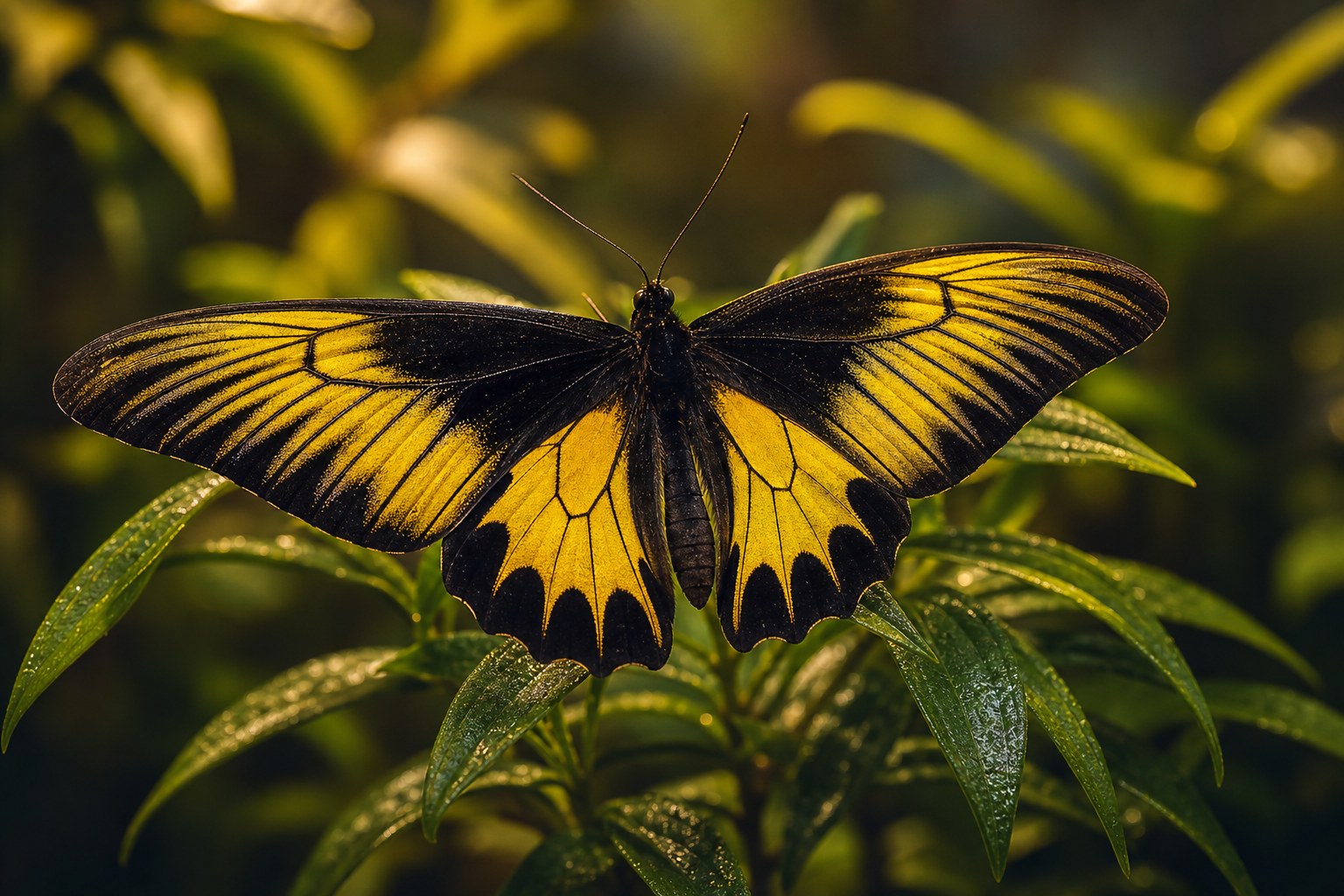
AI-generated educational wildlife portrait — World Animal Rescue Network · AI visualisation, not a photograph
In brief
The goliath birdwing (Ornithoptera goliath) is the second-largest butterfly in the world, with females reaching a wingspan of around 25 cm; its caterpillars sequester toxins from Aristolochia vines in the same way poison-dart frogs store alkaloids from their diet.
Also in Animals A to Z · Animals that start with G
By WARN Research & Conservation Team Last updated
The goliath birdwing is the second-largest butterfly in the world after Queen Alexandra's birdwing. Females reach a wingspan of around 25 centimetres; males are smaller but striking, with black wings banded in iridescent green and yellow and a bright yellow abdomen. It occurs across lowland rainforest in New Guinea and on the Aru and Salawati islands. What connects this butterfly to poison-dart frogs is chemistry rather than appearance. The caterpillar feeds on vines of the genus Aristolochia, which contain toxic aristolochic acids. The larva sequesters these compounds and retains them through pupation into the adult, making both caterpillar and butterfly unpalatable to birds — the same defensive strategy used by poison-dart frogs that take alkaloids from their diet and store them in their skin.
~25 cm
Female wingspan — second only to Queen Alexandra's birdwing
Aristolochia
Host vine whose toxins the caterpillar sequesters
Unpalatable
Both larva and adult, from stored aristolochic acids
Lowland
Rainforest across New Guinea and nearby islands
Figures sourced from IUCN Red List — Ornithoptera goliath, CITES Appendices, Natural History Museum — birdwing biology .
Goliath Birdwing: Quick Facts
| Female wingspan | Around 25 cm — second-largest butterfly |
|---|---|
| Defence | Sequesters aristolochic acids from Aristolochia vines |
| Male colour | Black with iridescent green bands and yellow abdomen |
| Larval food | Aristolochia vines |
| Range | Lowland New Guinea, Aru and Salawati islands |
| Main threats | Lowland forest clearance; collection for trade |
Scientific Classification
| Kingdom | Animalia |
|---|---|
| Phylum | Arthropoda |
| Class | Insecta |
| Order | Lepidoptera |
| Family | Papilionidae |
| Genus | Ornithoptera |
| Species | Ornithoptera goliath |
Conservation Status
- IUCN Status
- Least Concern
- Population
- No reliable estimate exists
- Trend
- Decreasing
- Assessed
- 2020
- CITES
- Appendix II
Wider range than Queen Alexandra's birdwing but occupies the same lowland altitude band being cleared for oil palm and logging across New Guinea.
Did you know?
The goliath birdwing caterpillar stores toxins from its food plant and carries them into adulthood — the same sequestration strategy poison-dart frogs use, though the chemistry and source are entirely different.
Key Facts: Goliath Birdwing
- The goliath birdwing is the second-largest butterfly in the world, with females reaching a wingspan of around 25 cm.
- Caterpillars feed on Aristolochia vines and sequester toxic aristolochic acids, retaining them into adulthood — the same defensive strategy poison-dart frogs use with dietary alkaloids.
- Both caterpillar and adult are unpalatable to birds because of the stored toxins, which makes warning colouration effective.
- Males are iridescent green and yellow on black; females are larger and predominantly dark brown with cream markings.
- The species occurs across lowland rainforest in New Guinea and on the Aru and Salawati islands.
- Lowland forest clearance and collection pressure affect the species across a range held largely under customary land tenure.
Toxins from the host plant
Aristolochia vines contain aristolochic acids, compounds that are toxic to most vertebrates. The goliath birdwing caterpillar not only tolerates them but stores them in its body tissues, and the adult retains them after pupation. A bird that eats the caterpillar or butterfly learns quickly not to repeat the mistake.
This is the same principle that makes poison-dart frogs dangerous. Those frogs take alkaloids from ants and mites in their diet and concentrate them in their skin; the goliath birdwing takes aristolochic acids from its larval food plant and carries them through its life cycle. In both cases the animal is advertising unpalatability with bright colour — aposematism — and in both cases removing the food source removes the defence. No Aristolochia, no birdwing.
Second largest, widely distributed
Queen Alexandra's birdwing holds the size record at around 28 cm wingspan; the goliath birdwing follows at around 25 cm. Unlike its relative, which is confined to a small area of Oro Province, the goliath occurs across much of lowland New Guinea and on several offshore islands.
That wider range earns it a Least Concern listing, but lowland forest is being cleared across the island for oil palm, logging and mining, and the goliath occupies exactly that altitude band. A Least Concern listing describes current range, not the rate at which lowland forest is being removed from it. Collection for the insect trade adds pressure, though the species is on CITES Appendix II rather than Appendix I.
Sexual dimorphism and display
Male goliath birdwings are vivid — black wings with broad iridescent green bands and a yellow abdomen — while females are larger, darker and less showy. Males patrol forest clearings and stream edges, searching for females, and the iridescent bands shift colour with viewing angle because they are structural rather than pigment-based.
Females lay single eggs on Aristolochia vines, and the caterpillar develops through several instars over weeks before pupating. The pupa is suspended from a stem and the adult emerges after several weeks. The entire life cycle depends on intact lowland forest with sufficient host vines, which is why fragmentation hits this species harder than a range map suggests.
Customary land and lowland forest
The goliath birdwing's range lies almost entirely within land held under customary tenure in Papua New Guinea and the Indonesian provinces of New Guinea. Protection of lowland forest patches with Aristolochia vines depends on landowning clans choosing to retain them rather than on protected-area designations alone.
Where lowland forest is cleared for oil palm or logging, both the butterfly and its host plant disappear together. CITES Appendix II regulates international trade but does not prevent local forest conversion. The practical conservation front line is the same as for Queen Alexandra's birdwing and for the lowland birds-of-paradise: forest retained on customary land, with host plants and display sites intact.
What WARN Does
WARN publishes free, sourced species education, including the chemical links between unrelated animals. The goliath birdwing and the poison-dart frog defend themselves the same way — by storing toxins from their diet — yet both depend on habitat that lowland forest clearance is removing across New Guinea.
If this guide helps you understand wildlife and the pressures it faces, a gift to WARN supports habitat protection and free public education in our partner countries.
Goliath Birdwing: Frequently Asked Questions
How big is the goliath birdwing?
Is the goliath birdwing poisonous?
What does the goliath birdwing caterpillar eat?
Where does the goliath birdwing live?
Is the goliath birdwing endangered?
How is it related to Queen Alexandra's birdwing?
Are goliath birdwings dangerous?
How long do goliath birdwings live?
Sources & References
Population figures, conservation status and biological facts on this page are drawn from authoritative scientific and intergovernmental sources.
Terms used on this page
Plain-English definitions, from our wildlife and conservation glossary.
Explore more animals
Discover more animals, their habitats and their conservation status in the WARN wildlife-guide library.
Enjoyed this Goliath Birdwing guide?
Receive appeal updates, animal-welfare news and published funding reports. Unsubscribe any time.
We only use your address for WARN updates. See our privacy policy.