Wildlife Guide · Tropical Atlantic and Pacific coasts & Caribbean and Galápagos islands
Frigatebird
Fregata magnificens Mathews, 1914 — family Fregatidae
A seabird that can stay airborne for weeks — and steals most of its meals on the wing.
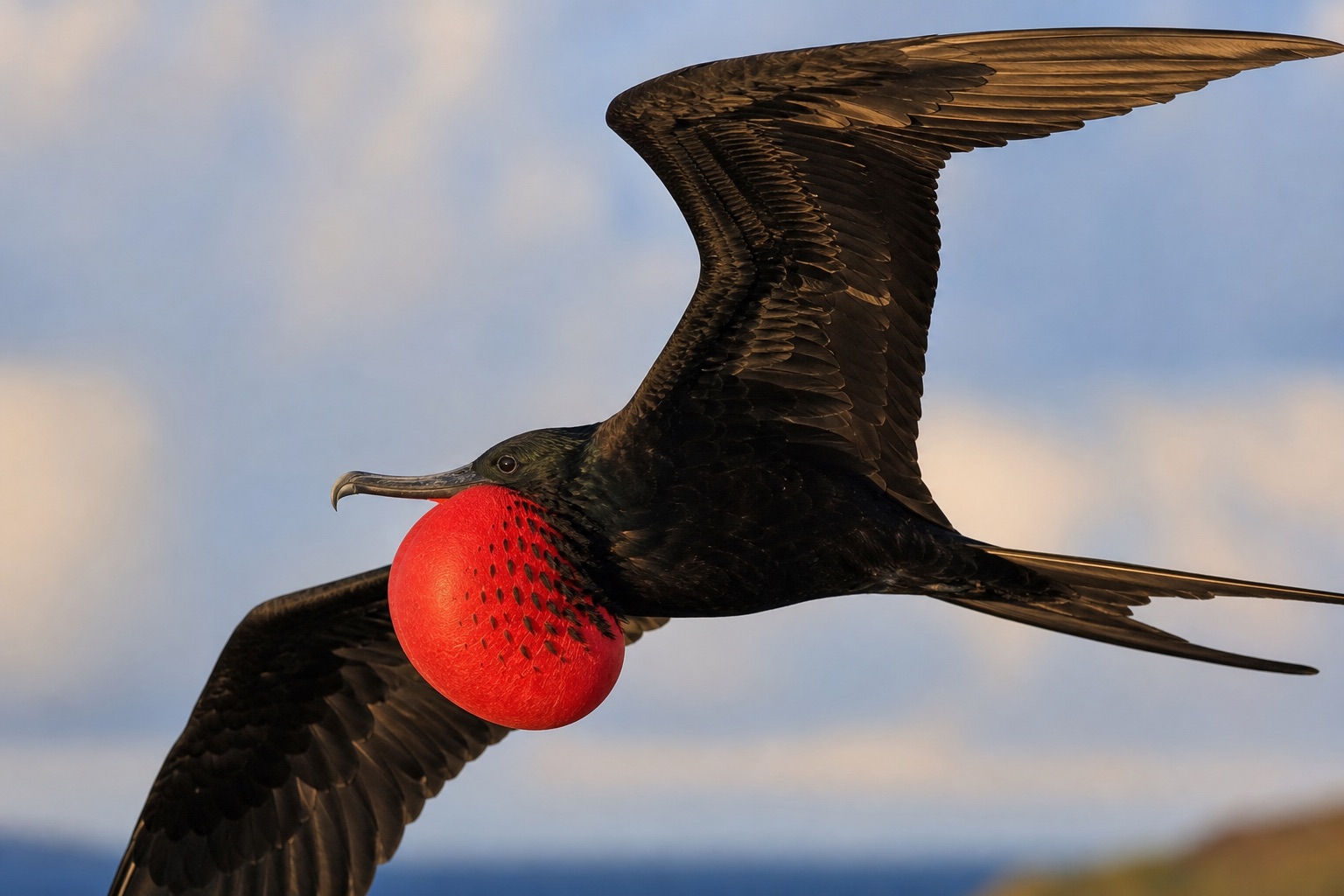
AI-generated educational wildlife portrait — World Animal Rescue Network · AI visualisation, not a photograph
In brief
The magnificent frigatebird (Fregata magnificens) is a large tropical seabird with the greatest wing-loading ratio of any bird, able to stay continuously airborne for weeks; males inflate a scarlet throat pouch in display, and the birds steal much of their food from other seabirds in flight.
Also in Animals A to Z · Animals that start with F
By WARN Research & Conservation Team Last updated
Frigatebirds are among the most aerial birds alive. They have the largest wing area relative to body weight of any bird, fly with barely a flap for hours, and roost on trees or cliffs only to sleep and breed. Tracking studies on great frigatebirds found individuals remaining continuously aloft for more than two months while crossing the Indian Ocean, sleeping on the wing and riding thermals with almost no energy cost. Magnificent frigatebirds are the species most people mean when they search the name: long, angular black wings, a deeply forked tail and, in breeding males, a scarlet throat pouch inflated like a balloon to attract females. They are kleptoparasites — specialists at harassing other seabirds until they regurgitate food — and they also pick fish and squid from the surface without landing on water, because their feathers are not waterproof and a soaked bird could not take off again.
2+ months
Longest verified continuous flight without landing (great frigatebird tracking study)
~2.3 m
Wingspan of the magnificent frigatebird
Zero
Safe landings on water — feathers are not waterproof
Scarlet
Colour of the breeding male's inflated gular pouch
Figures sourced from IUCN Red List — Fregata magnificens, Weimerskirch et al. 2016 — frigatebird flight and sleep on the wing (Science), Cornell Lab of Ornithology — Magnificent Frigatebird .
Frigatebird: Quick Facts
| Wingspan | About 2.3 m |
|---|---|
| Body mass | Roughly 1.2–1.9 kg |
| Diet | Fish, squid; much obtained by kleptoparasitism |
| Habitat | Tropical coasts, mangroves, breeding islands |
| Flight record | More than two months continuous flight documented in great frigatebirds |
| Breeding display | Male inflates scarlet gular pouch |
| IUCN status | Least Concern (magnificent frigatebird) |
Scientific Classification
| Kingdom | Animalia |
|---|---|
| Phylum | Chordata |
| Class | Aves |
| Order | Suliformes |
| Family | Fregatidae |
| Genus | Fregata |
| Species | Fregata magnificens |
Conservation Status
- IUCN Status
- Least Concern
- Population
- No reliable global estimate; widespread across tropical oceans
- Trend
- Stable for magnificent frigatebird at species level
- Assessed
- 2016
- CITES
- Appendix II
Species-level security does not reflect the broader seabird crisis. Around a third of seabird species are threatened, and frigatebirds depend on the same prey webs and island nesting sites.
Did you know?
Great frigatebirds tracked across the Indian Ocean stayed continuously airborne for up to 63 days — sleeping on the wing while crossing thousands of kilometres without once touching land or water.
Key Facts: Frigatebird
- Frigatebirds have the largest wing area relative to body mass of any bird and spend most of their lives in the air.
- Tracking data show great frigatebirds can remain continuously aloft for more than two months, sleeping on the wing.
- Magnificent frigatebirds cannot safely land on water because their plumage lacks waterproofing — wet birds would sink.
- They feed by snatching prey from the surface, catching airborne fish flushed by tuna, and kleptoparasitism — forcing other seabirds to disgorge meals.
- Breeding males inflate a scarlet throat pouch for display; females choose mates partly on pouch size and display vigour.
- The IUCN lists the magnificent frigatebird as Least Concern, but seabirds as a group face among the highest extinction risk of any bird category.
How can a bird fly for two months without landing?
The answer is wing design and wind. Frigatebird wings are extraordinarily long and narrow, with a span up to roughly 2.3 metres on a body weighing around 1.5 kilograms in the magnificent species. That ratio lets the bird stay aloft on minimal flapping, riding thermals and wind gradients the way an albatross does, but in tropical air rather than Southern Ocean gales.
GPS and accelerometer tracking published in 2016 followed great frigatebirds crossing the Indian Ocean from Mozambique to Indonesia. Birds remained airborne for up to 63 days without touching down. They gained altitude in daytime thermals, glided downward at night, and entered brief sleep episodes on the wing — one hemisphere of the brain at a time, as in other birds. The flight cost was low enough that fat reserves built before departure could sustain the journey. Frigatebirds are not unique in long flights — albatrosses also spend years at sea — but the documented multi-week non-stop tropical crossing is among the longest continuous flights verified for any bird.
Kleptoparasitism and why frigatebirds chase gulls
Frigatebirds are nicknamed 'man-o'-war birds' because they harass other species until food is surrendered. A frigatebird will dive at a gull, tern or booby carrying a fish, grabbing the victim's tail or wing and forcing it to regurgitate or drop the catch. Aerial chases can last minutes. Kleptoparasitism supplies a substantial share of diet in some populations, though frigatebirds also hunt directly.
Direct feeding includes snatching flying fish flushed by tuna schools, picking squid and fish from the surface in calm conditions, and taking chicks from unattended seabird colonies — behaviour that makes them unpopular on breeding islands shared with terns. Because they cannot land on water, every meal must be reachable from the air or stolen from a bird that can float. That constraint shapes the entire ecology: frigatebirds follow fishing boats, tuna schools and other seabirds because those are the events that concentrate food at the surface or in the air.
The scarlet pouch and colonial breeding
Breeding males of the magnificent frigatebird inflate a gular pouch to a scarlet balloon larger than the head, drumming the bill against the pouch to produce a sound females can hear across the colony. Females are black with a white breast band and choose among displaying males; the pouch is honest advertising of condition because only a well-fed male can sustain the display through a breeding season.
Colonies nest in mangroves or low coastal vegetation on islands — the Galápagos, Caribbean cays and Pacific coast rookeries hold thousands of pairs. Nests are platforms of sticks; one egg is typical. Both parents feed the chick by regurgitation for several months, one of the longest chick-rearing periods relative to body size among seabirds. Frigatebird colonies are sensitive to disturbance, introduced predators on nesting islands, and overfishing of the surface schools they depend on.
Seabird pressures that reach frigatebirds too
The magnificent frigatebird is listed as Least Concern with a large range across tropical oceans. That listing describes the species today, not the trajectory of seabirds generally. Around a third of seabird species are threatened — the highest proportion of any major bird group — and the causes are well documented: longline bycatch, invasive predators on breeding islands, overfishing of prey and plastic ingestion.
Frigatebirds are less vulnerable to longline hooks than albatrosses because they rarely dive on baited lines, but they still ingest plastic at sea and lose nesting habitat when mangroves are cleared. Kleptoparasitism ties their fortunes to other seabirds and to tuna fisheries; when those food chains weaken, frigatebirds feel it indirectly. A secure listing for one species should not be read as seabird security overall.
What WARN Does
WARN publishes free, sourced seabird education because the group is the most threatened bird category on Earth and the fixes — streamer lines, island predator removal — are known and inexpensive. Frigatebirds illustrate extreme aerial adaptation and the food-web links that make seabird conservation a system problem, not a single-species problem.
If this guide helps you understand wildlife and the pressures it faces, a gift to WARN supports habitat protection and free public education in our partner countries.
Frigatebird: Frequently Asked Questions
What do frigatebirds eat?
Where do frigatebirds live?
Are frigatebirds dangerous to humans?
How long do frigatebirds live?
How big are frigatebirds?
Why can't frigatebirds land on water?
Are frigatebirds endangered?
Sources & References
Population figures, conservation status and biological facts on this page are drawn from authoritative scientific and intergovernmental sources.
Terms used on this page
Plain-English definitions, from our wildlife and conservation glossary.
Explore more animals
Discover more animals, their habitats and their conservation status in the WARN wildlife-guide library.
Enjoyed this Frigatebird guide?
Receive appeal updates, animal-welfare news and published funding reports. Unsubscribe any time.
We only use your address for WARN updates. See our privacy policy.