Wildlife Guide · Worldwide except Antarctica & Most diverse in temperate and tropical regions
Bombardier Beetle
Brachinus spp. and related genera — family Carabidae
A beetle that fires a near-boiling chemical spray from its abdomen — by mixing two reactants at the moment of attack.
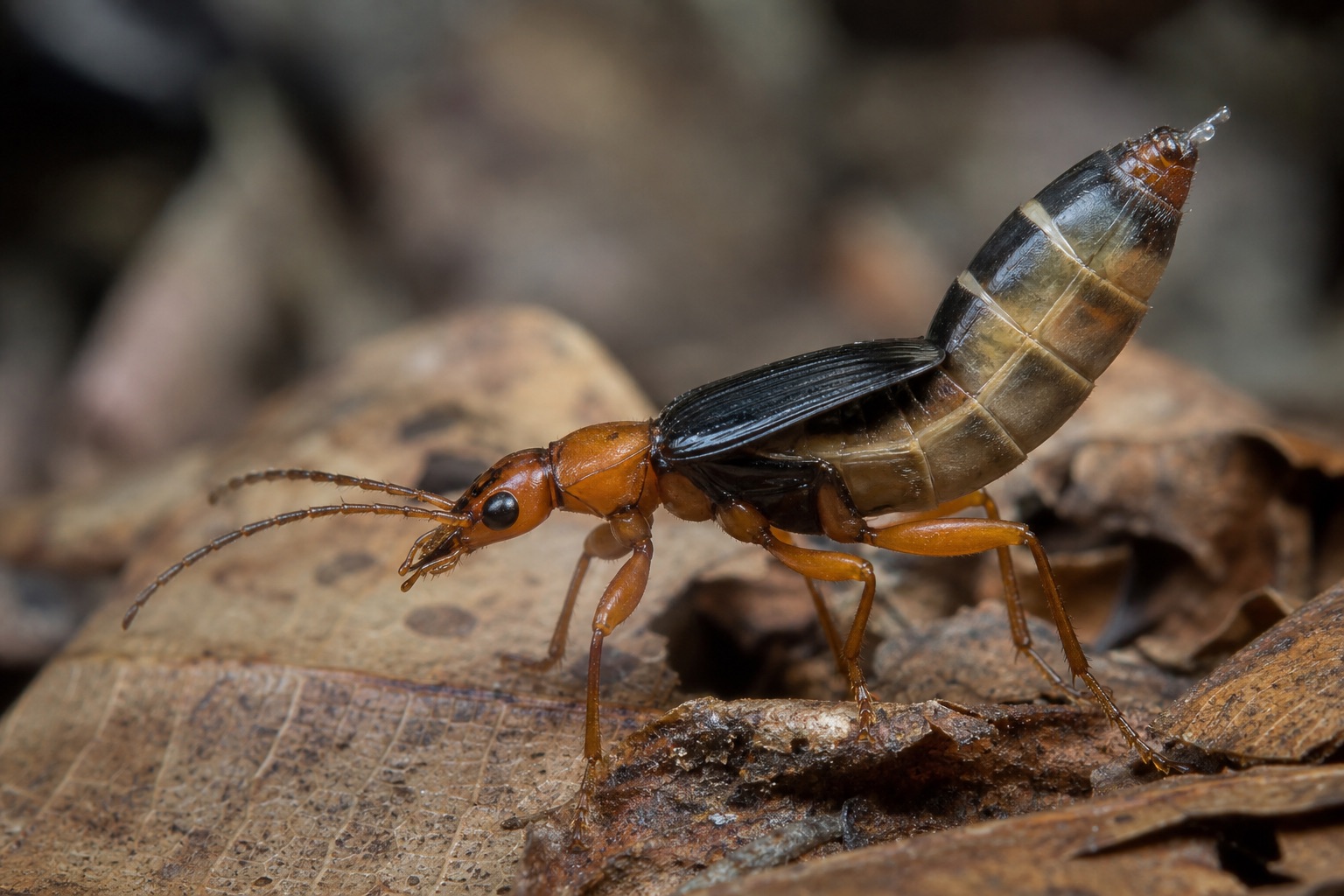
AI-generated educational wildlife portrait — World Animal Rescue Network · AI visualisation, not a photograph
In brief
Bombardier beetles (Brachinus and related carabids) spray predators with a hot, irritating benzoquinone jet produced by an instantaneous chemical reaction in a specialised abdominal chamber, reaching temperatures near 100 °C; they are ground beetles found worldwide and mostly unassessed on the IUCN Red List.
Also in Animals A to Z · Animals that start with B
By WARN Research & Conservation Team Last updated
Bombardier beetles defend themselves with one of the most extreme chemical weapons in the animal kingdom. When threatened, they discharge a pulsed jet from the abdomen tip by mixing hydroquinone and hydrogen peroxide in a reaction chamber, catalysed by enzymes to produce benzoquinone and enough heat to bring the spray close to 100 °C. The pulse can be aimed with surprising accuracy. The mechanism is not metaphorical boiling — high-speed video and thermography confirm a hot, noxious spray that deters frogs, ants and other predators. Brachinus is the best-known genus in Europe and North America; hundreds of carabid species share variants of the apparatus. Creationist misuse of bombardier beetles as 'too complex to evolve' makes accurate biology particularly worth publishing.
~100 °C
Temperature of the spray at discharge (studied species)
Pulsed
Jet delivered in rapid bursts, not a single squirt
Carabidae
Ground beetle family — most species are predators
Aimed
Abdominal tip can be directed toward the attacker
Figures sourced from Eisner et al. — bombardier beetle spray chemistry and temperature, Animal Diversity Web — Brachinus, Natural History Museum — Bombardier beetle .
Bombardier Beetle: Quick Facts
| Size | Roughly 5–15 mm depending on species |
|---|---|
| Defence | Hot benzoquinone spray near 100 °C |
| Diet | Predatory — small invertebrates |
| Habitat | Moist ground, stream edges, leaf litter |
| Family | Carabidae — ground beetles |
| IUCN status | Not Evaluated for most species |
Scientific Classification
| Kingdom | Animalia |
|---|---|
| Phylum | Arthropoda |
| Class | Insecta |
| Order | Coleoptera |
| Family | Carabidae |
| Genus | Brachinus (principal genus; others share the mechanism) |
| Species | Multiple species worldwide — e.g. Brachinus crepitans in Europe |
Conservation Status
- IUCN Status
- Not Evaluated
- Population
- Not applicable at genus level
- Trend
- Unknown; carabid communities decline with wetland loss and pesticides
- Assessed
- Most species not assessed
- CITES
- Not listed
Ground beetles are useful habitat indicators. Bombardier beetles share pressures with other carabids rather than facing species-specific trade or persecution.
Did you know?
The beetle fires its spray in audible pulses — a rapid series of chemical explosions at the abdomen tip, each hot enough to make a frog drop it instantly.
Key Facts: Bombardier Beetle
- Bombardier beetles mix hydroquinone and hydrogen peroxide with catalytic enzymes to produce a hot benzoquinone spray at the abdomen tip.
- The reaction chamber and valve system delivers pulsed jets that can be aimed at predators.
- Measured discharge temperatures approach 100 °C in studied Brachinus species — hot enough to hurt and chemically irritating.
- Adult bombardier beetles are predatory ground beetles, often found near water or in moist habitats.
- The apparatus varies across carabid lineages; not all ground beetles are bombardiers, but many share modified abdominal glands.
- Most species lack individual IUCN assessments; they are widespread but locally affected by wetland drainage and pesticide use.
How the reaction chamber works
Two compartments store precursor chemicals — hydroquinones and hydrogen peroxide — separately until a predator triggers discharge. On firing, they enter a thick-walled reaction chamber lined with catalytic enzymes including catalase and peroxidase. The mixture reaches high temperature and pressure within milliseconds; a valve at the abdomen tip opens and closes rapidly, producing the audible pops and pulsed jet.
The spray contains oxidised benzoquinones that burn mucous membranes and skin of small predators. Frogs that attempt to eat bombardier beetles often reject them violently. The system is refined enough that the beetle itself is protected by the chamber walls and directional aim away from its own body.
Predatory beetles, not just chemical tanks
Bombardier beetles are carabids — ground beetles — and most are active hunters of small invertebrates. Brachinus species often live near water margins and run quickly when disturbed. By day they hide under stones and leaf litter; the chemical defence is a last resort when pursuit fails.
Life cycles are typical for beetles: eggs, predatory larvae, pupation in soil, and short-lived adults. Larvae also have glands in some lineages, though the most famous spray belongs to adults. The beetle's ecological role is predation on other small arthropods as much as defence chemistry.
Evolution of a contested system
The bombardier apparatus has been misused in arguments that complex organs cannot evolve gradually. Comparative anatomy across Carabidae shows intermediate stages — species with partial separation of precursors and weaker reactions — which is exactly what evolutionary biology predicts. The full system is a refinement, not a single-step invention.
For field naturalists the point is simpler: if a small dark beetle near a stream pops and smells sharply when picked up, it is likely a bombardier. Wash hands afterwards; the spray irritates human skin and eyes.
Status and habitat
No global IUCN assessment covers 'bombardier beetles' as a group; individual Brachinus species are generally widespread and not assessed. Local losses follow wetland drainage, riparian development and broad insecticide use that hits ground-beetle communities broadly.
Because carabids are sensitive indicators of habitat quality, declines in bombardier beetles on a stream margin often signal wider invertebrate loss before charismatic species are affected.
What WARN Does
WARN publishes free, sourced education that separates accurate biology from myth — including misuse of bombardier beetles in anti-evolution arguments. The spray is real, measured and explainable; the conservation story is the wider loss of moist ground-beetle habitat.
If this guide helps you understand wildlife and the pressures it faces, a gift to WARN supports habitat protection and free public education in our partner countries.
Bombardier Beetle: Frequently Asked Questions
What do bombardier beetles eat?
Where do bombardier beetles live?
Are bombardier beetles dangerous to humans?
How long do bombardier beetles live?
How big are bombardier beetles?
How hot is the bombardier beetle spray?
Are bombardier beetles endangered?
Sources & References
Population figures, conservation status and biological facts on this page are drawn from authoritative scientific and intergovernmental sources.
Terms used on this page
Plain-English definitions, from our wildlife and conservation glossary.
Explore more animals
Discover more animals, their habitats and their conservation status in the WARN wildlife-guide library.
Enjoyed this Bombardier Beetle guide?
Receive appeal updates, animal-welfare news and published funding reports. Unsubscribe any time.
We only use your address for WARN updates. See our privacy policy.