Wildlife Guide · Deep waters off south-eastern Australia and Tasmania & New Zealand
Blobfish
Psychrolutes marcidus (McCulloch, 1926) — family Psychrolutidae
The famous photograph is not what a blobfish looks like. It is what one looks like after being killed.
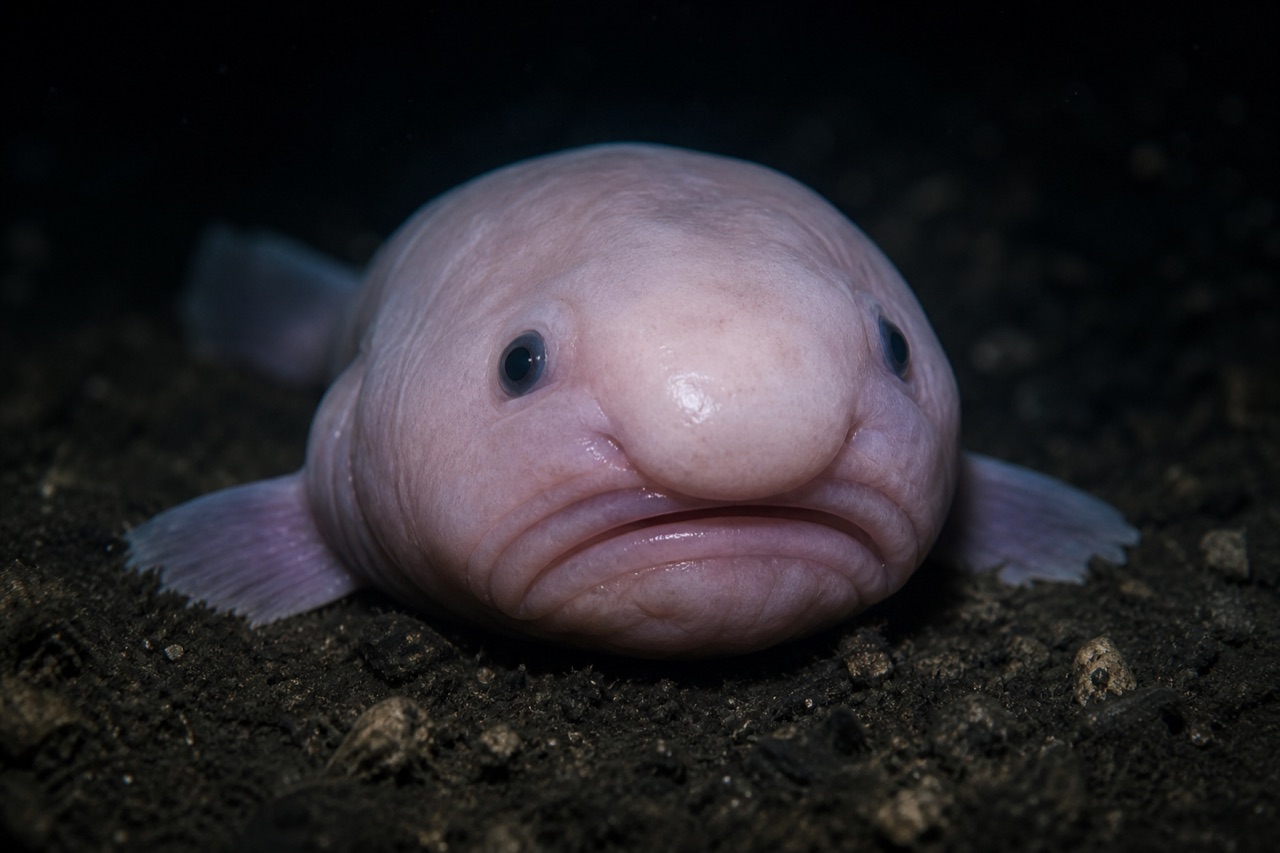
AI-generated educational wildlife portrait — World Animal Rescue Network · AI visualisation, not a photograph
In brief
The blobfish (Psychrolutes marcidus) is a deep-sea fish living 600–1,200 m down off Australia and New Zealand; it looks like a normal pinkish sculpin at that depth, and the famous droopy appearance is decompression damage that occurs only when a specimen is hauled to the surface.
Also in Animals A to Z · Animals that start with B
By WARN Research & Conservation Team Last updated
The blobfish is best known as the internet's ugliest animal, and that reputation rests entirely on a photograph of a dead, decompressed specimen. In its own habitat — 600 to 1,200 metres down, under pressure roughly 60 to 120 times that at the surface — a blobfish is an ordinary-looking deep-sea sculpin: pinkish, tadpole-shaped, with large eyes and a firm body. What happens in the photograph is physics. The blobfish has almost no skeleton and gelatinous, low-density flesh, which lets it hover just above the seabed without a swim bladder — and swim bladders are useless at that depth. Bring the animal to the surface and the pressure holding that soft tissue in shape disappears. The face collapses. The animal in the picture is not ugly; it is decompressed, and it is dead.
600–1,200 m
Depth range — pressure 60 to 120 times that at the surface
~30 cm
Maximum length
0
Swim bladders — useless at this depth, so buoyancy comes from low-density flesh
2003
Year 'Mr Blobby', the specimen in the famous photograph, was trawled up
Figures sourced from Australian Museum — Blobfish, Psychrolutes marcidus, FishBase — Psychrolutes marcidus, NIWA — NORFANZ deep-sea voyage .
Blobfish: Quick Facts
| Depth range | 600–1,200 m |
|---|---|
| Maximum length | About 30 cm |
| Swim bladder | None — buoyancy comes from low-density gelatinous flesh |
| Diet | Crustaceans, molluscs, sea urchins, sea pens and carrion |
| Feeding method | Ambush — waits on the seabed rather than pursuing prey |
| Main threat | Bycatch in deep-sea bottom trawling |
| IUCN status | Not Evaluated — no assessment exists |
Scientific Classification
| Kingdom | Animalia |
|---|---|
| Phylum | Chordata |
| Class | Actinopterygii |
| Order | Scorpaeniformes |
| Family | Psychrolutidae |
| Genus | Psychrolutes |
| Species | Psychrolutes marcidus |
Conservation Status
- IUCN Status
- Not Evaluated
- Population
- Unknown — no survey data exists for the species
- Trend
- Unknown
- Assessed
- Never assessed
- CITES
- Not listed
Deep-sea species are expensive to survey and rarely prioritised for assessment. The documented pressure on the blobfish is bottom-trawl bycatch on continental slopes fished for orange roughy and grenadier, which also destroys the cold-water coral and sponge habitat structures on the seabed.
Did you know?
The specimen in the world's most famous blobfish photograph has a name. 'Mr Blobby' was trawled up during the 2003 NORFANZ research voyage off New Zealand and is preserved at the Australian Museum in Sydney — one dead fish is responsible for how an entire species is pictured.
Key Facts: Blobfish
- A living blobfish does not look like the famous photograph. At depth it is a pinkish, tadpole-shaped sculpin with a firm body and large eyes.
- The droopy face is decompression damage. Removing the animal from 60–120 atmospheres of pressure causes its low-density tissue to lose shape.
- It has almost no skeleton and gelatinous flesh slightly less dense than seawater, which lets it hover above the seabed without expending energy.
- Deep-sea fish cannot use swim bladders — gas-filled organs fail under that pressure — so the blobfish solved buoyancy with body composition instead.
- The specimen in the photograph, nicknamed 'Mr Blobby', was caught during the 2003 NORFANZ research voyage off New Zealand and is held by the Australian Museum.
- It was voted the World's Ugliest Animal in 2013 by the Ugly Animal Preservation Society — a campaign specifically about conservation attention going to charismatic species.
- The blobfish has not been assessed by the IUCN. The main known pressure on it is bycatch in deep-sea bottom trawling, which it has no way of avoiding.
What does a blobfish actually look like?
At its natural depth, a blobfish looks like what it is: a fathead sculpin. The body is pinkish to pale grey, tapering from a broad head to a narrow tail, with large dark eyes, a wide mouth and pectoral fins held out to the sides. It sits on or hovers just above the seabed. Nothing about it is remarkable, and nothing about it droops.
Almost every photograph in circulation shows something else. Deep-sea fish are usually documented by trawl, and a blobfish brought up from 1,000 metres has undergone a pressure change of roughly 100 atmospheres in minutes. Its tissue is adapted to hold shape under that load and has no structural strength without it — there is barely any skeleton, and the muscle is gelatinous. On deck, the animal slumps. Submersible and ROV footage of living blobfish and close relatives shows normal-looking fish, which is why the correction matters: the ugliness is an artefact of how the specimen was collected.
How does a blobfish survive at 1,200 metres?
By giving up almost everything that makes a fish rigid. Most bony fish control buoyancy with a swim bladder, a gas-filled organ they inflate and deflate. That does not work in the deep sea: at 100 atmospheres the gas is compressed to a fraction of its volume and the energy cost of maintaining it becomes prohibitive. The blobfish has none.
Instead its flesh is a gelatinous mass with density slightly below that of seawater, so the animal is close to neutrally buoyant simply by being made of what it is made of. It can hold position above the seabed without swimming. Bone and muscle are reduced to the minimum, since neither is needed to fight gravity and both are metabolically expensive in an environment with very little food. The result is an animal that spends almost no energy existing — a reasonable strategy where meals are rare and unpredictable, and one that only works because the surrounding pressure does the structural work.
What does a blobfish eat?
Whatever passes within reach. The blobfish is an ambush feeder that sits on the bottom with its mouth open and takes crustaceans, molluscs, sea urchins, sea pens and carrion drifting down from above. It does not chase prey — pursuit costs energy that a low-metabolism animal in a food-poor environment cannot spare.
This is the standard deep-sea strategy, and it explains the body plan. Large mouth, minimal musculature, no pursuit capability, near-neutral buoyancy: the blobfish is built to wait. The trade-off is that it also cannot avoid anything, which is why bottom trawling is such an effective way of removing it.
Is the blobfish endangered?
Nobody knows, and that is the honest answer. The IUCN has not assessed Psychrolutes marcidus, and there is no population estimate for it. Deep-sea species are expensive to survey and rarely prioritised, so a great many of them sit in the same position: no data, no assessment, no status.
The pressure that is documented is bycatch. Blobfish live on continental slopes that are trawled for orange roughy, grenadier and other deep-water commercial species, and a bottom trawl takes everything on the seabed regardless of target. A slow-growing, low-fecundity, sedentary animal has no defence against that and no capacity to repopulate quickly afterwards. Deep-sea bottom trawling also destroys the seabed habitat itself — cold-water coral and sponge structures that take centuries to form. The blobfish's real conservation story is not about the blobfish; it is that an entire class of habitat is being removed before the species living in it have been described.
Why the 'world's ugliest animal' vote actually mattered
In 2013 the Ugly Animal Preservation Society ran a public vote for a mascot, and the blobfish won with around 10,000 votes. The campaign was a joke with a serious argument underneath it: conservation funding and public attention flow overwhelmingly to large, appealing vertebrates, and species that are small, strange-looking or unglamorous get neither, regardless of how threatened they are.
The blobfish proved the point twice over. It became globally famous, and it became famous on the basis of a photograph that misrepresents it — attention without accuracy, which is close to worthless for the animal. The species most in need of protection are frequently the ones nobody has heard of: amphibians, freshwater molluscs, deep-sea fish and invertebrates, which between them account for the overwhelming majority of animal species and a small fraction of conservation spending.
What WARN Does
WARN publishes free, sourced species education, including for animals that attract attention for the wrong reasons. The blobfish is the clearest example on this site: it is one of the most recognised fish in the world, almost every image of it is misleading, and it has never been formally assessed for extinction risk. Correcting a widely repeated error is worth as much as adding a new fact.
If this guide helps you understand wildlife and the pressures it faces, a gift to WARN supports habitat protection and free public education in our partner countries.
Blobfish: Frequently Asked Questions
What does a blobfish really look like?
Why does the blobfish look like that in photos?
How deep do blobfish live?
Is the blobfish endangered?
What do blobfish eat?
Where do blobfish live?
How big is a blobfish?
Are smooth-head blobfish dangerous?
How long do smooth-head blobfish live?
Sources & References
Population figures, conservation status and biological facts on this page are drawn from authoritative scientific and intergovernmental sources.
Terms used on this page
Plain-English definitions, from our wildlife and conservation glossary.
Explore more animals
Discover more animals, their habitats and their conservation status in the WARN wildlife-guide library.
Enjoyed this Blobfish guide?
Receive appeal updates, animal-welfare news and published funding reports. Unsubscribe any time.
We only use your address for WARN updates. See our privacy policy.