Wildlife Guide · Arid and semi-arid central and western Australia & Reintroduced populations in fenced sanctuaries
Bilby
Macrotis lagotis (Reid, 1837) — family Thylacomyidae
Australia's Easter Bilby — a rabbit-eared marsupial that burrows through the desert while the real rabbits eat it out of house and home.
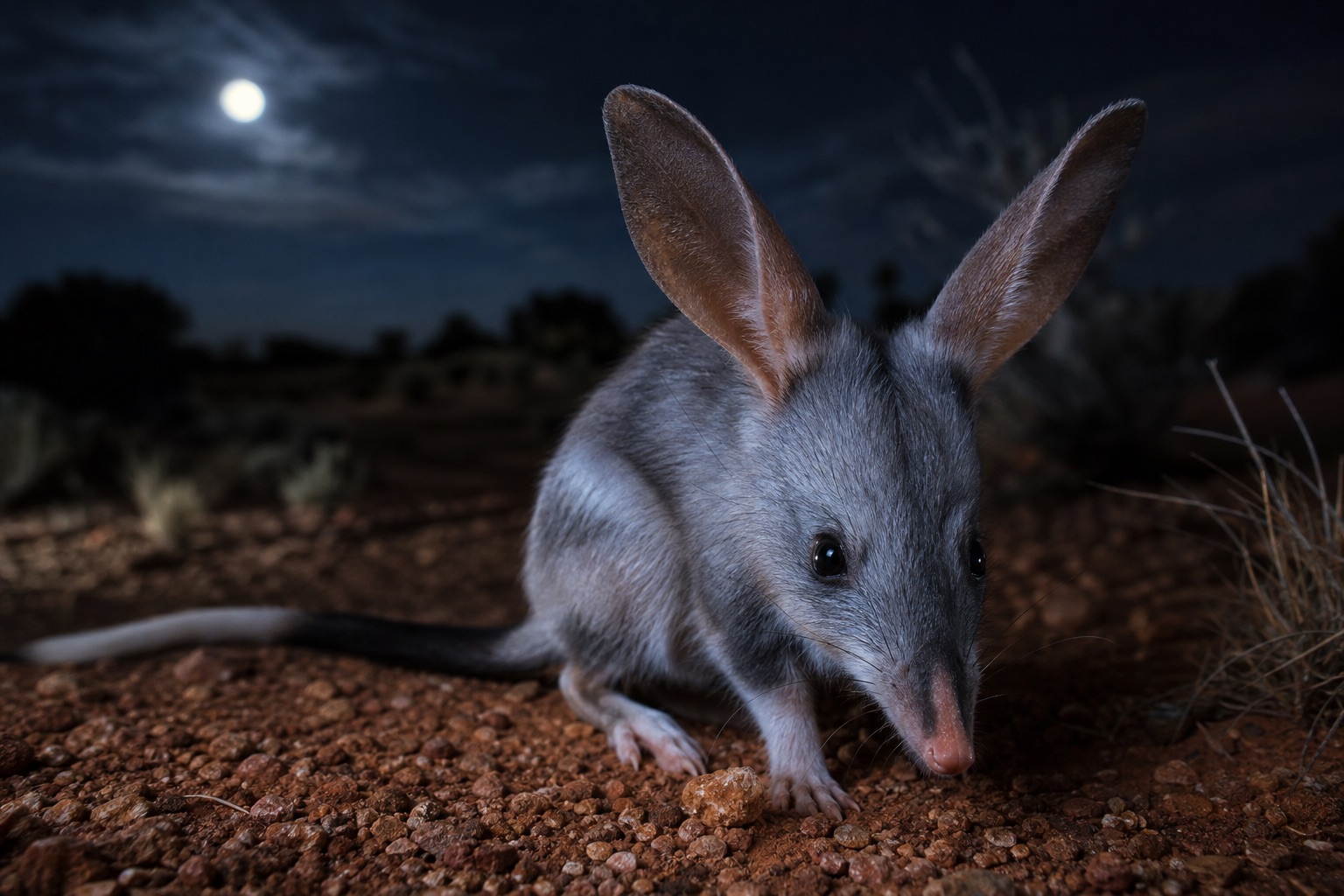
AI-generated educational wildlife portrait — World Animal Rescue Network · AI visualisation, not a photograph
In brief
The greater bilby (Macrotis lagotis) is a Vulnerable, nocturnal, burrowing marsupial of arid Australia with long ears and silky fur; fewer than 10,000 mature individuals remain after foxes, cats and habitat loss removed it from most of its former range across the mainland.
Also in Animals A to Z · Animals that start with B
How you can help
You can support the related appeal — read its purpose, recipient status and fund terms first — or give once to where it is needed most. Sharing accurate information helps too.
By WARN Research & Conservation Team Last updated
The greater bilby is a nocturnal, burrowing marsupial of Australia's arid interior — about the size of a rabbit, but a bandicoot relative with a long pointed snout, huge pink ears and silky blue-grey fur. Before European settlement it occurred across more than 70% of the mainland. Today it survives in scattered populations in the Northern Territory, Western Australia and Queensland, with an estimated fewer than 10,000 mature individuals and a range reduced to roughly 20% of what it once was. Bilbies are ecosystem engineers. Their spiralling burrows — up to about 3 m long and 2 m deep — aerate soil, trap seeds and provide shelter for other species. They eat bulbs, seeds, fungi, insects and small animals, turning over soil as they forage. The lesser bilby, Macrotis leucura, is extinct, lost by the 1950s; the greater bilby is what Australians now mean by 'bilby'. Since the 1990s chocolate bilbies have replaced Easter bunnies in many Australian shops, with part of the proceeds funding conservation — a rare case where a marketing campaign directly supports a threatened native species. The animal behind the chocolate is still Vulnerable, predated by foxes and cats, competing with rabbits and cattle, and losing ground to changed fire regimes and land clearing.
<10,000
Estimated mature individuals
~20%
Of the bilby's former range still occupied
3 m
Typical burrow length — spiralling underground
Easter Bilby
Chocolate campaigns fund conservation since the 1990s
Figures sourced from IUCN Red List — Macrotis lagotis, Australian Government — greater bilby conservation advice, Australian Government — Recovery Plan for Greater Bilby (2023) .
Bilby: Quick Facts
| Head and body length | About 29–55 cm |
|---|---|
| Weight | Up to about 2.5 kg (males); about 1.1 kg (females) |
| Diet | Omnivorous — seeds, bulbs, fungi, insects |
| Activity | Nocturnal |
| Lifespan | About seven years in the wild |
| Burrows | Up to about 3 m long and 2 m deep |
| Main threats | Foxes, feral cats, rabbits, fire and land clearing |
Scientific Classification
| Kingdom | Animalia |
|---|---|
| Phylum | Chordata |
| Class | Mammalia |
| Order | Peramelemorphia |
| Family | Thylacomyidae |
| Genus | Macrotis |
| Species | Macrotis lagotis |
Conservation Status
- IUCN Status
- Vulnerable
- Population
- Fewer than 10,000 mature individuals
- Trend
- Decreasing
- Assessed
- 2016
- CITES
- Appendix I
Range reduced to roughly 20% of pre-settlement extent. Feral-free fenced exclosures and predator control underpin recovery; the lesser bilby is extinct.
Did you know?
A single bilby may maintain a dozen burrows at once and dig a new one roughly every two and a half weeks — underground engineering on a schedule.
Key Facts: Bilby
- The greater bilby is a Vulnerable marsupial with fewer than 10,000 mature individuals estimated on the IUCN Red List.
- Its range has contracted to roughly 20% of the area it occupied before European settlement.
- Bilbies dig extensive burrow systems that aerate soil and shelter other desert species.
- Foxes and feral cats are the primary predators; rabbits and livestock compete for food and degrade habitat.
- The lesser bilby (Macrotis leucura) is extinct; only the greater bilby survives.
- Easter Bilby chocolate campaigns have raised public awareness and conservation funds since the 1990s.
- Feral-free fenced exclosures are central to current recovery and reintroduction programmes.
A rabbit look-alike that is nothing of the sort
European settlers called bilbies 'rabbit-eared bandicoots' because of the ears and burrowing habit. Taxonomically they are peramelemorphs — bandicoot relatives — with a backward-opening pouch, syndactylous hind feet and a dental formula suited to omnivory rather than grazing. The resemblance to rabbits is convergent: large ears radiate heat in desert conditions, powerful forelimbs dig burrows, and nocturnal habits avoid daytime heat and predators.
Males reach up to about 2.5 kg and roughly 55 cm head-to-tail; females are smaller, typically up to about 1.1 kg. The tail is crested, grey near the body and black with a white tip. Strong claws on the forefeet excavate burrows in hours; a single bilby may maintain up to a dozen active burrows within a home range, rotating between them and digging a new burrow on average every few weeks.
The Easter Bilby campaign
Rabbits are among the bilby's problems — introduced European rabbits compete for food, degrade vegetation and support fox populations that prey on bilbies. Replacing the Easter Bunny with the Easter Bilby was a deliberate attempt to redirect a cultural symbol towards a native animal that needs help rather than an invasive one that causes damage.
Darrell Lea, Haigh's Chocolates and other Australian makers sell chocolate bilbies, often with a portion of proceeds supporting bilby conservation programmes. The campaign dates from the early 1990s and has raised both funds and public recognition. It does not substitute for field conservation — fox and cat control, fenced sanctuaries and reintroduction remain essential — but it keeps a threatened desert marsupial in public view in a way that dry population statistics do not.
Burrows, diet and desert ecology
Bilbies emerge after dark to forage across spinifex grasslands, mulga scrub and dune fields. Diet is omnivorous: seeds, bulbs, fungi, insects and small vertebrates, dug from the soil with the pointed snout and foreclaws. That turnover benefits seed burial and nutrient cycling — bilbies are functional equivalents of rabbits in arid ecosystems, except that rabbits now outcompete them across much of the former range.
Burrows serve as temperature refuges and predator escape routes — multiple exits are common. Females leave young in the burrow while foraging; pouch life lasts about 75–80 days, followed by a further period of maternal care underground. Breeding can occur year-round when conditions allow, with litters of one to three, though one or two is typical.
What recovery requires
Bilby conservation rests on predator management and safe habitat. Feral-free fenced exclosures — at sites including Currawinya National Park in Queensland and Australian Wildlife Conservancy sanctuaries — hold insurance populations and source animals for reintroduction. Outside fences, fox and cat baiting, rabbit control and appropriate fire management are the main tools.
The species is listed on CITES Appendix I, reflecting past trade concerns. Indigenous rangers across central Australia monitor bilby populations and manage country using traditional burning practices that maintain the mosaic habitat bilbies need. Without sustained predator control, reintroduced bilbies disappear quickly — which is why fenced exclosures and intensive management remain non-negotiable parts of the recovery plan published in 2023.
What WARN Does
WARN publishes free, sourced species education for threatened mammals that compete with invasive species for public attention. The bilby loses ground to rabbits literally and figuratively — accurate guides help redirect that attention towards the native animal.
If this guide helps you understand wildlife and the pressures it faces, a gift to WARN supports habitat protection and free public education in our partner countries.
How can I help save the bilby?
Explore practical ways to support the bilby, from everyday choices and sharing reliable information to reviewing a related appeal before giving.
Explore ways to support
Read the related appeal’s purpose, recipient status and fund terms. Choose an affordable gift after checking what is proposed and what has been reported.
Ease the pressures
Avoid the wildlife trade and souvenirs, never buy wild animals as pets, and choose sustainable, habitat-friendly products — the threats behind the bilby's decline fall when demand does.
Spread the word
Share accurate, sourced information about the bilby. Wider awareness is what turns concern into lasting protection.
Bilby: Frequently Asked Questions
How can I help save the bilby?
What do bilbies eat?
Where do bilbies live?
Are bilbies dangerous?
How long do bilbies live?
How big is a bilby?
Why is the bilby associated with Easter in Australia?
Are bilbies endangered?
Sources & References
Population figures, conservation status and biological facts on this page are drawn from authoritative scientific and intergovernmental sources.
Terms used on this page
Plain-English definitions, from our wildlife and conservation glossary.
Explore more animals
Discover more animals, their habitats and their conservation status in the WARN wildlife-guide library.
Enjoyed this Bilby guide?
Receive appeal updates, animal-welfare news and published funding reports. Unsubscribe any time.
We only use your address for WARN updates. See our privacy policy.