Wildlife Guide · Every habitat on Earth except the open ocean & From arctic tundra to tropical rainforest canopies and desert dunes
Beetle
Order Coleoptera — more than 400,000 described species; roughly one in four of all known animals
One in four known animal species wears hardened wing-cases — and that is a low estimate.
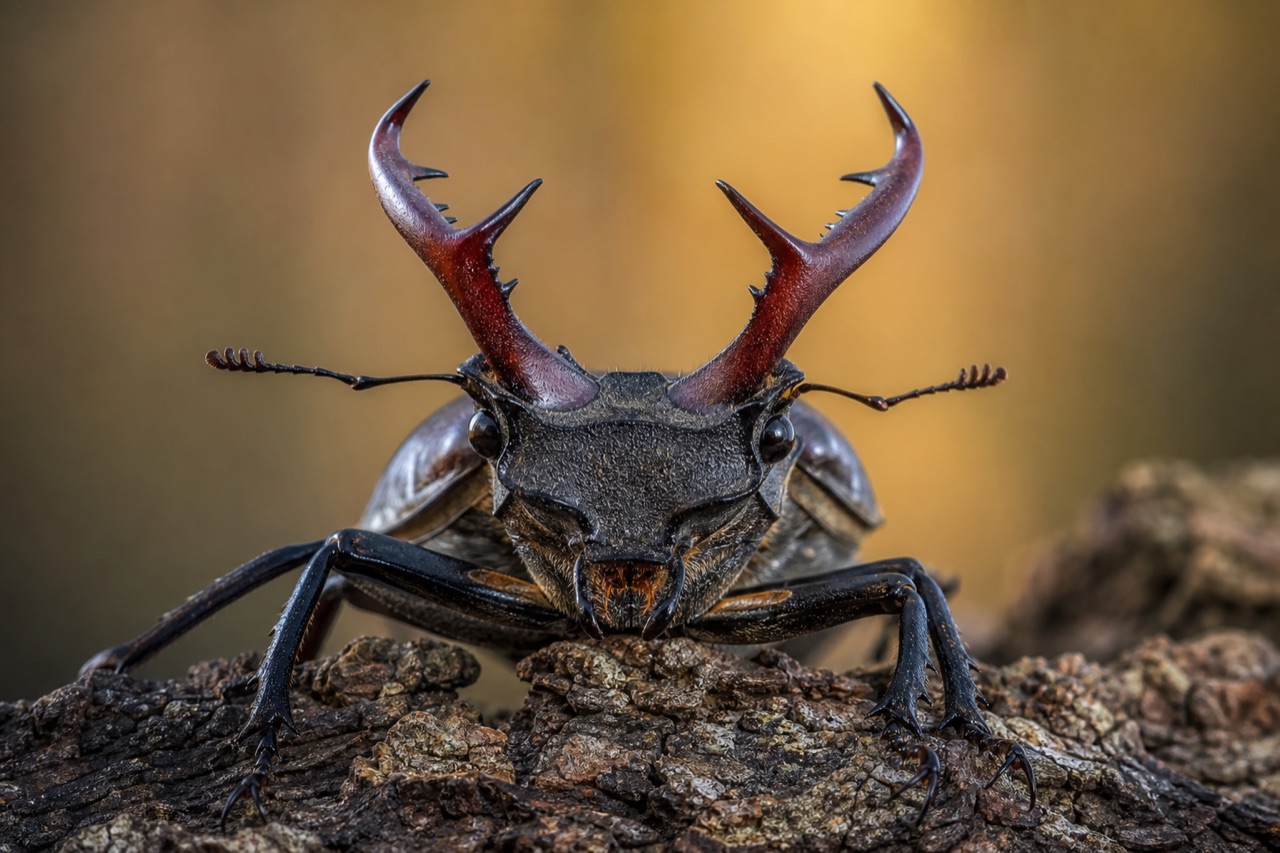
AI-generated educational wildlife portrait — World Animal Rescue Network · AI visualisation, not a photograph
In brief
Beetles (order Coleoptera) are the most species-rich animal order — more than 400,000 described species with hardened forewings (elytra) and complete metamorphosis — filling roles from pollinator and pest controller to forest pest and decomposer.
Also in Animals A to Z · Animals that start with B
By WARN Research & Conservation Team Last updated
Beetles are the largest order of living things. More than 400,000 species are described, and estimates of the true total run into the millions when tropical diversity is fully sampled. The name Coleoptera means 'sheath-winged': the front pair of wings hardened into elytra that protect the delicate hind wings folded beneath. That armoured body plan let beetles occupy nearly every terrestrial and freshwater niche — herbivore, predator, scavenger, fungivore, parasite and pollinator. Beetles shaped human history in quiet ways. Dung beetles recycle livestock waste and reduce pasture parasites. Ladybirds control aphids in gardens and fields. Bark beetles kill stressed trees and, in outbreak years, reshape forests. Pollinator beetles visit flowers that evolved before bees dominated daytime pollination. The Colorado potato beetle became a textbook case of pesticide resistance. The emerald ash borer has killed hundreds of millions of ash trees in North America since its accidental introduction. This page treats beetles as an order — the group overview — not any single species. Individual families range from stag beetles and fireflies to weevils with more species than all vertebrates combined. What unites them is the elytra, chewing mouthparts and complete metamorphosis: egg, larva, pupa, adult. The larval stage is often where the ecological work happens — a grub in wood, a maggot-like predator in soil, a caddis-like water beetle larva in a stream.
400,000+
Described species — about a quarter of all known animals
Elytra
Hardened forewings protecting the flight wings beneath
Complete
Metamorphosis — egg, larva, pupa, adult
Everywhere
All terrestrial and freshwater habitats; not marine
Figures sourced from IUCN Red List, Catalogue of Life — Coleoptera .
Beetle: Quick Facts
| Described species | 400,000+ |
|---|---|
| Defining feature | Elytra — hardened forewings |
| Metamorphosis | Complete — larva and adult often differ sharply |
| Habitats | All terrestrial and freshwater; none truly marine |
| Notable families | Scarabaeidae, Carabidae, Lampyridae, Curculionidae |
| Main threats | Habitat loss, pesticides, invasive species, light pollution |
Scientific Classification
| Kingdom | Animalia |
|---|---|
| Phylum | Arthropoda |
| Class | Insecta |
| Order | Coleoptera |
| Major suborders | Adephaga, Polyphaga, Archostemata, Myxophaga |
| Largest family | Curculionidae (weevils) — 60,000+ species |
Conservation Status
- IUCN Status
- Varies by species — order page
- Population
- Not applicable at order level
- Trend
- Declining for many saproxylic and firefly species; insufficient data for most
- Assessed
- Assessed species-by-species; the great majority are unassessed
- CITES
- Some species listed; most beetles are not
Firefly declines and loss of dead-wood habitat for saproxylic beetles are among the best-documented pressures. Tropical diversity likely faces extinction faster than description.
Did you know?
Weevils alone contain more described species than all mammals, birds, reptiles and amphibians combined — and new weevil species are still being found in tropical leaf litter.
Key Facts: Beetle
- Beetles are the most diverse order of animals — roughly one in four described species is a beetle.
- Elytra (hardened forewings) are the defining feature; hind wings fold under them for flight.
- Larval beetles often live in different habitats and eat different food from the adults — grubs in wood, soil or water.
- Many beetles are beneficial decomposers and pest controllers; others are serious forestry and agriculture pests.
- Fireflies are beetles; their bioluminescent courtship is declining where light pollution and habitat loss intersect.
- Tropical forests hold most undescribed beetle diversity — extinction may outpace naming.
Why there are so many beetles
Several features explain coleopteran dominance. Elytra protect wings and body when beetles push through soil, bark and leaf litter — environments that would damage softer insects. Chewing mouthparts handle food from pollen to wood to other insects without the specialisation limits of sucking mouthparts. Complete metamorphosis lets larvae and adults partition resources: a leaf-eating grub and a nectar-feeding adult do not compete directly.
Small size helps. Many beetles are a few millimetres long, allowing thousands of species to coexist in one forest by specialising on different microhabitats, host plants or fungi. Weevils (Curculionidae) alone contain more than 60,000 described species — the largest animal family — with snouts adapted for drilling into seeds, stems and nuts. Speciation in beetles often tracks plant diversification, producing tight host associations in herbivorous lineages.
The fossil record extends to the Permian. Beetles survived mass extinctions that removed other groups and radiated into niches opened by flowering plants in the Cretaceous. That deep history means modern beetle communities are both ancient and finely partitioned — which is why invasive beetles can be catastrophic: they enter food webs that have no evolved defence against them.
Beetles that run ecosystems
Dung beetles (Scarabaeidae and allies) bury and consume animal dung, returning nutrients to soil, reducing fly breeding sites and improving pasture. In Australia, introduced dung beetles were deliberately released to process cattle dung that native scarabs could not handle efficiently — one of the clearer successes in classical biological control. Without dung beetles, pastoral landscapes would be literally buried in waste.
Ground beetles (Carabidae) are nocturnal predators on the soil surface — fast runners with powerful jaws that consume slugs, caterpillars and other invertebrates. Rove beetles (Staphylinidae) are even more species-rich, living in leaf litter, carrion and ant nests. Carrion beetles (Silphidae) bury small dead animals and prepare them as food for their larvae, competing with flies in a race to decompose.
Pollination by beetles — cantharophily — is ancient. Magnolias, some water lilies and many tropical flowers produce strong scents and bowl-shaped blooms suited to beetle visitors that chew pollen rather than delicately collecting it. Beetle pollination is less economically prominent than bee pollination today but remains ecologically significant in many tropical and temperate plant lineages.
Beetles as pests and invaders
The same adaptability that makes beetles successful also makes some species destructive. Bark and wood-boring beetles — scolytines and longhorns — attack stressed or dead trees; in outbreak conditions they kill living forest at scale. Mountain pine beetle outbreaks linked to warmer winters have killed vast areas of North American conifer forest. Emerald ash borer, an Asian wood-borer, has eliminated ash as a viable street and forest tree across much of eastern North America since its introduction in the 1990s.
Agricultural pests include the Colorado potato beetle, western corn rootworm and numerous weevils that attack stored grain. Resistance evolution to insecticides is documented repeatedly in these species because generation times are short and population sizes large. Stored-product beetles infest grain silos worldwide, causing post-harvest losses that rival field pests.
Invasive beetles travel in timber, packaging and plants. Biosecurity — heat treatment of pallets, inspection of nursery stock, early detection trapping — is the front line. Once established, few invasive wood-borers are eradicated; management shifts to slowing spread and breeding resistant tree varieties.
Fireflies, stag beetles and the beetles people notice
Fireflies (Lampyridae) are beetles whose larvae glow as warning signals and whose adults use species-specific flash patterns for courtship. Light pollution disrupts those signals — males cannot find females, females cannot assess males — and habitat loss removes the moist leaf litter where larvae spend one to two years feeding on snails and worms. Firefly declines are reported across Europe, North America and Asia and are one of the more visible faces of insect loss.
Stag beetles (Lucanidae) are among the largest European beetles; males contest with mandibles that are display structures rather than efficient weapons. Dead wood in old parks and orchards is essential larval habitat, and tidying culture that removes every rotting stump contributes to their scarcity in intensively managed landscapes. Rhinoceros beetles and Goliath beetles fill similar cultural niches in the tropics — charismatic megafauna of the insect world.
Conservation for beetles is habitat conservation: dead wood, undisturbed soil, dung on pasture, native plants for specialists, and dark skies for fireflies. The order is too large for single-species thinking at this page level, but the principles repeat — specialists need their substrate left alone, and generalists need fewer broad-spectrum pesticides.
Beetles in agriculture and forestry economics
The economic story of beetles cuts both ways. Pollinator beetles and dung beetles provide services worth billions when aggregated globally — pasture productivity, soil structure, pest suppression. Conversely, bark beetles, rootworms and grain weevils cost forestry and agriculture comparable sums in lost yield, control chemicals and tree replacement.
Integrated pest management tries to distinguish beneficial from harmful coleopterans rather than spraying indiscriminately. Predatory ground beetles in field margins reduce caterpillar loads; preserving those margins is cheaper than foliar insecticide on every hectare. In forestry, diversifying tree age and species reduces monoculture vulnerability to single bark-beetle species that explode when drought stress weakens uniform stands.
Public policy often lags behind entomological detail — beetle outbreaks trigger emergency spraying that kills non-target species and sets up the next outbreak by removing predators. Order-level literacy about beetles is therefore not academic; it is how land managers avoid expensive ecological mistakes.
What WARN Does
WARN publishes free, sourced species education for the invertebrate majority that carries ecosystems yet receives a fraction of public attention. Beetles are the largest slice of that majority — understanding them is understanding how land ecosystems actually work.
If this guide helps you understand wildlife and the pressures it faces, a gift to WARN supports habitat protection and free public education in our partner countries.
Beetle: Frequently Asked Questions
How many beetle species exist?
Are beetles insects?
Are fireflies beetles?
What are elytra?
What do beetles eat?
Where do beetles live?
Are beetles dangerous?
How long do beetles live?
How big is a beetle?
Sources & References
Population figures, conservation status and biological facts on this page are drawn from authoritative scientific and intergovernmental sources.
Terms used on this page
Plain-English definitions, from our wildlife and conservation glossary.
Explore more animals
Discover more animals, their habitats and their conservation status in the WARN wildlife-guide library.
Enjoyed this Beetle guide?
Receive appeal updates, animal-welfare news and published funding reports. Unsubscribe any time.
We only use your address for WARN updates. See our privacy policy.