Wildlife Guide · Every continent except Antarctica & Farmland, grassland, marsh edge and rough grass margins
Barn Owl
Tyto alba (Scopoli, 1769) — family Tytonidae
The most widely distributed land bird on Earth — and it hunts almost entirely by ear.
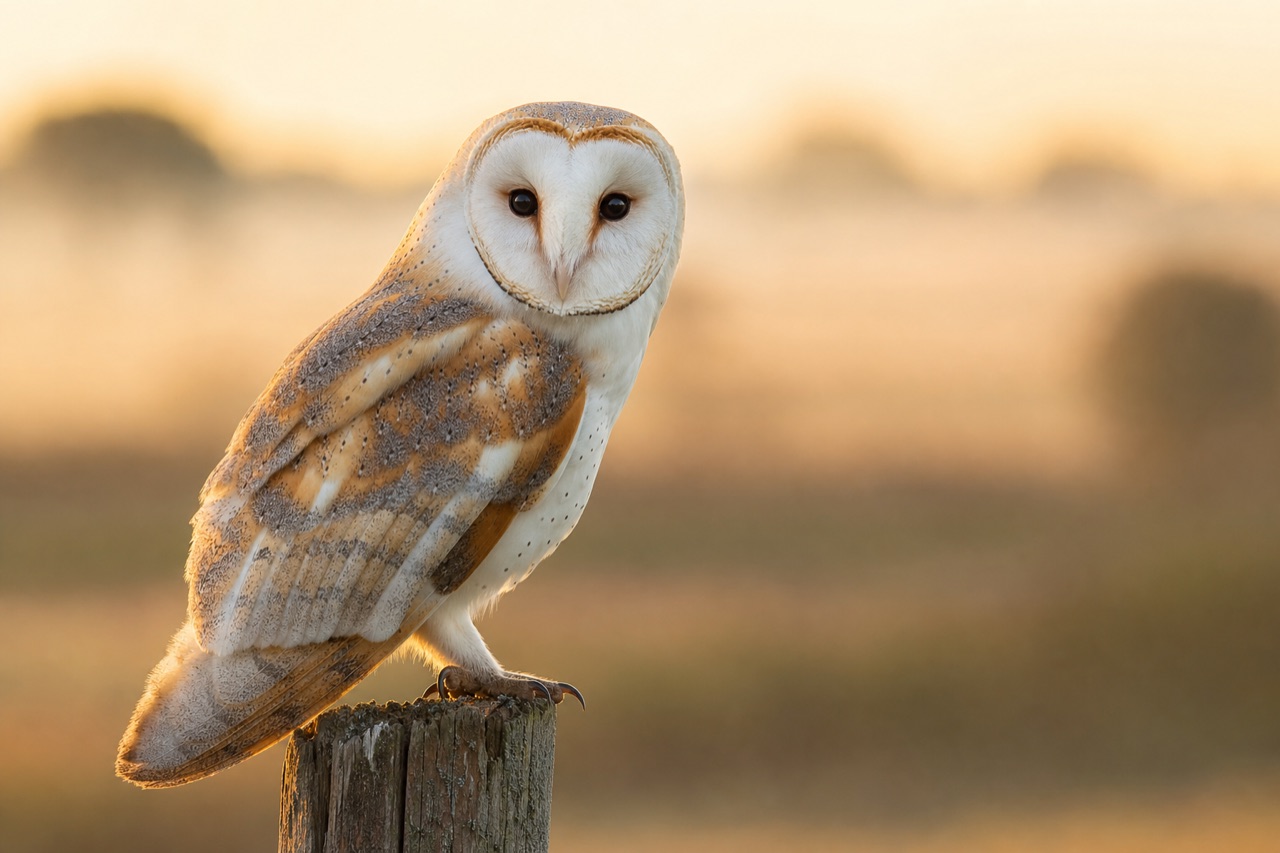
AI-generated educational wildlife portrait — World Animal Rescue Network · AI visualisation, not a photograph
In brief
The barn owl (Tyto alba) is a pale, heart-faced owl found on every continent except Antarctica; it hunts almost entirely by sound, using asymmetric ear openings and a facial disc to locate prey it cannot see, and flies almost silently.
Also in Animals A to Z · Animals that start with B
By WARN Research & Conservation Team Last updated
The barn owl is one of the most widespread land birds in the world, found on every continent except Antarctica. Pale, heart-faced and almost silent in flight, it hunts low over rough grassland at dusk, locating voles beneath vegetation and even beneath snow using hearing alone. That hunting method depends on two adaptations. Its facial disc funnels sound to ear openings set at different heights on each side of the skull, so the bird can pinpoint a sound source vertically as well as horizontally. And the comb-like leading edge of its flight feathers breaks up the air turbulence that makes wingbeats audible — silence that protects both the hunt and its own hearing.
6 continents
One of the most widespread land birds on Earth
~3,000
Small mammals a breeding pair may take in a year
Asymmetric
Ear openings set at different heights for vertical location
~4 years
Typical wild lifespan; many die in their first winter
Figures sourced from IUCN Red List — Tyto alba, CITES Appendices .
Barn Owl: Quick Facts
| Wingspan | 80–95 cm |
|---|---|
| Weight | 250–350 g |
| Hunting method | Acoustic — locates prey by sound alone |
| Main prey | Field voles, mice, shrews and rats |
| Call | Screech, not a hoot |
| Key threat | Rodenticides, loss of rough grassland, road collisions |
Scientific Classification
| Kingdom | Animalia |
|---|---|
| Phylum | Chordata |
| Class | Aves |
| Order | Strigiformes |
| Family | Tytonidae |
| Genus | Tyto |
| Species | Tyto alba |
Conservation Status
- IUCN Status
- Least Concern
- Population
- Several million globally; regional populations vary widely
- Trend
- Stable globally; declining in intensively farmed regions
- Assessed
- 2019
- CITES
- Appendix II (all Strigiformes)
A Least Concern global listing masks steep regional declines. Barn owls are covered by CITES Appendix II because all owls are listed as a group.
Did you know?
A barn owl's ears are set at different heights on its skull, so it hears in three dimensions — the vertical fix that lets it strike a vole it has never seen.
Key Facts: Barn Owl
- Barn owls locate prey by sound alone and can catch voles hidden under vegetation or snow.
- Their ear openings sit at different heights, giving vertical as well as horizontal sound location.
- Fringed flight feathers break up turbulence, making the flight almost silent.
- A breeding pair may take around 3,000 small mammals in a year — significant natural rodent control.
- The barn owl screeches; it does not hoot. The classic hoot belongs to the tawny owl.
- Second-generation rodenticides accumulate in barn owls and are a documented cause of death.
Hearing built for hunting in the dark
The barn owl's heart-shaped facial disc is a sound collector, funnelling noise towards the ear openings hidden at its edges. Crucially those openings are asymmetric — one sits higher than the other — so a sound arriving from above reaches one ear marginally before the other. The bird reads that difference as elevation, and the left-right difference as bearing, giving it a full three-dimensional fix on a rustle in the grass.
Laboratory work established that barn owls can strike prey accurately in total darkness. In the field this means a bird can take a vole moving under a layer of vegetation or snow, having never seen it at all.
Silent flight, and what it costs
Barn owl flight feathers carry a comb-like fringe on the leading edge and a soft, velvety upper surface. Together these break large air vortices into smaller ones and damp the sound of feathers sliding over one another, cutting the noise of flight to near nothing.
Silence serves twice: prey gets no warning, and the owl's own hearing is not masked by its wingbeats. The trade-off is that the soft feather structure sheds water poorly, so barn owls hunt badly in sustained rain and can be grounded by prolonged wet weather — a real cause of winter mortality.
Farmland, and why numbers fall
Barn owls need rough, tussocky grassland holding field voles, plus cavities for nesting. Modern farmland often supplies neither: grass margins are cut short or ploughed out, old barns are converted, and mature hollow trees are removed.
Second-generation anticoagulant rodenticides are the other major pressure. A poisoned rodent stays active and easy to catch for days, so it is exactly the prey an owl is most likely to take. The compounds accumulate in the liver, and post-mortem surveys in several countries have found residues in a large majority of barn owls tested. Road collisions add to it — verges are good vole habitat, so owls hunt beside fast traffic.
What actually helps a barn owl
Leave rough grass margins uncut through winter, which is where the voles are. Put up a correctly sited nest box — high, sheltered, facing away from prevailing weather, and away from major roads. Switch to trapping or first-generation compounds rather than second-generation rodenticides, and never leave poisoned carcasses accessible.
Barn owls will use a well-placed box readily, and a single pair is a substantial and free rodent-control service. The limiting factor is almost always food and nest sites together — a box in a landscape with no rough grass will stay empty.
What WARN Does
WARN publishes free, sourced species education covering the wildlife people live alongside as well as distant flagship species. Barn owls are a clear case where an everyday decision — which rodenticide to buy, whether to cut a field margin — decides whether a predator survives on that land.
If this guide helps you understand wildlife and the pressures it faces, a gift to WARN supports habitat protection and free public education in our partner countries.
Barn Owl: Frequently Asked Questions
Do barn owls hoot?
How do barn owls hunt in complete darkness?
Why is barn owl flight silent?
Are barn owls endangered?
How can I help barn owls?
What do barn owls eat?
Where do barn owls live?
Are barn owls dangerous?
How long do barn owls live?
How big is a barn owl?
Sources & References
Population figures, conservation status and biological facts on this page are drawn from authoritative scientific and intergovernmental sources.
Terms used on this page
Plain-English definitions, from our wildlife and conservation glossary.
Explore more animals
Discover more animals, their habitats and their conservation status in the WARN wildlife-guide library.
Enjoyed this Barn Owl guide?
Receive appeal updates, animal-welfare news and published funding reports. Unsubscribe any time.
We only use your address for WARN updates. See our privacy policy.