Wildlife Guide · Africa
Aye-aye
Daubentonia madagascariensis
Madagascar's nocturnal oddity
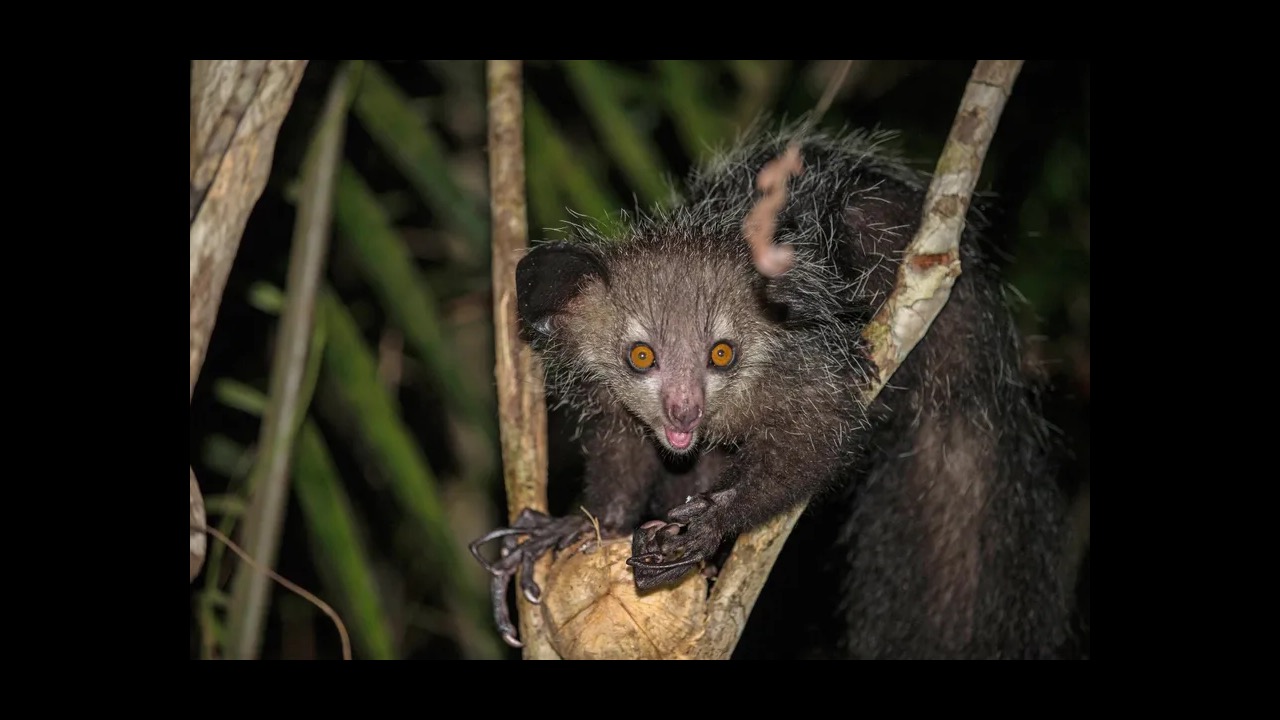
Photo: nomis-simon / Wikimedia Commons (CC BY 2.0)
In brief
The aye-aye is a large nocturnal lemur found only in Madagascar, easily recognised by its bushy tail, rodent-like teeth and long, spindly middle finger. It weighs 2 to 3 kg (4.4 to 6.6 lb) and forages alone at night for insect larvae, fruit, nectar and fungi.
Also in Animals A to Z · Animals that start with A
By WARN Research & Conservation Team Last updated
The aye-aye is a large nocturnal lemur found only in Madagascar, easily recognised by its bushy tail, rodent-like teeth and long, spindly middle finger. It weighs 2 to 3 kg (4.4 to 6.6 lb) and forages alone at night for insect larvae, fruit, nectar and fungi. Long-lived for a lemur, it can survive 20 to 23 years in the wild. The IUCN lists it as Endangered.
0.9 m
Typical length
3 kg
Typical weight
8 km/h
Top speed
23 yrs
Lifespan
Figures sourced from IUCN Red List — Aye-aye, Wikipedia — Aye-aye, Wikidata — Aye-aye .
Aye-aye: Quick Facts
| Scientific name | Daubentonia madagascariensis |
|---|---|
| Diet | Omnivore — insect larvae, fruit, nectar, and fungi |
| Habitat | Rainforests and coconut plantations of Madagascar |
| Lifespan | 20–23 years in the wild (long-lived for a lemur) |
| Weight | 2–3 kg (4.4–6.6 lb) |
| Top speed | Slow arboreal locomotion; leaps between branches at night |
| Conservation status | Endangered (IUCN) |
Scientific Classification
| Kingdom | Animalia |
|---|---|
| Phylum | Chordata |
| Class | Mammalia |
| Order | Primates |
| Family | Daubentoniidae |
| Genus | Daubentonia |
Conservation Status
- IUCN Status
- Endangered (IUCN Red List)
- Population
- See the IUCN Red List assessment
- Trend
- Decreasing
- Assessed
- 2020
- CITES
- See CITES appendices
Key documented threats: Deforestation in Madagascar; Persecution due to cultural beliefs; Hunting; Habitat fragmentation.
Key Facts: Aye-aye
- The aye-aye feeds using a method found in no other primate, sometimes called percussive foraging.
- Although insect larvae are a signature food, the aye-aye is an omnivore with a varied menu.
- The aye-aye grows to around 0.9 m (3 ft) including its long, bushy tail, which is often longer than its body.
A unique way of finding food
The aye-aye feeds using a method found in no other primate, sometimes called percussive foraging. It taps rapidly along a branch with its slender middle finger and listens for the hollow echo of a tunnel left by wood-boring grubs. Once it locates a cavity, it gnaws a hole with its ever-growing incisors and hooks the larva out with that same thin finger. This tap-and-listen technique fills the same ecological niche that woodpeckers occupy elsewhere in the world.
Diet beyond insects
Although insect larvae are a signature food, the aye-aye is an omnivore with a varied menu. It also eats fruit, nectar and fungi, and is fond of the seeds inside ripe coconuts and ramy nuts, which it opens with its powerful teeth. This flexible diet allows it to survive in both native rainforest and human-planted coconut groves. Its taste for cultivated crops occasionally brings it into conflict with farmers.
Anatomy and senses
The aye-aye grows to around 0.9 m (3 ft) including its long, bushy tail, which is often longer than its body. Its most extraordinary feature is the elongated, almost skeletal middle finger, fitted with a ball-and-socket joint that lets it swivel freely. Large, sensitive ears give it acute hearing for detecting grubs beneath bark, and its huge eyes are adapted to gathering light on moonlit nights. Unusually among primates, its front teeth never stop growing, like a rodent's.
Behaviour and lifestyle
Aye-ayes are strictly nocturnal and spend the daylight hours asleep in a spherical nest of leaves and twigs high in the canopy. They are largely solitary, moving slowly through the trees and leaping between branches to cover their large home ranges. Males range more widely than females and their territories often overlap, though individuals usually forage alone. They are surprisingly long-lived for a lemur, reaching over two decades in the wild.
Why it is endangered
The aye-aye is listed as Endangered by the IUCN, threatened chiefly by the clearing of Madagascar's forests for farming and timber. It also suffers from direct persecution, because some local traditions regard the animal as an omen of bad luck and kill it on sight. Its slow reproduction, with females raising a single infant every two to three years, makes it hard for populations to recover. Protected reserves and captive-breeding programmes now play a key role in safeguarding the species.
What WARN Does
WARN does not run a dedicated aye-aye programme — this guide is part of the World Animal Rescue Network's free educational library. The aye-aye faces documented conservation pressure in the wild, which is why clear, sourced public information about it matters. Building public understanding of species like the aye-aye supports the broader conservation awareness that underpins WARN's partner-led rescue work across its network.
If clear, science-based wildlife guides like this help you understand and value animals, please consider supporting the World Animal Rescue Network's educational and rescue work so we can keep producing them.
Aye-aye: Frequently Asked Questions
What is an aye-aye?
Why does the aye-aye have such a long finger?
What do aye-ayes eat?
How long do aye-ayes live?
Are aye-ayes endangered?
Where do aye-ayes live?
Are aye-ayes dangerous?
How big is an aye-aye?
Sources & References
Population figures, conservation status and biological facts on this page are drawn from authoritative scientific and intergovernmental sources.
Terms used on this page
Plain-English definitions, from our wildlife and conservation glossary.
Latest Aye-aye Stories
Quick, fact-checked reads on the aye-aye — amazing facts, key questions and the threats it faces.
Guides
Pangolin Species Explained: All Eight of the World's Most Trafficked Mammal
There are eight pangolin species — four in Africa and four in Asia. All eight are trafficked. Here is the briefing.
Read the storySpecies
Tiger vs Lion: 7 Key Differences Between the Two Biggest Cats
Tigers are bigger, stripier and solitary; lions are social and live in prides. Here's how the two largest cats really differ in size, habitat and behaviour.
Read the storySpecies
Asian vs African Elephant: 7 Key Differences
Ears, back shape, tusks and size all set Asian and African elephants apart. Here is a clear, science-backed guide to telling the world's three elephant species apart.
Read the storyExplore more animals
Discover more animals, their habitats and their conservation status in the WARN wildlife-guide library.
Enjoyed this Aye-aye guide?
Receive appeal updates, animal-welfare news and published funding reports. Unsubscribe any time.
We only use your address for WARN updates. See our privacy policy.