Wildlife Guide · Worldwide in temperate and tropical regions & Gardens, woodland and scrub
Assassin Bug
Family Reduviidae — over 7,000 described species worldwide
A predatory bug that stabs prey with a needle rostrum — and some species wear their victims as camouflage.
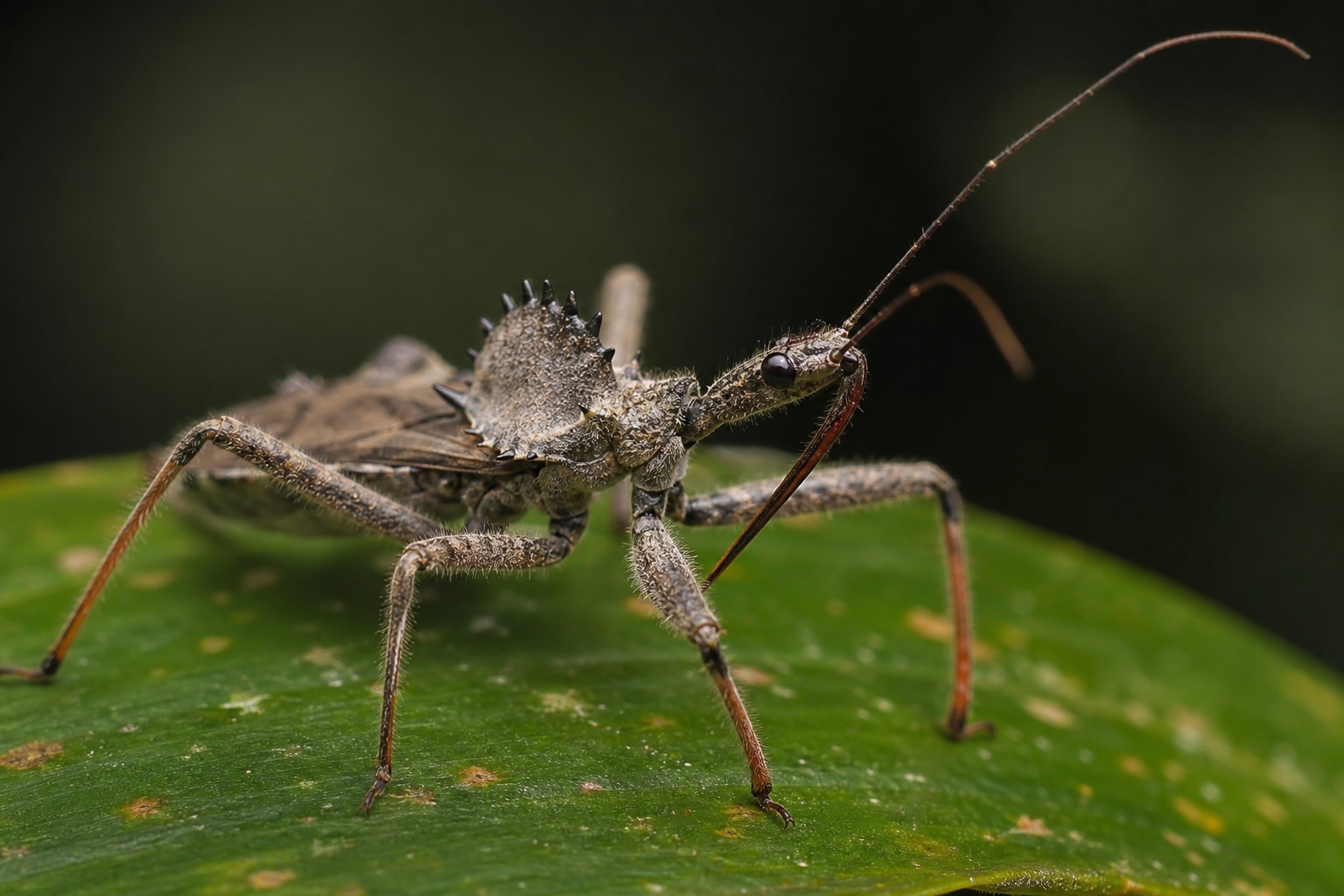
AI-generated educational wildlife portrait — World Animal Rescue Network · AI visualisation, not a photograph
In brief
Assassin bugs (family Reduviidae) are predatory true bugs that stab prey with a curved rostrum and inject digestive saliva; over 7,000 species exist worldwide, some stacking ant corpses on their backs for camouflage, and most are not individually assessed on the IUCN Red List.
Also in Animals A to Z · Animals that start with A
By WARN Research & Conservation Team Last updated
Assassin bugs are predatory true bugs in family Reduviidae — hemipterans with piercing mouthparts used to inject digestive saliva and suck liquefied prey tissue. The name is earned: they hunt insects and other arthropods, often ambushing from vegetation. Some species in genus Acanthaspis stack the empty exoskeletons of ant victims on their backs, wearing a carcass coat that may confuse predators or prey. Most assassin bugs are harmless if left alone. A few — including triatomines ('kissing bugs') in the Americas — feed on vertebrate blood and can transmit Chagas disease; those species are not the garden predators most people encounter in Britain and Europe. Wheel bugs and masked hunters are familiar temperate examples.
7,000+
Described reduviid species worldwide
Rostrum
Piercing mouthpart folded under the head
Predatory
Hunt insects and other arthropods
Carcass stack
Some species glue ant corpses onto their backs
Figures sourced from Animal Diversity Web — Reduviidae, Jackson and Pollard — corpse-carrying behaviour in Acanthaspis, Centers for Disease Control — Triatomine bugs and Chagas .
Assassin Bug: Quick Facts
| Feeding | Predatory — pierce prey with rostrum |
|---|---|
| Famous behaviour | Ant corpse stacking in Acanthaspis |
| Size range | Few mm to about 4 cm |
| Garden role | Beneficial predator of pest insects |
| Medical subgroup | Triatomines transmit Chagas in Americas |
| IUCN status | Not Evaluated for most species |
Scientific Classification
| Kingdom | Animalia |
|---|---|
| Phylum | Arthropoda |
| Class | Insecta |
| Order | Hemiptera |
| Family | Reduviidae |
| Subfamily note | Triatominae — blood-feeding kissing bugs of medical importance |
| Described species | Over 7,000 worldwide |
Conservation Status
- IUCN Status
- Not Evaluated
- Population
- Not applicable at family level
- Trend
- Unknown; reduced locally by pesticides
- Assessed
- Most species not assessed
- CITES
- Not listed
Assassin bugs are ecologically valuable predators. Broad insecticide use removes them alongside target pests.
Did you know?
Some assassin bugs glue the empty bodies of ants they have eaten onto their own backs — a backpack of corpses that may keep jumping spiders from attacking.
Key Facts: Assassin Bug
- Assassin bugs (Reduviidae) are predatory true bugs with a curved rostrum used to stab and digest prey.
- Some Acanthaspis species stack empty ant exoskeletons on their backs — possible camouflage against jumping spiders.
- Most garden assassin bugs are beneficial predators of pest insects.
- Triatomine 'kissing bugs' are reduviids that feed on vertebrate blood and transmit Chagas disease in the Americas — a distinct medical subgroup.
- Bites from large temperate species such as wheel bugs are painful but not usually dangerous to healthy adults.
- Most species lack IUCN assessments; family is widespread and ecologically important as invertebrate predators.
Stab, inject, suck
Reduviids are hemipterans — true bugs with sucking mouthparts. The rostrum folds into a groove on the ventral head and extends forward to pierce prey. Saliva contains enzymes that predigest tissue; the bug then sucks the liquefied meal. Forelegs are often thickened for grasping.
Ambush species wait on flowers or leaves; active hunters track prey through vegetation. Assassin bugs are slow compared with wasps but overpower insects their own size or larger through grip and venomous saliva. Garden species reduce caterpillars, beetles and other plant pests without pesticide.
The ant corpse backpack
Researchers documented Acanthaspis species pinning ants, feeding, and gluing the drained exoskeletons onto the dorsal surface with sticky secretions. The stack grows with each kill. Experiments suggest jumping spiders — visual hunters — hesitate to attack bugs wearing ant armour, while unadorned assassin bugs are taken more readily.
Whether the stack mimics ants chemically, visually or both remains debated. The behaviour is one of the more macabre examples of invertebrate tool use and remains a standard teaching case in entomology courses.
Kissing bugs versus garden assassins
Triatominae are blood-feeding reduviids of the Americas that bite sleeping humans near the mouth — hence 'kissing bug'. They transmit Trypanosoma cruzi, causing Chagas disease. That medical story applies to a specific subfamily, not to European garden reduviids.
Conflating all assassin bugs with kissing bugs produces unnecessary fear in regions where triatomines do not occur. Identification matters: triatomines are often flattened, kinked at the rostrum, and associated with rural housing in Latin America.
Bites, handling and status
Large species such as the North American wheel bug bite defensively if grabbed. Pain can be sharp and persist for days but is not equivalent to venomous spider envenomation for most people. Avoid handling; observe in situ.
Reduviidae as a whole is Not Evaluated at family level. Pesticide use and habitat loss reduce predatory bug communities alongside other invertebrates. Assassin bugs are net beneficial in gardens — indiscriminate spraying removes them with pests.
What WARN Does
WARN publishes accurate invertebrate education that separates beneficial garden predators from medically significant subgroups. Assassin bugs reduce pest insects; only a blood-feeding lineage in the Americas carries Chagas risk.
If this guide helps you understand wildlife and the pressures it faces, a gift to WARN supports habitat protection and free public education in our partner countries.
Assassin Bug: Frequently Asked Questions
What do assassin bugs eat?
Where do assassin bugs live?
Are assassin bugs dangerous?
How long do assassin bugs live?
How big are assassin bugs?
Why do some assassin bugs carry ant corpses?
Are assassin bugs endangered?
Sources & References
Population figures, conservation status and biological facts on this page are drawn from authoritative scientific and intergovernmental sources.
Terms used on this page
Plain-English definitions, from our wildlife and conservation glossary.
Explore more animals
Discover more animals, their habitats and their conservation status in the WARN wildlife-guide library.
Enjoyed this Assassin Bug guide?
Receive appeal updates, animal-welfare news and published funding reports. Unsubscribe any time.
We only use your address for WARN updates. See our privacy policy.