When people in the UK think of the Southeast Asian meat trade, they think of dogs. The cats are almost invisible — and that invisibility is exactly the problem. Open-source welfare investigations published in 2020 estimate that around one million cats are slaughtered for meat in Vietnam every year, sold under the local name tiểu hổ — "little tiger". A large share of those cats are not strays. They are stolen pets.
The scale of the trade
The figures in this section are drawn from the 2020 multi-country open-source investigations into the Southeast Asian dog and cat meat trade, which remain the most comprehensive publicly available dataset on the subject.
- Vietnam: an estimated five million dogs and one million cats slaughtered for meat each year.
- Cats are concentrated in specific urban and peri-urban regional markets, where they are sold alongside dog meat.
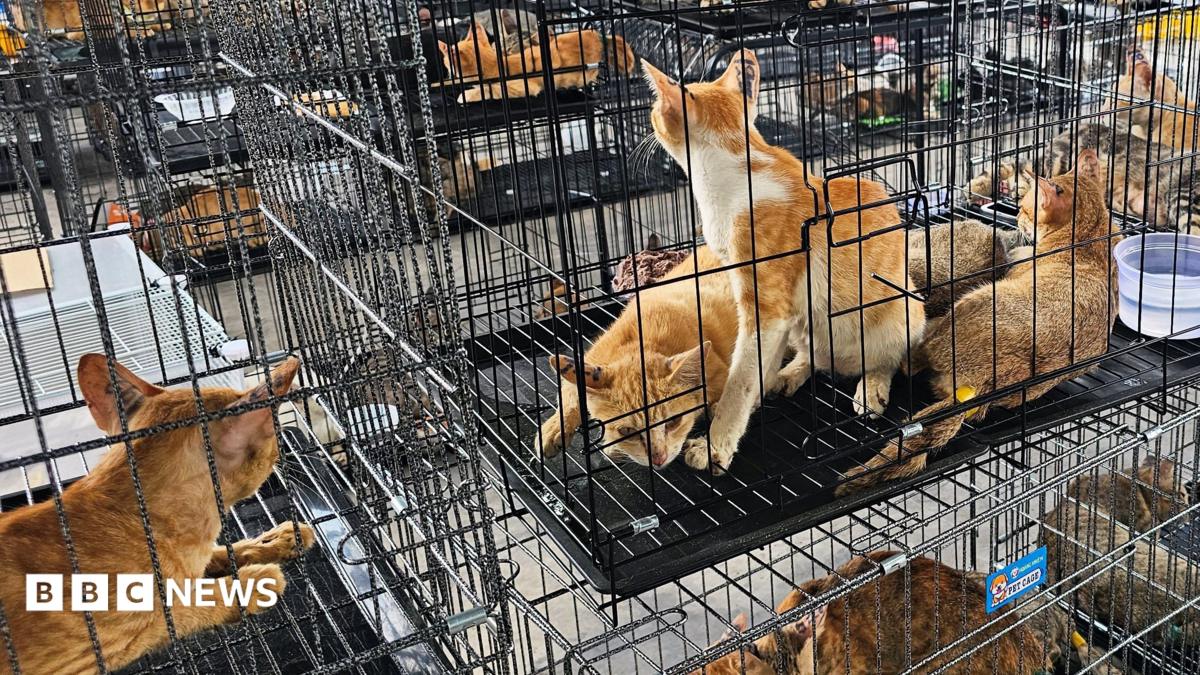
- Documented transport conditions include cats packed into wire crates without food or water, frequently in shared loads with dogs of unknown origin.
- Documented slaughter methods fall far below any accepted humane-slaughter standard.
'Little tiger': the language of the trade
The local market name for cat meat in Vietnam — tiểu hổ, "little tiger" — points to one of the reasons the trade has been so under-reported internationally. The supply chain is small enough, and language-specific enough, to slip past most foreign-language welfare reporting. Within Vietnam, however, cat meat has been openly sold in named neighbourhoods of major cities, particularly in the north of the country, for decades.
Stolen pets, not strays
The single most overlooked aspect of the trade — for cats as much as for dogs — is how the supply chain actually works. Demand outstrips the available stray population, so collectors sweep up pet cats from yards, doorways and village streets. Field reporting from the 2020 investigations documents the same pattern in cat supply as in dog supply: stolen pets, taken in front of owners, moved at speed and at scale. Pet owners in Vietnam have increasingly organised against the practice, and reform pressure is already coming from inside the affected communities.
A public health problem as well as a welfare one
Cats are not the dominant rabies vector globally — that is dogs — but the World Health Organization explicitly recognises cats as a secondary rabies vector and recommends that cats be included in mass vaccination programmes in rabies-endemic regions. Markets and backyard slaughter points that mix cats and dogs of unknown origin at high density, with no sanitary controls, are precisely the kind of unregulated live animal trade WHO has long flagged as a route for rabies amplification and the emergence of novel zoonotic disease. Ending the cat meat trade is, among other things, a public-health intervention.
Where the cultural picture is going
The 2020 investigations also found that public attitudes in Vietnam are shifting. Hanoi has previously published a formal call for residents to stop eating dog and cat meat. Younger urban residents in particular are turning away from the practice, and the assumption that the trade is "traditional" and untouchable does not match what residents themselves are now saying.
Where cat rescue fits in
Animals recovered from the trade need a lawful care plan with qualified veterinary assessment and suitable accommodation. Community-cat management is a separate question: ICAM recommends assessing the local setting before choosing a comprehensive programme. Sterilisation addresses reproduction; appropriate vaccination addresses specified diseases. Neither a procedure count nor a general reference to TNVR establishes a public-health outcome or a funded WARN programme.
WARN's appeal purpose and current status
The dog and cat meat-trade appeal raises contributions towards assessed welfare needs associated with the trade. It covers both species. Potential support depends on recipient assessment and an agreed scope; this article does not establish an approved Vietnam delivery programme or a launch date. Check the grant register for published funding status.
Community-animal veterinary care is a separate purpose. The Indonesia community-animal proposal has no confirmed recipient or costed plan and is not collecting donations. A gift to the meat-trade appeal should not be understood as funding community-cat neutering.
Sources
- Open-source welfare investigations into the Southeast Asian dog and cat meat trade, published 2020 — the most comprehensive publicly available dataset.
- World Health Organization — Rabies Fact Sheet, including guidance on cat vaccination in rabies-endemic regions.
- World Organisation for Animal Health (WOAH) — guidance on humane management of free-roaming cat and dog populations.
- Public statements from Hanoi municipal authorities calling on residents to stop consuming dog and cat meat.
Understand the purpose before giving
WARN's dog and cat meat-trade appeal raises contributions towards assessed welfare needs associated with the trade. It covers both species. Potential support depends on recipient assessment and an agreed scope; a gift does not guarantee a particular procedure or create a separate cat-only fund.
Read the dog and cat meat-trade appeal and check the grant register before giving. For general community-cat care, the separate Indonesia community-animal proposal is being assessed and has no dedicated collection open.