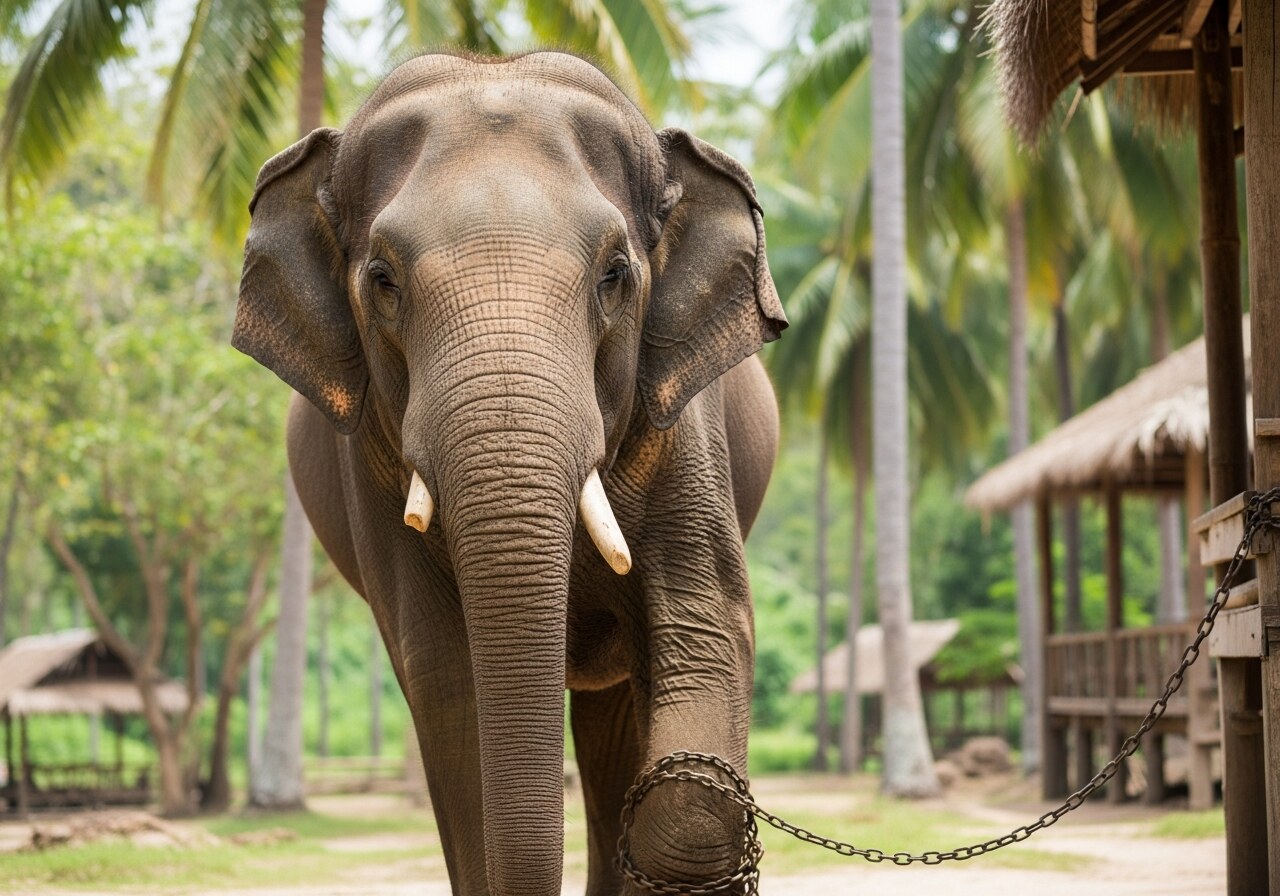
An adult Asian elephant with rounded ears and a domed forehead bathing in a forested river in northern Thailand
Species

· THAILAND & CAMBODIA · 9 min read

The Asian Elephant: Endangered, Shrinking and Largely Captive

In brief

The Asian elephant (Elephas maximus) is an Endangered species native to thirteen range states across South and Southeast Asia, with an estimated 41,000-52,000 wild individuals; roughly a third of all Asian elephants alive today live in captivity, most of them in tourist or working-elephant contexts.

What are the key takeaways from this briefing?

  • Listed as Endangered on the IUCN Red List; CITES Appendix I.
  • Estimated 41,000-52,000 wild Asian elephants remain.
  • Roughly a third of all Asian elephants alive today live in captivity.
  • Thailand alone holds an estimated 3,000-4,000 captive elephants, mostly in the tourism industry.
  • Major Asian elephant range states include India, Sri Lanka, Thailand and Cambodia; WARN's in-network elephant focus is Indonesia and Malaysia.

The Asian elephant (Elephas maximus) is one of the most heavily intertwined large mammals with human society — and one of the most welfare-compromised. Around a third of every Asian elephant alive today is in captivity, in working camps, religious institutions or tourist attractions.

WARN is preparing to operate in India, Sri Lanka, Thailand and Cambodia, all Asian elephant range states. Thailand alone holds an estimated 3,000-4,000 captive elephants — a number that, for the size of the country, indicates a captive-welfare crisis as much as a wild-population crisis.

How Asian elephants differ from African elephants?

  • Smaller body size; adults typically 2.5-3 tonnes.
  • Rounded ears, more domed forehead, smaller tusks (often only in males).
  • Two body humps along the back rather than one.
  • Far more often kept in captivity, with a long cultural history of working-elephant traditions.

See our explainer on Asian vs African elephants for a fuller comparison.

What should you know about the threats?

  • Habitat loss. Forest conversion to agriculture, plantations and infrastructure has fragmented Asian elephant range across all thirteen countries.
  • Human-elephant conflict. Crop-raiding elephants are killed in retaliation; elephant retaliation kills hundreds of people each year. Both sides of the conflict cause unacceptable welfare outcomes.
  • Captive-welfare crisis. The tourism industry in Thailand, working camps in Myanmar and Laos, and temple-elephant traditions in India and Sri Lanka all hold elephants under conditions that frequently fail basic welfare standards — chained for long hours, denied conspecific contact, and trained with aversive methods.
  • Illegal trade. Live calves are still trafficked into the tourism trade; ivory from male tuskers continues to enter international markets despite CITES controls.

What good captive-elephant welfare looks like?

The World Organisation for Animal Health (WOAH) and credible elephant-welfare specialists agree on a short list of core minimums: no chaining for routine handling, no riding, no performance shows, large-area soft substrates, daily conspecific contact, expert-led foot care and a published veterinary plan.

How WARN fits in?

Our planned Thailand and Cambodia work focuses on the welfare end of the elephant problem — supporting partner sanctuaries that provide lifetime care for retired tourism elephants, and contributing to capacity-building for high-quality captive-elephant veterinary teams. We do not currently operate our own elephant sanctuary and we will not claim otherwise. Wild Asian elephant work is critical, but it is the field of established Asian conservation organisations whose capacity our launch funding aims to support, not replace.

Sources: IUCN Red List, CITES Appendix I, WOAH captive-elephant welfare guidance, UNEP-WCMC.

Is it true that listed as Endangered on the IUCN Red List; CITES Appendix I?

Listed as Endangered on the IUCN Red List; CITES Appendix I. A fact list is not an IUCN assessment. Asian elephant still needs habitat, enforcement and honest funding — see the full species guide rather than stopping at trivia.

What should you know about estimated 41,000-52,000 wild Asian elephants remain?

Estimated 41,000-52,000 wild Asian elephants remain. Estimated 41,000-52,000 wild Asian elephants remain is one of the details people actually search for about Asian elephant. It holds as a field note from THAILAND & CAMBODIA; it is not a care sheet and not a substitute for the species guide.

Is it true that roughly a third of all Asian elephants alive today live in captivity?

Roughly a third of all Asian elephants alive today live in captivity. Slow or specialised life history is why recovery takes years even when a threat eases. That is the conservation maths, not a cute aside.

Is it true that thailand alone holds an estimated 3,000-4,000 captive elephants, mostly in the tourism industry?

Thailand alone holds an estimated 3,000-4,000 captive elephants, mostly in the tourism industry. Thailand alone holds an estimated 3,000-4,000 captive elephants, mostly in the tourism industry is one of the details people actually search for about Asian elephant. It holds as a field note from THAILAND & CAMBODIA; it is not a care sheet and not a substitute for the species guide.

Is it true that major Asian elephant range states include India, Sri Lanka, Thailand and Cambodia; WARN's in-network elephant focus is Indonesia and Malaysia?

Major Asian elephant range states include India, Sri Lanka, Thailand and Cambodia; WARN's in-network elephant focus is Indonesia and Malaysia. A fact list is not an IUCN assessment. Asian elephant still needs habitat, enforcement and honest funding — see the full species guide rather than stopping at trivia.

Is it true that smaller body size; adults typically 2.5-3 tonnes?

Smaller body size; adults typically 2.5-3 tonnes. That scale is ecology, not a pet-shop talking point. Asian elephant needs room to use a body like that in THAILAND & CAMBODIA, which is why habitat fragmentation hits so hard.

Is it true that rounded ears, more domed forehead, smaller tusks (often only in males)?

Rounded ears, more domed forehead, smaller tusks (often only in males). Rounded ears, more domed forehead, smaller tusks (often only in males) is one of the details people actually search for about Asian elephant. It holds as a field note from THAILAND & CAMBODIA; it is not a care sheet and not a substitute for the species guide.

Is it true that two body humps along the back rather than one?

Two body humps along the back rather than one. Two body humps along the back rather than one is one of the details people actually search for about Asian elephant. It holds as a field note from THAILAND & CAMBODIA; it is not a care sheet and not a substitute for the species guide.

Is it true that far more often kept in captivity, with a long cultural history of working-elephant traditions?

Far more often kept in captivity, with a long cultural history of working-elephant traditions. That scale is ecology, not a pet-shop talking point. Asian elephant needs room to use a body like that in THAILAND & CAMBODIA, which is why habitat fragmentation hits so hard.

Is it true that habitat loss. Forest conversion to agriculture, plantations and infrastructure has fragmented Asian elephant range across all thirteen countries?

Habitat loss. Forest conversion to agriculture, plantations and infrastructure has fragmented Asian elephant range across all thirteen countries. A fact list is not an IUCN assessment. Asian elephant still needs habitat, enforcement and honest funding — see the full species guide rather than stopping at trivia.

Is it true that human-elephant conflict. Crop-raiding elephants are killed in retaliation; elephant retaliation kills hundreds of people each year. Both sides of the conflict cause unacceptable welfare outcomes?

Human-elephant conflict. Crop-raiding elephants are killed in retaliation; elephant retaliation kills hundreds of people each year. Both sides of the conflict cause unacceptable welfare outcomes. A fact list is not an IUCN assessment. Asian elephant still needs habitat, enforcement and honest funding — see the full species guide rather than stopping at trivia.

What is this briefing not?

This briefing is not a substitute for the full Asian elephant wildlife guide, not a pet-care manual, and not a first-person field dispatch. It is a desk-researched explainer for people who searched a specific question about Asian elephant. The setting is THAILAND & CAMBODIA.

The Asian Elephant: Endangered, Shrinking and Largely Captive sits in the newsroom as a species explainer. It is not a Field notes dispatch from a partner clinic, and it is not a reason to keep Asian elephant. Location context: THAILAND & CAMBODIA.

Who should skip this page?

Skip this page if you wanted a complete IUCN-style species profile, veterinary advice, or permission to keep Asian elephant as a pet. You will not find those here. Read the wildlife guide next if you need status, range and sources in one place.

Skip it if you needed veterinary instructions, a travel itinerary, or a fundraising story dressed up as science. The skip is the point: a page that cannot say no is not a guide.

How does this briefing compare to the full species guide?

This page answers the search in the headline. The wildlife guide answers status, threats, and what is actually known. Use both; do not cite the listicle as if it were the Red List. The Asian elephant is listed as Endangered, with around 41,000-52,000 wild individuals remaining across thirteen range states.

Claims this briefing actually stands behind
Takeaway
Listed as Endangered on the IUCN Red List; CITES Appendix I.
Estimated 41,000-52,000 wild Asian elephants remain.
Roughly a third of all Asian elephants alive today live in captivity.
Thailand alone holds an estimated 3,000-4,000 captive elephants, mostly in the tourism industry.

What is the catch with a short wildlife briefing?

The catch with wildlife listicles is that a true fact can still be the wrong takeaway. “Amazing” is not the same as “safe to keep”, and a number without a source is trivia. Every figure on this page should be read against the cited IUCN or zoo pages, not against a screenshot.

Factory “12 facts” pages elsewhere on the web pad the same three sentences. Here each heading is a real question, each answer is meant to stand alone, and the sources at the end are the audit trail. If a number is not on this page or in those sources, we did not invent it.

What should you do after reading this?

Use this briefing to answer the question in the title, then go to the species guide for status and sources. If you want to help Asian elephant, fund habitat and enforcement — do not buy the animal. The Asian elephant (Elephas maximus) is an Endangered species native to thirteen range states across South and Southeast Asia, with an estimated 41,000-52,000 wild individuals; roughly a third of all Asian elephants alive today live in captivity, most of them in tourist or working-elephant contexts.

If you want to support WARN’s partner work, donate knowing we are a community interest company, not a registered charity. If you want the animal itself, you have the wrong page.

Read the verdict on the first screen, the skip-if before you share the page, and the sources at the end before you quote a number. That is the whole contract of this briefing.

What do people ask about this briefing?

Is this Asian elephant briefing a complete species guide?
No. It is a newsroom explainer for a specific search. Status, range and the full source list live on the wildlife guide where one exists. The briefing is set in THAILAND & CAMBODIA. The Asian elephant is listed as Endangered, with around 41,000-52,000 wild individuals remaining across thirteen range states.
Should you keep a Asian elephant as a pet after reading this?
No. Amazing facts are not a care plan. Wild animals belong in wild habitat; buying one, posing with one, or sharing selling ads all worsen the trade. Location context on this page is THAILAND & CAMBODIA. The Asian elephant is listed as Endangered, with around 41,000-52,000 wild individuals remaining across thirteen range states.
Who should skip this Asian elephant page?
Anyone who needed veterinary advice, a full IUCN profile, or permission to handle the animal. This page will tell you to leave if that is you. The Asian elephant is listed as Endangered, with around 41,000-52,000 wild individuals remaining across thirteen range states.
What is the one-line answer on Asian elephant?
The Asian elephant (Elephas maximus) is an Endangered species native to thirteen range states across South and Southeast Asia, with an estimated 41,000-52,000 wild individuals; roughly a third of all Asian elephants alive today live in captivity, most of them in tourist or working-elephant contexts.
Where is this Asian elephant briefing set?
The location context is THAILAND & CAMBODIA. That is geography for the story, not a claim that WARN runs a programme in every place named. The Asian elephant is listed as Endangered, with around 41,000-52,000 wild individuals remaining across thirteen range states.
Where does WARN work on Asian elephant?
Only claim a programme where this site already names one. This briefing is desk research about Asian elephant in THAILAND & CAMBODIA; it does not invent a field team to match the headline. Read the species guide and appeals for funded work.
Is it true that listed as Endangered on the IUCN Red List; CITES Appendix I?
Listed as Endangered on the IUCN Red List; CITES Appendix I. The Asian elephant is listed as Endangered, with around 41,000-52,000 wild individuals remaining across thirteen range states. Roughly a third of all Asian elephants alive today live in captivity — many of them in countries where WARN is preparing to operate.
What should you know about estimated 41,000-52,000 wild Asian elephants remain?
Estimated 41,000-52,000 wild Asian elephants remain. The Asian elephant is listed as Endangered, with around 41,000-52,000 wild individuals remaining across thirteen range states. Roughly a third of all Asian elephants alive today live in captivity — many of them in countries where WARN is preparing to operate.
W

WARN Research & Conservation Team

World Animal Rescue Network

Published Updated 9 min read · 1,777 words
Share
Support animal rescue