Wildlife Guide · Western and central New Guinea & Lowland and hill rainforest
Superb Bird-of-Paradise
Lophorina superba (Pennant, 1781) — family Paradisaeidae; species complex
The bird that transforms into a black oval with a blue smile during display.
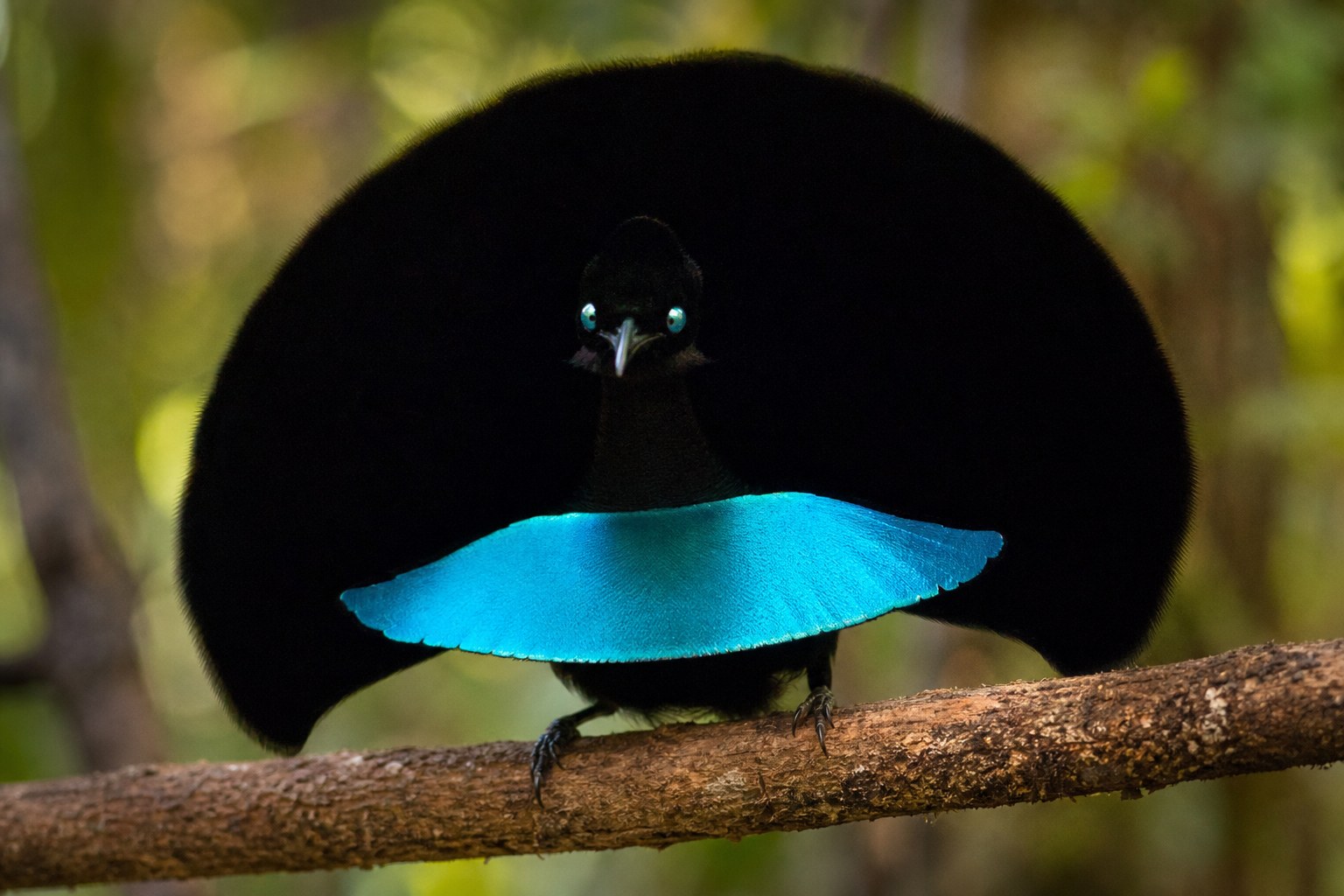
AI-generated educational wildlife portrait — World Animal Rescue Network · AI visualisation, not a photograph
In brief
The superb bird-of-paradise (Lophorina superba complex) is a small black bird-of-paradise whose male transforms into a floating oval with an iridescent blue 'face' during display; genetic and behavioural work has split the complex into several species with distinct displays and ranges.
Also in Animals A to Z · Animals that start with S
By WARN Research & Conservation Team Last updated
The superb bird-of-paradise is the species behind one of the most widely shared clips in natural history: a male that, in display, reshapes himself into a floating black oval with an iridescent blue breast shield and two bright blue eye-spots — a pattern that reads, unmistakably, as a face. At rest he is a small black bird with a blue crown; in display he becomes something else entirely. What the clip usually does not say is that 'superb' is now a species complex rather than a single species. Research on display behaviour, calls and genetics has split the former Lophorina superba into several species, including the Vogelkop superb bird-of-paradise with a crescent-shaped rather than oval shield. The split matters because each form has a different display and a different range, and treating them as one species obscures both.
~26 cm
Body length
Oval
The shape the male creates by spreading his cape in display
4+
Species now recognised within the former L. superba complex
Blue shield
Iridescent breast patch with eye-spots that form a 'face'
Figures sourced from IUCN Red List — Lophorina superba, Cornell Lab of Ornithology — Birds-of-Paradise Project, CITES Appendices .
Superb Bird-of-Paradise: Quick Facts
| Length | About 26 cm |
|---|---|
| Display | Black oval cape with iridescent blue breast shield and eye-spots |
| Taxonomy | Species complex — at least four recognised forms |
| Female plumage | Plain brown |
| Display site | Cleared patch of forest floor |
| Main threats | Lowland forest clearance |
Scientific Classification
| Kingdom | Animalia |
|---|---|
| Phylum | Chordata |
| Class | Aves |
| Order | Passeriformes |
| Family | Paradisaeidae |
| Genus | Lophorina |
| Species | Lophorina superba (species complex) |
Conservation Status
- IUCN Status
- Least Concern (complex)
- Population
- No reliable estimate exists
- Trend
- Decreasing
- Assessed
- 2016
- CITES
- Appendix II
The Least Concern listing covers the complex as formerly defined. Split species with smaller ranges may warrant more cautious assessment than the lumped listing implies.
Did you know?
The viral 'smiley face' display belongs to the Vogelkop form, which was treated as the same species as populations across the rest of New Guinea until display and genetic work split them in 2018.
Key Facts: Superb Bird-of-Paradise
- The male superb bird-of-paradise transforms in display from a small black bird into a floating black oval with an iridescent blue breast shield and eye-spots resembling a face.
- The former Lophorina superba is now recognised as a species complex split on display behaviour, calls and genetics into several distinct species.
- The Vogelkop form has a crescent-shaped rather than oval shield and a different display sequence, which was enough to justify separate species status.
- Females are brown and unornamented; they inspect the display from close range on the forest floor where males perform.
- The display involves spreading a black cape of feathers to eliminate the bird's normal outline, a form of shape-shifting rare even among birds-of-paradise.
- Customary land tenure across New Guinea means the forest patches where males display depend on local landowner decisions rather than on protected-area designations alone.
The shape-shifting display
A male superb bird-of-paradise clears a small area of forest floor and calls from a low perch. When a female arrives he drops to the ground, spreads a cape of long black feathers laterally until they meet above his head, and erects an iridescent blue breast shield with paired eye-spots. The effect is to replace his normal bird outline with a flat, symmetrical oval bearing a vivid blue pattern.
He bobs, hops and snaps his wings while the oval holds steady, the blue shield catching light from different angles. The female watches from centimetres away. If she accepts, she mates and leaves; he resumes calling. The display is one of the most extreme examples of shape transformation in any bird, and it works because the female's visual system is tuned to detect symmetry, contrast and movement within a very specific spatial frame.
One name, several species
For most of the twentieth century, all populations of this bird were treated as Lophorina superba. Detailed comparison of display behaviour, vocalisations and mitochondrial DNA changed that. The Vogelkop population in the Bird's Head Peninsula performs a different display — the shield is crescent-shaped rather than oval, and the sequence differs — and its call is distinct. Other populations across western and central New Guinea show further variation.
The result is a complex of at least four recognised species, with more splits possible as additional populations are studied. This is not academic pedantry. Each form occupies a different range, may face different threats, and cannot be assessed or protected if lumped under a single Least Concern listing. The viral video most people have seen is specifically the Vogelkop form, which was only confirmed as a separate species in 2018.
Why transform at all?
Most bird-of-paradise displays emphasise plumage colour and movement. The superb complex goes further by destroying the bird's own silhouette. Spreading the black cape eliminates the cues a predator — or a choosy female — uses to recognise a bird shape, replacing them with a novel geometric form.
That novelty may be the point. Females of many species prefer males whose displays include elements they have not seen before, which drives escalating complexity over evolutionary time. The blue 'face' adds a further layer: eye-spots are a widespread signal in animal display, and pairing them with a symmetrical oval may trigger a response that isolated colour alone would not. The male invests heavily in this performance and contributes nothing to nesting, which is the standard bird-of-paradise bargain.
Customary land and forest patches
Superb birds-of-paradise display on cleared patches of forest floor within lowland and hill rainforest. Those patches exist because the surrounding forest is intact enough to hold a territory and because local hunting and logging pressure has not removed the trees entirely.
In Papua New Guinea and the Indonesian provinces of western New Guinea, over 90% of land is under customary ownership. A display site on clan land survives only if the landowners choose to keep the forest standing. Lowland clearance for oil palm and logging removes display habitat directly, and unlike lek trees used by the Raggiana bird-of-paradise, floor-display sites cannot be preserved as single standing trees amid cleared land. The species complex as a whole is listed Least Concern, but individual split species with smaller ranges may face sharper pressure than the listing suggests.
What WARN Does
WARN publishes free, sourced species education, including where a famous clip tells only part of the story. The superb bird-of-paradise is widely shared as a single species transforming into a smiley face, but it is now recognised as a complex of several species with different displays — and each form depends on lowland forest held under customary tenure.
If this guide helps you understand wildlife and the pressures it faces, a gift to WARN supports habitat protection and free public education in our partner countries.
Superb Bird-of-Paradise: Frequently Asked Questions
Why does the superb bird-of-paradise look like a smiley face?
Is the superb bird-of-paradise one species?
How does the superb bird-of-paradise display?
Where does the superb bird-of-paradise live?
Is the superb bird-of-paradise endangered?
What do superb bird-of-paradises eat?
Are superb bird-of-paradises dangerous?
How long do superb bird-of-paradises live?
How big is a superb bird-of-paradise?
Sources & References
Population figures, conservation status and biological facts on this page are drawn from authoritative scientific and intergovernmental sources.
Terms used on this page
Plain-English definitions, from our wildlife and conservation glossary.
Explore more animals
Discover more animals, their habitats and their conservation status in the WARN wildlife-guide library.
Enjoyed this Superb Bird-of-Paradise guide?
Receive appeal updates, animal-welfare news and published funding reports. Unsubscribe any time.
We only use your address for WARN updates. See our privacy policy.