Wildlife Guide · Indian Ocean and Pacific Ocean & Tropical and subtropical coastal waters; absent from the Atlantic
Sea Snake
Subfamily Hydrophiinae — roughly 70 species of fully marine elapid snakes
Elapids that never come ashore — paddle tails, salt glands and venom more potent than most cobras.
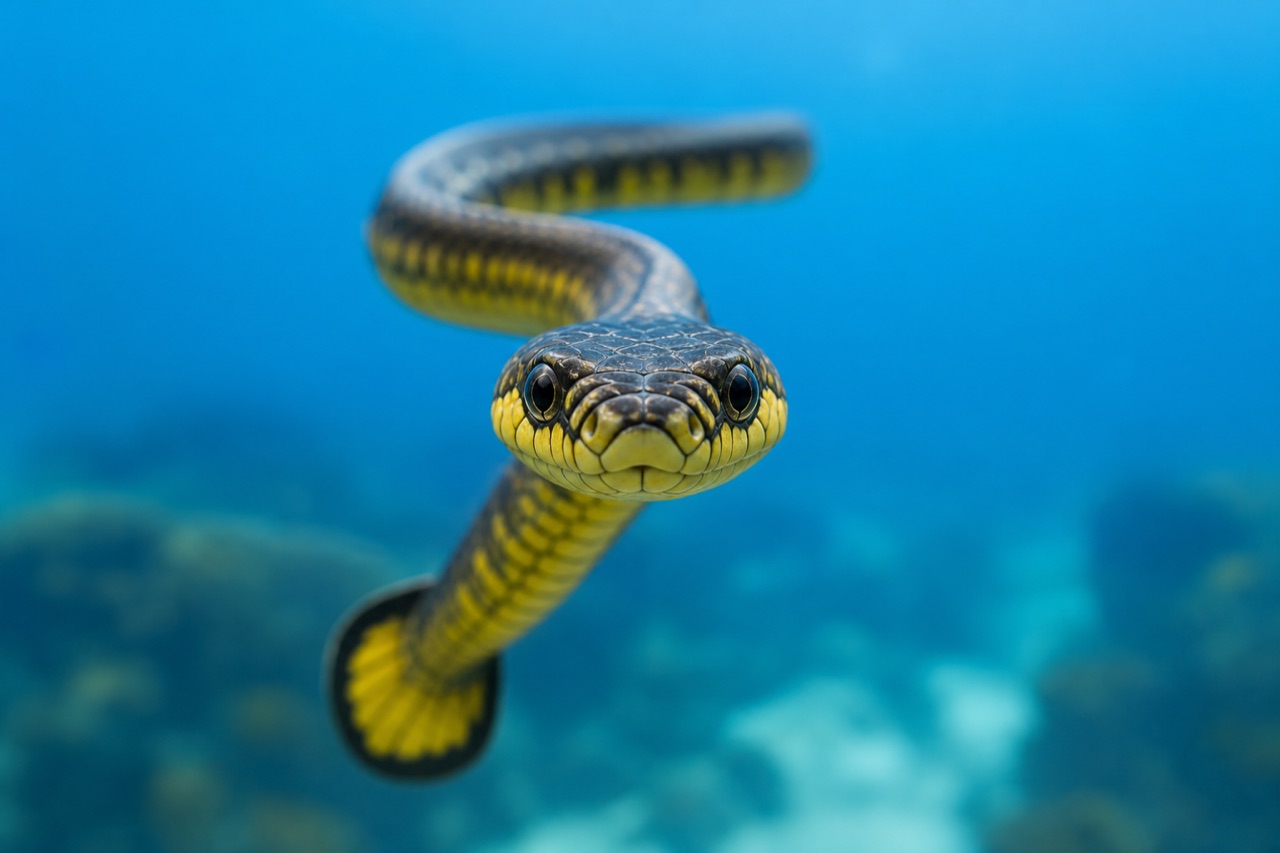
AI-generated educational wildlife portrait — World Animal Rescue Network · AI visualisation, not a photograph
In brief
Sea snakes (subfamily Hydrophiinae) are roughly 70 species of fully marine venomous elapid with paddle tails and salt-excreting glands — among the most venomous snakes, generally inoffensive to humans, and vulnerable to trawl bycatch.
Also in Animals A to Z · Animals that start with S
By WARN Research & Conservation Team Last updated
Sea snakes are elapid snakes adapted to life in the ocean. Subfamily Hydrophiinae contains roughly 70 species — all venomous, most fully marine, and all restricted to the Indian and Pacific Oceans. They evolved from terrestrial elapid ancestors and returned to the sea independently of sea kraits (Laticauda), which retain some land dependency. A sea snake's tail is flattened laterally into a paddle; nostrils have valves; lungs extend almost the length of the body to store air; and salt glands beneath the tongue excrete excess sodium from seawater ingestion. They are among the most venomous snakes alive. Envenomation potency per drop exceeds that of many cobras because venom evolved for quick immobilisation of fish prey in an environment where a bitten fish might otherwise escape. Human fatalities are rare despite high encounter rates in fishing communities — sea snakes are generally inoffensive, with small mouths and reluctance to bite unless handled. Fishermen bitten while sorting nets constitute most serious cases. Ecologically, sea snakes are mesopredators in reef and shallow coastal systems, feeding on fish and fish eggs. Bycatch in trawl fisheries kills enormous numbers annually with little documentation. Habitat degradation — coral loss, pollution, sedimentation — reduces prey. Sea snakes illustrate how marine reptile conservation overlaps fisheries management and reef health rather than terrestrial protected areas. Divers in the Philippines, Indonesia and northern Australia encounter sea snakes regularly on healthy reefs — a sign of productivity and a reminder to observe without handling, because envenomation potency is high even when temperament is calm. Sea snake venom has yielded pharmacological research compounds affecting nerve and muscle signalling — the same neurotoxicity that threatens fishermen has laboratory value when studied responsibly, though that never justifies careless handling in the field. Fishermen sorting nets at night benefit from headlamps and gloves — simple equipment that reduces bite incidence more effectively than killing every snake landed as bycatch, which continues silently regardless. Marine protected areas with active fish recovery often show sea snake counts rising within a few years — a measurable co-benefit of reef protection that costs nothing extra when the reserve was designed for fisheries anyway.
~70
Sea snake species — all in Indo-Pacific
Paddle tail
Laterally flattened for swimming
Salt glands
Excrete excess sodium from swallowed seawater
Bycatch
Major undocumented mortality in trawl fisheries
Figures sourced from IUCN Red List, Sea Snakes — Australian Museum .
Sea Snake: Quick Facts
| Species count | ~70 |
|---|---|
| Range | Indo-Pacific only |
| Tail | Paddle-shaped for swimming |
| Venom | Highly neurotoxic |
| Reproduction | Live-bearing in most species |
| Main threats | Trawl bycatch, reef degradation |
Scientific Classification
| Kingdom | Animalia |
|---|---|
| Phylum | Chordata |
| Class | Reptilia |
| Order | Squamata |
| Family | Elapidae |
| Subfamily | Hydrophiinae — ~70 species |
Conservation Status
- IUCN Status
- Varies by species — group page
- Population
- Unknown for most species
- Trend
- Suspected declining where bycatch and reef loss are high
- Assessed
- Most species unassessed
- CITES
- Some species listed
Bycatch mortality likely exceeds targeted conservation attention. Reef protection and fisheries observer data are the practical levers.
Did you know?
Sea snakes can absorb part of their oxygen through the skin while submerged — supplementing the long lung that stores air for dives lasting hours.
Key Facts: Sea Snake
- Sea snakes are elapids adapted for full marine life — paddle tail, valved nostrils, extended lungs.
- All are venomous; potency is high but bites to humans are rare and usually involve handling.
- They occur only in the Indian and Pacific Oceans — none in the Atlantic.
- Salt glands under the tongue help excrete sodium from ingested seawater.
- Trawl fishery bycatch is a major source of mortality, often unrecorded.
- Most species are unassessed by the IUCN; reef health and fisheries policy are conservation levers.
Anatomy of a marine elapid
Sea snakes lost the terrestrial elapid body plan for one optimised to water. The tail is the primary propulsive surface — flattened sideways like an oar. Ventral scales are reduced; the body is round in cross-section. Nostrils close with valves during dives. Some species remain submerged for hours, absorbing oxygen through the skin supplementing lung stores — a capacity that varies by species and temperature.
Salt excretion is critical. Drinking seawater would dehydrate a reptile without removal of excess salt. Sub lingual glands secrete a concentrated brine that the snake expels, maintaining electrolyte balance. Reproduction is live-bearing in most species — sea kraits and some hydrophiines come ashore to lay, but true pelagic sea snakes give birth at sea.
Colour patterns are often bold — bands of black and yellow, blue-grey overlays — which may serve aposematic warning given toxicity to predators. Fish prey do not learn the signal; bird and larger fish predators may.
Venom, bites and the handling risk
Sea snake venom is predominantly neurotoxic, causing muscle pain, stiffness and potentially paralysis. Potency measured in laboratory tests exceeds many terrestrial elapids, reflecting the need to immobilise fish quickly. Fang size is small relative to cobras; envenomation requires prolonged contact in some cases, which is why fishermen sorting catch by hand are the typical bite victims.
Defensive biting at divers is uncommon. Sea snakes investigate curiously but rarely strike unless grabbed. Antivenom exists where sea snake fisheries overlap human populations — notably northern Australia and Southeast Asia — but must be species-appropriate where possible.
First aid mirrors other neurotoxic snakebites: urgent hospital care, antivenom if available, supportive ventilation if needed. Prevention is gloves and tools when handling nets, not killing snakes at sea.
Fisheries bycatch and silent mortality
Trawl nets scoop sea snakes along with target fish across tropical fisheries. Brought to the surface, snakes may be dead or dying; many are discarded overboard uncounted. Estimates of annual bycatch reach tens of thousands in single regional fisheries, yet reporting is sparse because sea snakes have no commercial value and no constituency in catch statistics.
Reduction devices — exclusion grids, net modifications, spatial closures — can lower bycatch where implemented. Turtle excluder devices adapted for snakes have been trialled in some fisheries. Without pressure, bycatch continues as background mortality eroding populations that reproduce slowly — many sea snakes mature late and produce small litters.
Linking sea snake monitoring to existing fisheries observer programmes would cost little relative to the information gained. Currently, population trends for most species are guesses inferred from catch rates and anecdotal diver sightings.
Reef dependence and climate pressure
Sea snakes feed on small fish, eels and fish eggs associated with coral reefs, seagrass and estuaries. Reef degradation from warming, acidification, pollution and dynamite fishing reduces prey density. Sedimentation smothers seagrass beds used by some species. The snakes are indicators of reef productivity — abundant sea snakes usually mean a functioning fish community below.
Climate change adds thermal stress directly. Sea snakes are ectotherms with upper temperature tolerances; shallow water warming may exceed preferred ranges in some regions, forcing depth shifts or local extirpation. Oxygen minimum zones expanding in tropical seas add another stress layer for air-breathing divers.
Conservation is therefore reef conservation plus fisheries reform — not snake-specific reserves. Marine protected areas that recover fish stocks benefit sea snakes as a side effect. Species-level Red List assessments lag; filling that gap is prerequisite to arguing for bycatch reduction in international fisheries forums.
Sea kraits versus true sea snakes
Not every marine elapid is fully pelagic. Sea kraits in genus Laticauda retain land dependency — they must come ashore to lay eggs and to drink freshwater when available. They forage at sea but return to coastlines, making them vulnerable to coastal development and egg predation on beaches.
True hydrophiine sea snakes give birth at sea and may never voluntarily beach. The distinction matters for conservation planning: sea krait protection requires terrestrial nesting habitat; hydrophiine protection requires fisheries and reef management.
Both groups share venom potency and bycatch vulnerability. Diver education in Indo-Pacific tourism hubs — look but do not grab, even when snakes appear docile on the bottom — reduces handling bites without harming snake populations.
What WARN Does
WARN publishes free, sourced species education for marine life killed as collateral rather than targeted. Sea snake bycatch is invisible in most statistics — making it visible is step one toward net reform.
If this guide helps you understand wildlife and the pressures it faces, a gift to WARN supports habitat protection and free public education in our partner countries.
Sea Snake: Frequently Asked Questions
Are sea snakes venomous?
Do sea snakes come on land?
Where are sea snakes found?
How do sea snakes drink?
Are sea snakes aggressive to divers?
What do sea snakes eat?
Where do sea snakes live?
How long do sea snakes live?
How big is a sea snake?
Sources & References
Population figures, conservation status and biological facts on this page are drawn from authoritative scientific and intergovernmental sources.
Terms used on this page
Plain-English definitions, from our wildlife and conservation glossary.
Explore more animals
Discover more animals, their habitats and their conservation status in the WARN wildlife-guide library.
Enjoyed this Sea Snake guide?
Receive appeal updates, animal-welfare news and published funding reports. Unsubscribe any time.
We only use your address for WARN updates. See our privacy policy.