Wildlife Guide · Southern and eastern New Guinea & Papua New Guinea lowland forests
Raggiana Bird-of-Paradise
Paradisaea raggiana (Salvadori, 1877) — family Paradisaeidae
Papua New Guinea's national bird — and the one that displays in leks rather than alone on a perch.
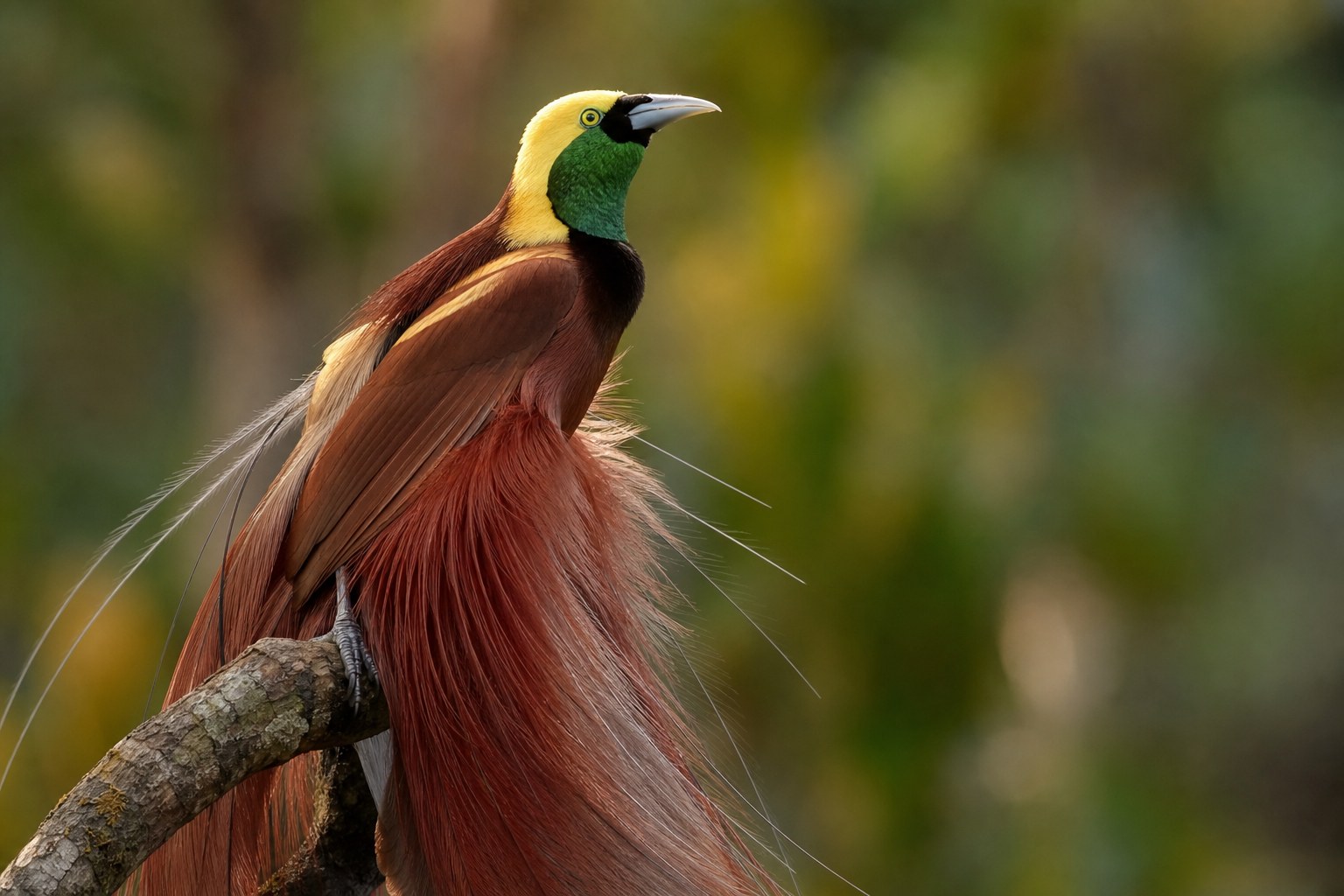
AI-generated educational wildlife portrait — World Animal Rescue Network · AI visualisation, not a photograph
In brief
The Raggiana bird-of-paradise (Paradisaea raggiana) is Papua New Guinea's national bird, a lowland species in which males gather at shared display trees in leks and spread long crimson flank plumes; it is listed as Least Concern but faces lowland forest loss.
Also in Animals A to Z · Animals that start with R
By WARN Research & Conservation Team Last updated
The Raggiana bird-of-paradise is the national bird of Papua New Guinea and appears on the flag, which makes it among the most politically visible birds-of-paradise even though it is not the most famous in photographs. The male is a deep maroon above and pale below, with a yellow crown, a blue bill and two extraordinary cascades of long crimson flank plumes that he spreads upward during display. Where the king bird-of-paradise — the smallest member of the family — displays alone from a perch and ends by hanging upside down, the Raggiana gathers with other males at a shared display tree, a lek. Up to a dozen males may occupy adjacent branches on the same tree, each calling, hopping and spreading his plumes while females visit to choose. The contrast is instructive: one family, two display architectures, both driven by the same underlying logic of female choice.
~34 cm
Body length excluding the long flank plumes
Lek
Display system — multiple males on one shared tree
National bird
Of Papua New Guinea, depicted on the flag
Crimson
The colour of the male's cascading flank plumes
Figures sourced from IUCN Red List — Paradisaea raggiana, Cornell Lab of Ornithology — Birds-of-Paradise Project, CITES Appendices .
Raggiana Bird-of-Paradise: Quick Facts
| Length | About 34 cm excluding flank plumes |
|---|---|
| Male display | Lek — multiple males on a shared display tree |
| National status | National bird of Papua New Guinea |
| Female plumage | Plain brown — no ornament |
| Habitat | Lowland and hill forest |
| Main threats | Lowland forest clearance; loss of display trees |
Scientific Classification
| Kingdom | Animalia |
|---|---|
| Phylum | Chordata |
| Class | Aves |
| Order | Passeriformes |
| Family | Paradisaeidae |
| Genus | Paradisaea |
| Species | Paradisaea raggiana |
Conservation Status
- IUCN Status
- Least Concern
- Population
- No reliable estimate exists
- Trend
- Decreasing
- Assessed
- 2016
- CITES
- Appendix II
Lowland forest is being cleared faster than montane forest across New Guinea. Display trees left standing after surrounding forest is felled cannot support lekking.
Did you know?
A lek tree may hold a dozen male Raggiana birds-of-paradise displaying simultaneously, each with crimson plumes raised — while the king bird-of-paradise, the smallest in the family, performs alone and upside down on a branch nearby.
Key Facts: Raggiana Bird-of-Paradise
- The Raggiana bird-of-paradise is the national bird of Papua New Guinea and appears on the national flag.
- Males display at leks — shared display trees where several males perform simultaneously while females choose among them.
- The display involves spreading long crimson flank plumes upward and hopping along a branch, unlike the king bird-of-paradise which displays alone and hangs upside down.
- Females are plain brown and raise the young alone, which is typical of the family and explains the extreme male ornament.
- The species occupies lowland and hill forest across much of southern and eastern New Guinea, placing it in the altitude band most affected by logging and oil palm.
- Over 90% of land in Papua New Guinea is held under customary tenure, so protection of display trees and surrounding forest depends on landowning clans rather than on state reserves alone.
Why leks instead of solo displays?
In a lek, males gather at a fixed site and compete purely through display rather than through territory quality or nest provision. Females visit, inspect several males in succession, and mate with one or a few. The males contribute nothing further.
Lekking is rare in birds generally but appears in several bird-of-paradise genera, including Paradisaea. It concentrates display effort in a place females can find reliably, which matters in dense rainforest where individuals are otherwise hard to locate. It also intensifies competition: a male on a lek tree is judged directly against his neighbours, which may explain why Raggiana plumes are longer and more voluminous than those of species that display alone. The king bird-of-paradise, by contrast, holds a solitary perch and performs a sequence that ends upside down — a different solution to the same problem of being chosen.
The display
A lek tree may hold up to a dozen males, each on his own branch. When a female approaches, males begin calling — a series of loud squawks and rattles — and hop along their branch with wings spread and the long crimson flank plumes raised vertically above the back.
The plumes are the signal. They are among the longest ornamental feathers in the family relative to body size, and their colour is structural as well as pigment-based, shifting with viewing angle in the dim understory light. Females move between males, sometimes perching beside one for close inspection before moving on. There is no pair bond and no male parental care. She will build a nest, incubate and rear the chick alone.
National symbol, lowland reality
Papua New Guinea adopted the Raggiana as its national bird and placed it on the flag because the plumes carry long-standing ceremonial significance across many Papuan cultures. Headdresses and body adornment using bird-of-paradise feathers remain part of customary practice, distinct from the commercial plume trade that devastated populations in the nineteenth century.
The species is listed as Least Concern because it remains widespread, but the listing describes range rather than trajectory. Lowland forest — the altitude band this bird occupies — is being cleared for oil palm, logging and mining faster than montane forest across New Guinea. Display trees are sometimes left standing when surrounding forest is felled, but a lek tree without connected canopy is useless. The national bird's security depends on forest that is being removed from exactly the elevations where it lives.
Customary land and display trees
Over 90% of land in Papua New Guinea is held under customary tenure rather than state ownership. That means a government-declared protected area has no force unless the clans who own the land agree to it, and it also means that local decisions about hunting, logging and forest use are made by landowners rather than by a distant authority.
Some communities have long-standing taboos against killing birds-of-paradise or felling known display trees. Others have lost those restrictions as cash economies and logging concessions have expanded. Conservation that works in this context treats customary landowners as decision-makers, not as obstacles — because legally and practically, they are the only people who can protect a lek tree or the forest around it. The Raggiana's political visibility on the flag has not, by itself, translated into secure lowland forest.
What WARN Does
WARN publishes free, sourced species education, including for animals that are national symbols but not secure. The Raggiana bird-of-paradise appears on a flag and in ceremonial dress across Papua New Guinea, yet the lowland forest it depends on is among the most rapidly converted habitat on the island.
If this guide helps you understand wildlife and the pressures it faces, a gift to WARN supports habitat protection and free public education in our partner countries.
Raggiana Bird-of-Paradise: Frequently Asked Questions
What is the national bird of Papua New Guinea?
How does the Raggiana bird-of-paradise display?
How is the Raggiana different from the king bird-of-paradise?
Why are birds-of-paradise so elaborately ornamented?
Who protects bird-of-paradise habitat in Papua New Guinea?
Are raggiana bird-of-paradises dangerous?
How long do raggiana bird-of-paradises live?
Sources & References
Population figures, conservation status and biological facts on this page are drawn from authoritative scientific and intergovernmental sources.
Terms used on this page
Plain-English definitions, from our wildlife and conservation glossary.
Explore more animals
Discover more animals, their habitats and their conservation status in the WARN wildlife-guide library.
Enjoyed this Raggiana Bird-of-Paradise guide?
Receive appeal updates, animal-welfare news and published funding reports. Unsubscribe any time.
We only use your address for WARN updates. See our privacy policy.