Wildlife Guide · New Guinea and nearby islands & Cape York Peninsula, Australia
Palm Cockatoo
Probosciger aterrimus (Gmelin, 1788) — family Cacatuidae
The only animal besides us known to manufacture a tool in order to make music.
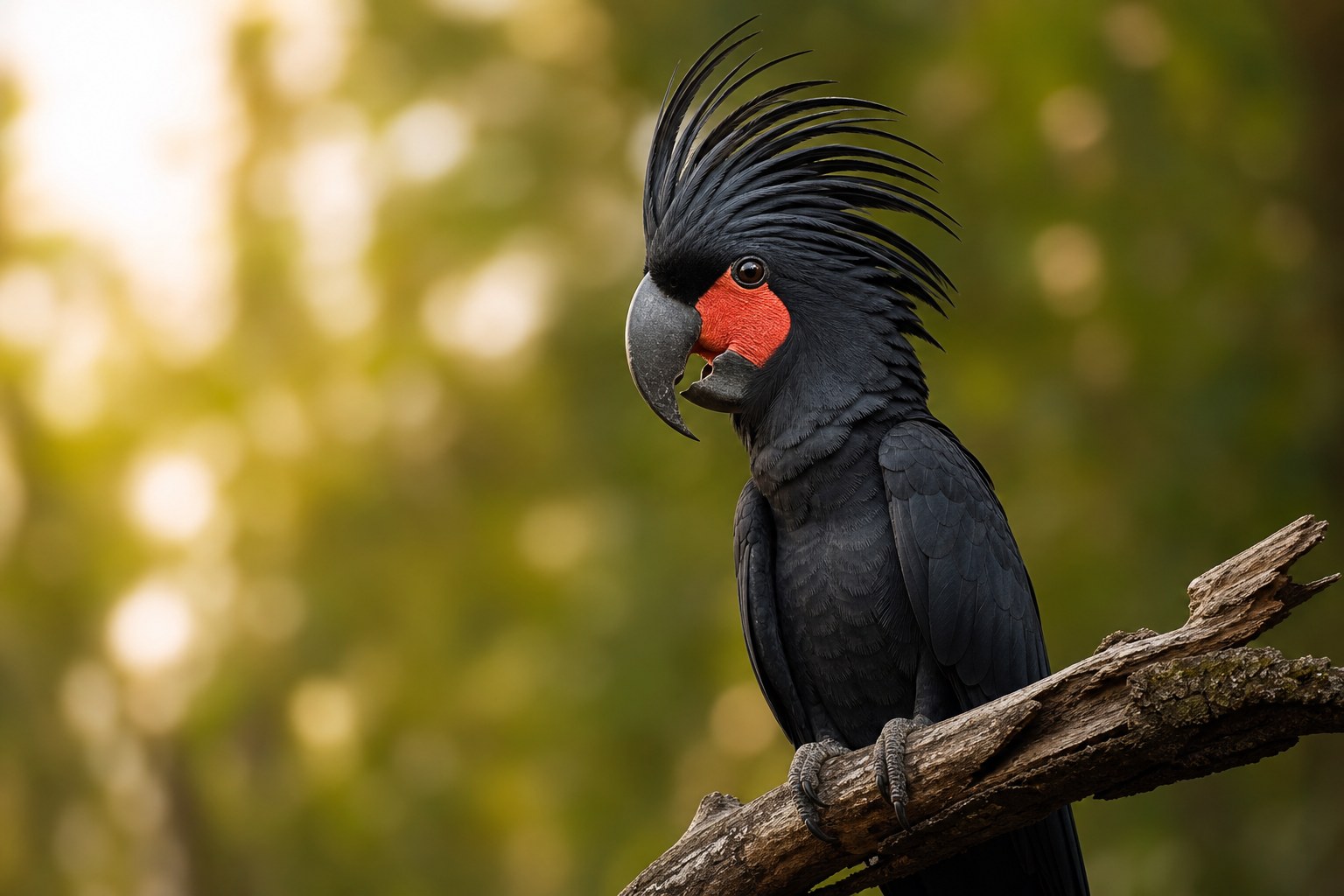
AI-generated educational wildlife portrait — World Animal Rescue Network · AI visualisation, not a photograph
In brief
The palm cockatoo (Probosciger aterrimus) is a large black parrot of New Guinea and Cape York that manufactures drumsticks from branches and beats them rhythmically against hollow trees in display — the only known non-human animal to make a tool for producing music.
Also in Animals A to Z · Animals that start with P
By WARN Research & Conservation Team Last updated
The palm cockatoo is a large smoky-black parrot with a crest of narrow curved feathers and a patch of bare red facial skin that flushes deeper when the bird is excited. Its bill is enormous — so large that the upper and lower mandibles do not meet, which is why the genus is called Probosciger and why the bird uses its tongue to hold food against the roof of its mouth. What sets it apart is the drumming. A male breaks off a stick, shapes it to length, grips it in one foot and beats it rhythmically against a hollow trunk, producing a sound carrying up to a hundred metres. Each male drums a signature rhythm that is consistent across performances and distinguishable from his neighbours'. No other non-human animal is known to make a tool specifically in order to produce rhythmic sound.
~100 m
Distance a male's drumming carries through forest
Individual
Each male drums a consistent signature rhythm
~1 egg / 2 yr
Among the lowest reproductive rates of any parrot
Never closes
The bill — the mandibles do not meet, hence Probosciger
Figures sourced from IUCN Red List — Probosciger aterrimus, Heinsohn et al. (2017), Science Advances — tool manufacture and rhythm in palm cockatoos, CITES Appendices .
Palm Cockatoo: Quick Facts
| Length | About 55–60 cm |
|---|---|
| Distinguishing feature | Bare red cheek patch that flushes when excited |
| Tool use | Manufactures drumsticks for rhythmic display |
| Clutch | A single egg, roughly every two years |
| Lifespan | 40–60 years, sometimes considerably more |
| Main threats | Loss of hollow-bearing trees, changed fire regimes, mining |
Scientific Classification
| Kingdom | Animalia |
|---|---|
| Phylum | Chordata |
| Class | Aves |
| Order | Psittaciformes |
| Family | Cacatuidae |
| Genus | Probosciger |
| Species | Probosciger aterrimus |
Conservation Status
- IUCN Status
- Least Concern globally; Australian population declining
- Population
- No reliable global estimate; Cape York population small and decreasing
- Trend
- Decreasing
- Assessed
- 2018
- CITES
- Appendix I
Nest hollow availability appears to be the binding constraint rather than adult mortality. Suitable hollows take a century or more to form, so protecting old trees and managing fire are the interventions that matter.
Did you know?
Palm cockatoos are consistently left-footed when drumming, and some males drum when no female is present — behaviour researchers have compared to practising.
Key Facts: Palm Cockatoo
- Male palm cockatoos manufacture drumsticks, breaking off a branch and trimming it to length before using it to beat a hollow trunk in display.
- Each male has an individual signature rhythm, consistent over time and distinguishable from other males — the closest thing to instrumental music documented outside humans.
- The bill is so large that the mandibles do not meet, so the bird holds food against the palate with its tongue rather than gripping it between the jaws.
- The bare red cheek patch flushes darker when the bird is excited or alarmed, making it one of the few birds with a visible blush.
- It has one of the lowest reproductive rates of any parrot — a single egg roughly every two years, with low fledging success.
- It is listed as Least Concern globally, but the Cape York population in Australia is declining and is a conservation concern, hit by nest hollow loss and fire.
The drumming
A male selects a branch, breaks it off and works it down to a usable length — typically around 20 centimetres — or alternatively uses a large seed pod. He then grips it in his left foot and strikes it repeatedly against a hollow branch or trunk, producing a resonant knocking that travels up to a hundred metres through forest.
Research tracking individual birds has established two things that matter. The beats are not random: they fall into consistent rhythmic patterns with regular intervals, which is the technical definition of a rhythm rather than a series of noises. And the pattern is individual — each male drums in a way that is stable across performances and distinct from other males in the area. He accompanies the drumming with crest raising, foot stamping and calls, and the whole performance is directed at a female. Some males also drum in the absence of any observer, which suggests the behaviour is not purely for immediate display.
Why this counts as tool use
Plenty of animals use objects. Sea otters break shellfish on stones; Egyptian vultures throw rocks at eggs; chimpanzees fish for termites with stripped twigs. What is unusual about the palm cockatoo is the combination of manufacture and purpose.
The bird does not pick up a convenient stick. It selects a branch, detaches it, and shapes it — trimming to a length that works — before use, which meets the definition of tool manufacture rather than tool use. And the purpose is not obtaining food, which is what nearly every other documented animal tool serves. It is producing sound in a social display. That combination, a manufactured object made for an acoustic and social rather than nutritional purpose, is not known in any other non-human species. It is the reason the palm cockatoo appears in the literature on the origins of human music.
Breeding almost too slowly to survive
Palm cockatoos need a very specific nest site: a large tree hollow with a deep chamber, usually formed where a trunk has broken and the interior has rotted out. Suitable hollows take a century or more to form, and competition for them with other species is intense.
Once a pair has one, the female lays a single egg, and successful breeding attempts are far apart — estimates suggest one fledged chick every two years at best, with success rates in some studied populations well below that. The birds compensate with longevity, living 40 to 60 years and in some records considerably more. That arithmetic works in a stable forest and fails quickly in a changing one. Losing adults, or losing hollow-bearing trees, removes something the population cannot replace on any short timescale — which is why the Australian population's decline matters more than a Least Concern listing suggests.
The Cape York problem
The species as a whole is listed as Least Concern because it remains widespread across New Guinea. The Australian population on Cape York Peninsula is a different picture and is treated as a conservation concern in its own right.
Three things are eroding it. Changed fire regimes destroy the hollow-bearing trees the birds nest in and prevent replacements maturing, since a hollow needs a century of undisturbed growth. Bauxite mining and land clearance remove habitat directly. And the low reproductive rate means the population cannot absorb either. Nest hollow availability, rather than adult mortality, appears to be the binding constraint — which points to a specific intervention: protecting old hollow-bearing trees and managing fire to let new ones form. That is slower and less visible than most conservation work, and it is what this bird actually needs.
What WARN Does
WARN publishes free, sourced species education, including where the popular framing misses the point. The palm cockatoo is widely shared online as a novelty — the parrot that plays the drums — and the substance is more interesting: a manufactured tool made for a social, acoustic purpose, in a bird that breeds too slowly to absorb the loss of the old trees it depends on.
If this guide helps you understand wildlife and the pressures it faces, a gift to WARN supports habitat protection and free public education in our partner countries.
Palm Cockatoo: Frequently Asked Questions
Do palm cockatoos really use drumsticks?
Why is palm cockatoo drumming significant?
Does each palm cockatoo have its own rhythm?
Are palm cockatoos dangerous?
How long do palm cockatoos live?
How big is a palm cockatoo?
Sources & References
Population figures, conservation status and biological facts on this page are drawn from authoritative scientific and intergovernmental sources.
Terms used on this page
Plain-English definitions, from our wildlife and conservation glossary.
Explore more animals
Discover more animals, their habitats and their conservation status in the WARN wildlife-guide library.
Enjoyed this Palm Cockatoo guide?
Receive appeal updates, animal-welfare news and published funding reports. Unsubscribe any time.
We only use your address for WARN updates. See our privacy policy.