Wildlife Guide · New Guinea & Aru Islands and nearby offshore islands
King Bird-of-Paradise
Cicinnurus regius (Scopoli, 1783) — family Paradisaeidae
The smallest bird-of-paradise, and the one that displays hanging upside down.
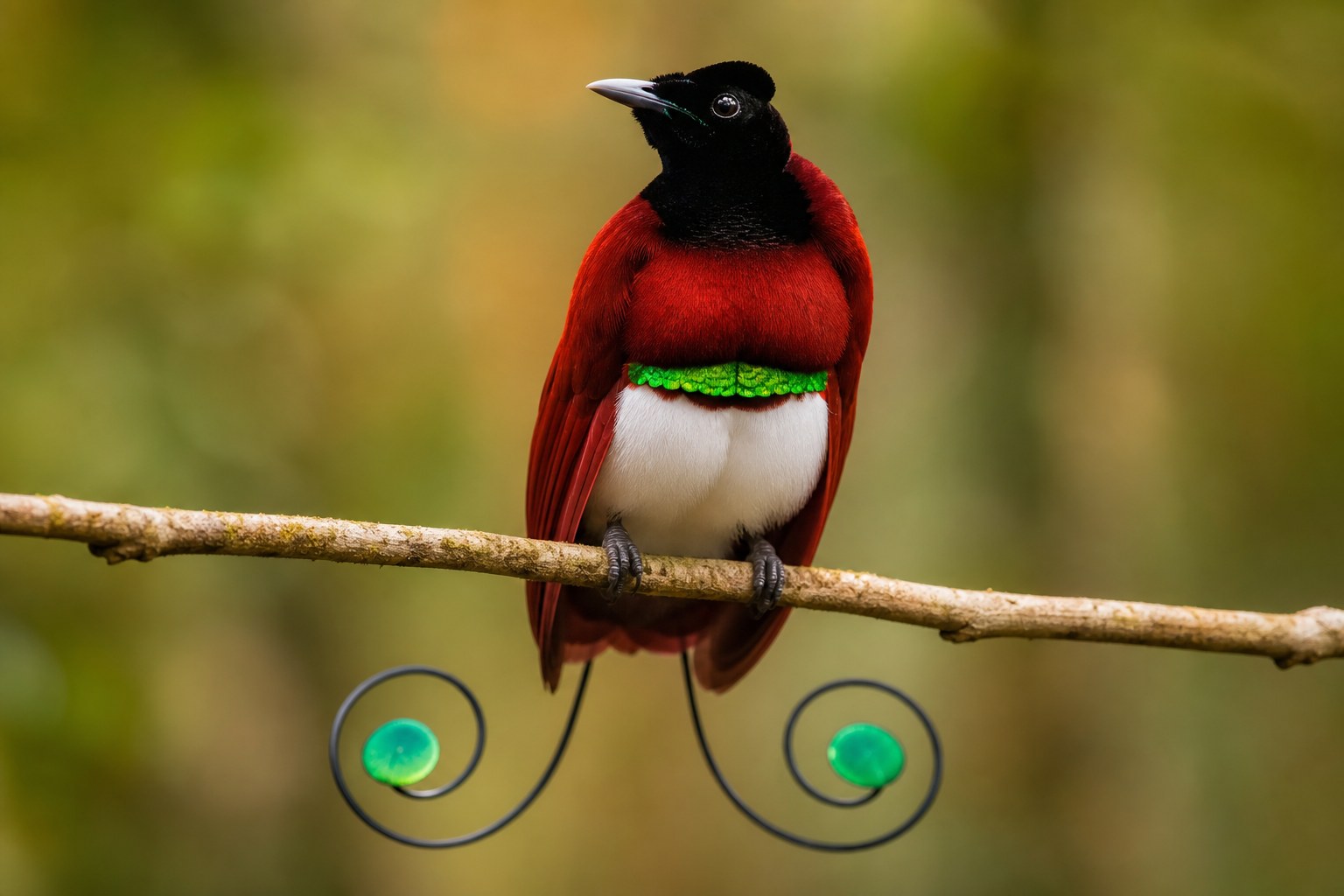
AI-generated educational wildlife portrait — World Animal Rescue Network · AI visualisation, not a photograph
In brief
The king bird-of-paradise (Cicinnurus regius) is the smallest of the roughly 45 bird-of-paradise species at about 16 cm, found in the lowland forests of New Guinea and nearby islands; the crimson male displays by fanning iridescent flank plumes and hanging upside down from a branch.
Also in Animals A to Z · Animals that start with K
By WARN Research & Conservation Team Last updated
The king bird-of-paradise is the smallest member of the most extravagantly ornamented bird family on Earth. The male is about 16 centimetres long — smaller than a starling — and is a deep glossy crimson above and white below, with a band of iridescent green across the chest, fans of grey plumes tipped in emerald along each flank, and two bare tail wires each ending in a coiled disc of green. The display is stranger than the plumage. He calls from a chosen perch, spreads the flank fans into two shimmering discs, vibrates his wings, and then swings beneath the branch to hang upside down with the tail wires circling above him. Females, as in most of the family, are plain brown and choose among males on the strength of the performance.
~16 cm
Body length — the smallest bird-of-paradise
~45
Species in the family Paradisaeidae
2
Wire-like tail feathers ending in coiled emerald discs
Upside down
The posture the male adopts at the climax of his display
Figures sourced from IUCN Red List — Cicinnurus regius, Cornell Lab of Ornithology — Birds-of-Paradise Project, CITES Appendices .
King Bird-of-Paradise: Quick Facts
| Length | About 16 cm excluding tail wires |
|---|---|
| Male plumage | Crimson above, white below, green breast band, emerald-tipped flank fans |
| Female plumage | Plain brown — no ornament |
| Display | Fanned flank plumes, wing vibration, then hanging upside down |
| Family size | Around 45 species of bird-of-paradise |
| Closest relatives | Crows and jays (Corvidae) |
Scientific Classification
| Kingdom | Animalia |
|---|---|
| Phylum | Chordata |
| Class | Aves |
| Order | Passeriformes |
| Family | Paradisaeidae |
| Genus | Cicinnurus |
| Species | Cicinnurus regius |
Conservation Status
- IUCN Status
- Least Concern
- Population
- No reliable estimate exists
- Trend
- Decreasing
- Assessed
- 2016
- CITES
- Appendix II
Lowland forest is being cleared faster than montane forest across New Guinea, which puts lowland birds-of-paradise under greater pressure than their better-known mountain relatives despite currently secure listings.
Did you know?
Early bird-of-paradise skins reached Europe with the feet cut off by traders, which convinced naturalists the birds never landed and lived entirely on the wing. One species is still called Paradisaea apoda — 'the footless bird of paradise'.
Key Facts: King Bird-of-Paradise
- The king bird-of-paradise is the smallest of roughly 45 species in the family Paradisaeidae, at about 16 cm excluding the tail wires.
- Only the male is ornamented. Females are plain brown, which is typical of the family and is what makes the extreme male plumage possible.
- The male's display ends with him hanging upside down beneath his perch, flank fans spread and tail wires circling above.
- Birds-of-paradise are corvids' close relatives — the family sits near crows, jays and magpies rather than near any tropical group they resemble.
- Extreme male ornament evolves where females raise young alone and choose mates purely on display, so there is no cost to a male being conspicuous once he has mated.
- The nineteenth-century plume trade killed birds-of-paradise in enormous numbers for the European and American hat industry, and the family's protection dates from the campaigns that ended it.
Why are birds-of-paradise so ornate?
Because the females do all the work. In most bird-of-paradise species the female builds the nest, incubates the eggs and raises the chicks without help. A male contributes nothing after mating, which frees him from every constraint that keeps other male birds inconspicuous — he does not need to avoid drawing predators to a nest, and he does not need to be a competent parent.
What remains is a single selective pressure: be chosen. Over long periods that produces runaway sexual selection, in which female preference and male ornament escalate together. The result across the family is plumes, wires, capes, iridescent breast shields and displays that involve clearing a stage on the forest floor, dancing, transforming shape or hanging upside down. New Guinea also has relatively few large predators and abundant year-round fruit, which lowers the cost of being conspicuous and of carrying ornaments that make flying harder. Isolation on separate mountain ranges then let the process run independently many times over.
The display
A male king bird-of-paradise defends a display perch in the mid-storey and advertises with a loud call. When a female arrives he begins a fixed sequence: he raises and spreads the grey flank plumes into two fans, exposing the emerald tips so they catch the light as flat shimmering discs, then vibrates his wings and puffs the green breast band.
The finale is the part that separates him from his relatives. He swings down beneath the branch and hangs upside down by his feet, body swaying, while the two wire tail feathers with their coiled green discs circle above him. The female inspects from close range. If she is unimpressed she leaves, and he resumes calling. She will build the nest, incubate and rear the young alone.
The plume trade
Bird-of-paradise skins reached Europe long before live birds did, and because traders removed the feet before export, early naturalists believed the birds never landed — hence the genus name Paradisaea and the persistent legend that they lived permanently in the air. The name of one species, apoda, still means 'footless'.
The damage came later. Through the nineteenth and early twentieth centuries the fashion for feathered hats consumed bird-of-paradise plumes on an industrial scale, and tens of thousands of skins a year passed through the London and Paris markets. Populations of the most sought-after species were seriously depleted. The trade was ended by legislation driven by early conservation campaigners — the same movement that produced the first bird protection laws in Britain and the United States. Birds-of-paradise are now protected across their range, with traditional use by Papuan communities, for whom the plumes carry long-standing ceremonial significance, treated separately from commercial export.
How is it doing now?
The king bird-of-paradise is listed as Least Concern. It is widespread in the lowland and hill forests of New Guinea and adjacent islands, tolerates some forest disturbance better than several of its relatives, and is not currently a major target of hunting.
The pressure it faces is the one affecting the whole region: lowland forest conversion. Oil palm, logging concessions and mining have expanded across exactly the altitude band this species occupies, and lowland forest is being lost faster than montane forest across New Guinea. Species that live low are therefore more exposed than the more famous montane birds-of-paradise, even where their numbers currently look secure. As with the grey cuscus, a Least Concern listing here describes range rather than trajectory.
What WARN Does
WARN publishes free, sourced species education. Birds-of-paradise are among the most photographed birds on Earth and among the least explained — the reason they look the way they do is a specific, well-understood consequence of females raising young alone, and that is more interesting than any photograph of the plumage.
If this guide helps you understand wildlife and the pressures it faces, a gift to WARN supports habitat protection and free public education in our partner countries.
King Bird-of-Paradise: Frequently Asked Questions
How big is the king bird-of-paradise?
Why do birds-of-paradise have such elaborate feathers?
How does the king bird-of-paradise display?
What are birds-of-paradise related to?
Why were birds-of-paradise almost wiped out?
What do king bird-of-paradises eat?
Where do king bird-of-paradises live?
Are king bird-of-paradises dangerous?
How long do king bird-of-paradises live?
Sources & References
Population figures, conservation status and biological facts on this page are drawn from authoritative scientific and intergovernmental sources.
Terms used on this page
Plain-English definitions, from our wildlife and conservation glossary.
Explore more animals
Discover more animals, their habitats and their conservation status in the WARN wildlife-guide library.
Enjoyed this King Bird-of-Paradise guide?
Receive appeal updates, animal-welfare news and published funding reports. Unsubscribe any time.
We only use your address for WARN updates. See our privacy policy.