Wildlife Guide · North America
Hellbender
Cryptobranchus alleganiensis
North America's giant, fully aquatic salamander
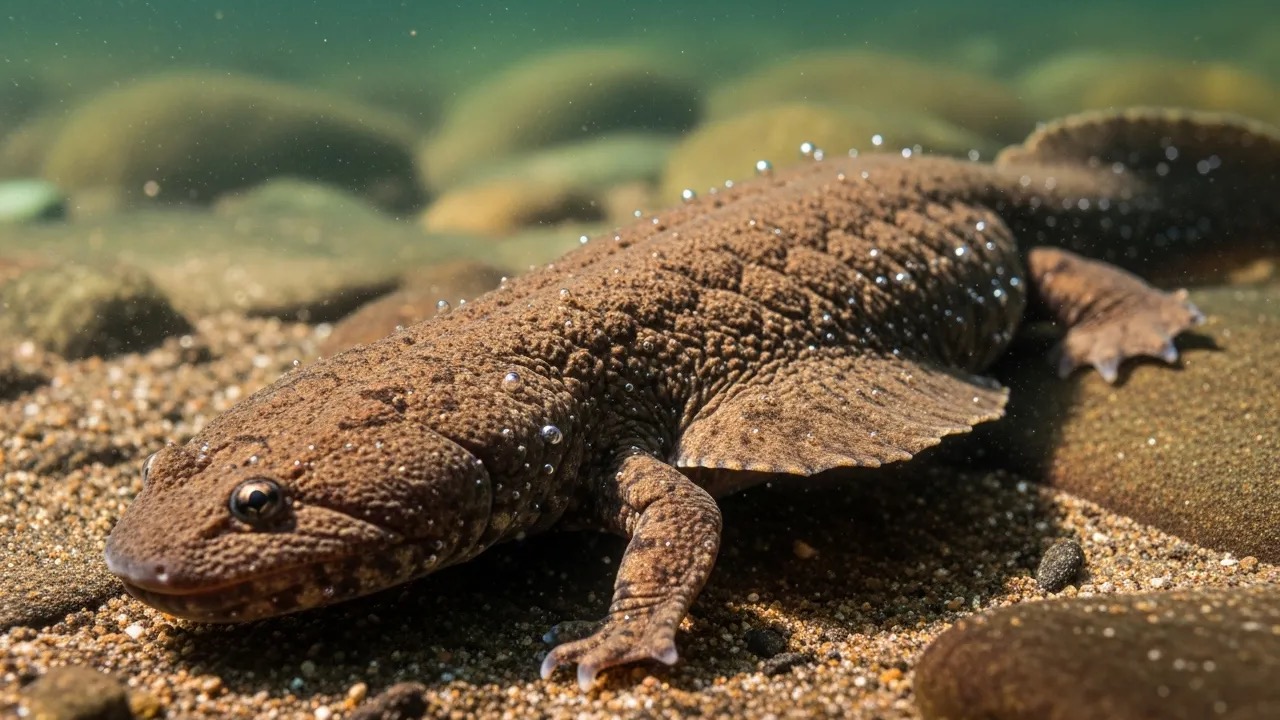
Photo: Brian Gratwicke / Wikimedia Commons (CC BY 2.0)
In brief
The hellbender is the largest salamander in North America, reaching up to 74 cm (29 in) long. It is fully aquatic, living its whole life in clean, fast-flowing streams where it breathes mainly through the wrinkled folds of its skin.
Also in Animals A to Z · Animals that start with H
By WARN Research & Conservation Team Last updated
The hellbender is the largest salamander in North America, reaching up to 74 cm (29 in) long. It is fully aquatic, living its whole life in clean, fast-flowing streams where it breathes mainly through the wrinkled folds of its skin. Hellbenders are long-lived, often surviving 25 to 30 years.
0.6 m
Typical length
1.5 kg
Typical weight
3 km/h
Top speed
28 yrs
Lifespan
Figures sourced from IUCN Red List — Cryptobranchus alleganiensis, Wikipedia — Hellbender, Wikidata — Hellbender .
Hellbender: Quick Facts
| Scientific name | Cryptobranchus alleganiensis |
|---|---|
| Diet | Carnivore (crayfish, small fish) |
| Habitat | Clean, fast-flowing rocky streams and rivers |
| Lifespan | 25–30 years |
| Weight | Up to about 1.5 kg (3.3 lb) |
| Size | 30–74 cm (12–29 in) body length |
| Conservation status | Vulnerable (IUCN) |
Scientific Classification
| Kingdom | Animalia |
|---|---|
| Phylum | Chordata |
| Class | Amphibia |
| Order | Urodela |
| Family | Cryptobranchidae |
| Genus | Cryptobranchus |
Conservation Status
- IUCN Status
- Vulnerable (IUCN Red List category)
- Population
- Global population not compiled for this guide
- Trend
- See the IUCN Red List assessment
- Assessed
- See the IUCN Red List assessment
- CITES
- See CITES appendices
Conservation figures are drawn from the IUCN Red List and CITES; this guide links to the authoritative sources rather than restating population counts.
Key Facts: Hellbender
- Hellbenders are secretive, mostly nocturnal salamanders that hide by day under large flat rocks in the streambed.
- Hellbenders are carnivores whose diet is dominated by crayfish, along with small fish and aquatic insects.
- This giant salamander lives in cool, clear, fast-flowing rivers and streams of the eastern and central United States, particularly in the Appalachian region.
Behavior and breathing
Hellbenders are secretive, mostly nocturnal salamanders that hide by day under large flat rocks in the streambed. They are fully aquatic and absorb most of their oxygen directly through the heavily wrinkled folds of skin along their bodies, which increase surface area in cool, oxygen-rich water. They rarely leave the stream and rely on clean, flowing water to survive.
Diet and feeding
Hellbenders are carnivores whose diet is dominated by crayfish, along with small fish and aquatic insects. They hunt at night, using suction and a quick sideways snap of the jaws to capture prey. Healthy crayfish populations are essential to their survival.
Habitat and range
This giant salamander lives in cool, clear, fast-flowing rivers and streams of the eastern and central United States, particularly in the Appalachian region. It needs rocky stream bottoms with large flat stones for shelter and nesting. Because it breathes through its skin, it is extremely sensitive to silt and pollution.
Conservation
Hellbenders are listed as Vulnerable and have declined sharply across much of their range. The main threats are water pollution, siltation from erosion, dams, and disease, all of which degrade the clean streams they depend on. Captive breeding and stream restoration programs are working to recover populations.
What WARN Does
WARN does not run a dedicated hellbender programme — this guide is part of the World Animal Rescue Network's free educational library. The hellbender faces documented conservation pressure in the wild, which is why clear, sourced public information about it matters. Building public understanding of species like the hellbender supports the broader conservation awareness that underpins WARN's partner-led rescue work across its network.
If clear, science-based wildlife guides like this help you understand and value animals, please consider supporting the World Animal Rescue Network's educational and rescue work so we can keep producing them.
Hellbender: Frequently Asked Questions
How big do hellbenders get?
How do hellbenders breathe?
What do hellbenders eat?
Are hellbenders endangered?
Are hellbenders dangerous to people?
Where do hellbenders live?
How long do hellbenders live?
Sources & References
Population figures, conservation status and biological facts on this page are drawn from authoritative scientific and intergovernmental sources.
Terms used on this page
Plain-English definitions, from our wildlife and conservation glossary.
Latest Hellbender Stories
Quick, fact-checked reads on the hellbender — amazing facts, key questions and the threats it faces.
Species
12 Amazing Facts About Grey Wolves (And Why Alpha Wolves Aren't Real)
A howl that carries 16 km, a pack that is really a family, and the debunked study behind the 'alpha wolf' myth. Twelve verified facts.
Read the storySpecies
12 Amazing Facts About Beavers (Iron in Their Teeth, and They Rebuild Rivers)
Orange iron-hardened incisors, transparent eyelids, and a keystone role that reduces flooding and drought. Twelve facts.
Read the storySpecies
12 Amazing Facts About Wolverines (They Take Down Prey Five Times Their Size)
Frost-resistant fur, jaws that crush frozen bone, and territories the size of small countries. Twelve verified facts.
Read the storyExplore more animals
Discover more animals, their habitats and their conservation status in the WARN wildlife-guide library.
Enjoyed this Hellbender guide?
Receive appeal updates, animal-welfare news and published funding reports. Unsubscribe any time.
We only use your address for WARN updates. See our privacy policy.