Wildlife Guide · Africa
Goliath Frog
Conraua goliath
The largest frog on Earth
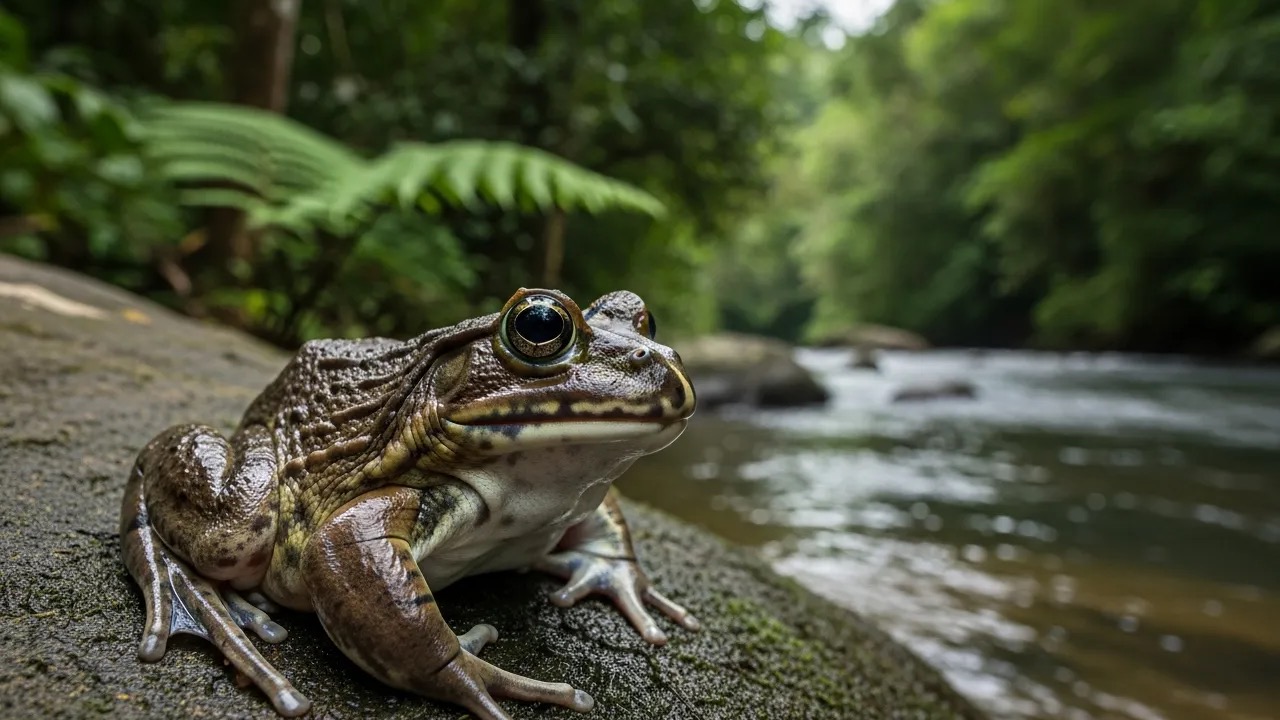
Photo: jeanlouisamiet / Wikimedia Commons (CC BY 4.0)
In brief
The Goliath frog is the largest living frog, growing up to 32 cm (13 in) long and weighing as much as 3.3 kg (7.3 lb). It lives only in fast-flowing rivers of Cameroon and Equatorial Guinea in West Africa.
Also in Animals A to Z · Animals that start with G
By WARN Research & Conservation Team Last updated
The Goliath frog is the largest living frog, growing up to 32 cm (13 in) long and weighing as much as 3.3 kg (7.3 lb). It lives only in fast-flowing rivers of Cameroon and Equatorial Guinea in West Africa. This powerful frog is endangered and can live around 15 years.
0.32 m
Typical length
3.3 kg
Typical weight
12 km/h
Top speed
15 yrs
Lifespan
Figures sourced from IUCN Red List — Conraua goliath, Wikipedia — Goliath Frog, Wikidata — Goliath Frog .
Goliath Frog: Quick Facts
| Scientific name | Conraua goliath |
|---|---|
| Diet | Carnivore (insects, crustaceans, small animals) |
| Habitat | Fast-flowing rainforest rivers and waterfalls |
| Lifespan | About 15 years |
| Weight | Up to 3.3 kg (7.3 lb) |
| Size | Up to 32 cm (13 in) body length |
| Conservation status | Endangered (IUCN) |
Scientific Classification
| Kingdom | Animalia |
|---|---|
| Phylum | Chordata |
| Class | Amphibia |
| Order | Anura |
| Family | Conrauidae |
| Genus | Conraua |
Conservation Status
- IUCN Status
- Endangered (IUCN Red List category)
- Population
- Global population not compiled for this guide
- Trend
- See the IUCN Red List assessment
- Assessed
- See the IUCN Red List assessment
- CITES
- See CITES appendices
Conservation figures are drawn from the IUCN Red List and CITES; this guide links to the authoritative sources rather than restating population counts.
Key Facts: Goliath Frog
- Despite their size, Goliath frogs are wary and quick to dive into rushing water when disturbed.
- Goliath frogs are carnivores that ambush prey near and in fast water.
- This giant frog has a small range in the rainforests of Cameroon and Equatorial Guinea, where it depends on clean, fast-flowing rivers and waterfalls.
Behavior and strength
Despite their size, Goliath frogs are wary and quick to dive into rushing water when disturbed. They are remarkably strong and have been observed moving rocks weighing several kilograms to build small breeding pools at the river's edge. Lacking a vocal sac, they communicate with whistles and an open-mouthed call rather than a typical croak.
Diet and feeding
Goliath frogs are carnivores that ambush prey near and in fast water. Adults eat insects, crustaceans, worms, fish, and other amphibians, and large individuals can take small snakes or even baby turtles. Powerful hind legs let them lunge at prey and leap several meters.
Habitat and range
This giant frog has a small range in the rainforests of Cameroon and Equatorial Guinea, where it depends on clean, fast-flowing rivers and waterfalls. It needs well-oxygenated water and rocky riverbanks for breeding. Its narrow habitat makes it especially vulnerable to disturbance.
Conservation
The Goliath frog is listed as Endangered, with populations falling due to habitat destruction from logging and agriculture, river pollution, and collection for food and the pet trade. Its limited range and slow reproduction make recovery difficult. Protecting intact river forest is essential to its survival.
What WARN Does
WARN does not run a dedicated goliath frog programme — this guide is part of the World Animal Rescue Network's free educational library. The goliath frog faces documented conservation pressure in the wild, which is why clear, sourced public information about it matters. Building public understanding of species like the goliath frog supports the broader conservation awareness that underpins WARN's partner-led rescue work across its network.
If clear, science-based wildlife guides like this help you understand and value animals, please consider supporting the World Animal Rescue Network's educational and rescue work so we can keep producing them.
Goliath Frog: Frequently Asked Questions
How big is the Goliath frog?
Where do Goliath frogs live?
What do Goliath frogs eat?
Are Goliath frogs endangered?
Can Goliath frogs jump far?
Are goliath frogs dangerous?
How long do goliath frogs live?
Sources & References
Population figures, conservation status and biological facts on this page are drawn from authoritative scientific and intergovernmental sources.
Terms used on this page
Plain-English definitions, from our wildlife and conservation glossary.
Latest Goliath Frog Stories
Quick, fact-checked reads on the goliath frog — amazing facts, key questions and the threats it faces.
Guides
Pangolin Species Explained: All Eight of the World's Most Trafficked Mammal
There are eight pangolin species — four in Africa and four in Asia. All eight are trafficked. Here is the briefing.
Read the storySpecies
Tiger vs Lion: 7 Key Differences Between the Two Biggest Cats
Tigers are bigger, stripier and solitary; lions are social and live in prides. Here's how the two largest cats really differ in size, habitat and behaviour.
Read the storySpecies
Asian vs African Elephant: 7 Key Differences
Ears, back shape, tusks and size all set Asian and African elephants apart. Here is a clear, science-backed guide to telling the world's three elephant species apart.
Read the storyExplore more animals
Discover more animals, their habitats and their conservation status in the WARN wildlife-guide library.
Enjoyed this Goliath Frog guide?
Receive appeal updates, animal-welfare news and published funding reports. Unsubscribe any time.
We only use your address for WARN updates. See our privacy policy.