Wildlife Guide · Galápagos Islands, Ecuador
Galápagos Tortoise
Chelonoidis niger species complex (Quoy & Gaimard, 1824) — 12 surviving species
Hunted to 3,000 animals, brought back to 60,000 — the clearest recovery story in conservation.
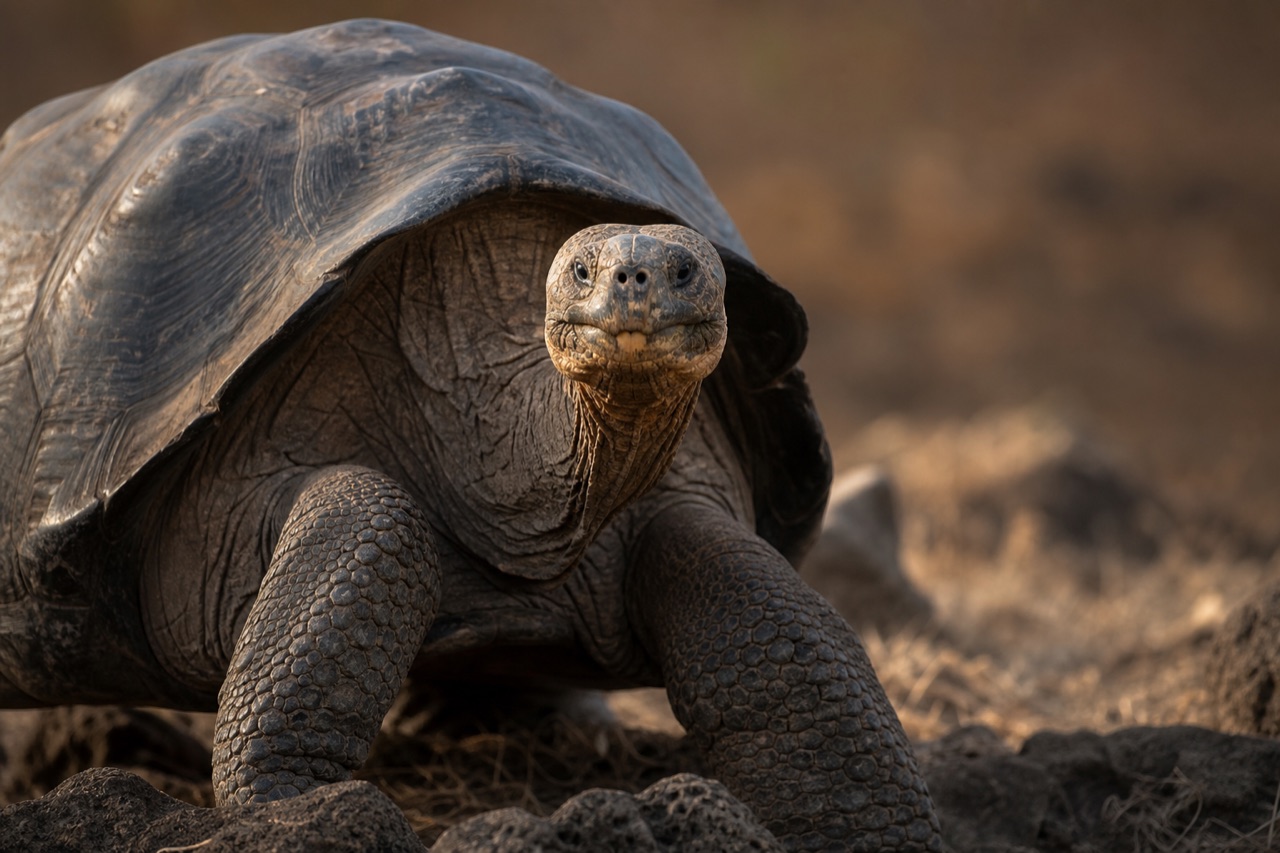
AI-generated educational wildlife portrait — World Animal Rescue Network · AI visualisation, not a photograph
In brief
The Galápagos tortoise is the world's largest tortoise, reaching over 400 kg and living beyond 100 years; hunted from an estimated 200,000 animals down to about 3,000 by the 1970s, captive breeding and invasive-species removal have since recovered the population to around 60,000.
Also in Animals A to Z · Animals that start with G
How you can help
You can support the related appeal — read its purpose, recipient status and fund terms first — or give once to where it is needed most. Sharing accurate information helps too.
By WARN Research & Conservation Team Last updated
The Galápagos tortoise is the largest living tortoise, reaching over 400 kg and routinely living beyond 100 years. It is also one of the very few species on this site whose numbers are going the right way. Whalers and sealers took an estimated 200,000 tortoises through the eighteenth and nineteenth centuries, keeping them alive in ships' holds for months as fresh meat. Introduced goats, rats and pigs then ate the vegetation and the eggs. By the 1970s roughly 3,000 remained. Captive breeding, invasive-species removal and repatriation have brought the total to around 60,000. Two species were lost along the way, and the rest are still classed as threatened — but this is what conservation looks like when it is funded before the population reaches double digits.
417 kg
Heaviest recorded — the largest tortoise alive
100–150+ yr
Typical lifespan, with credible records well beyond
~3,000
Total population at the 1970s low point
~60,000
Population today, after five decades of recovery work
Figures sourced from IUCN Red List — Chelonoidis niger, Galápagos Conservancy — Giant Tortoise Restoration Initiative, CITES Appendices .
Galápagos Tortoise: Quick Facts
| Maximum weight | 417 kg — the largest living tortoise |
|---|---|
| Lifespan | Over 100 years; credible records beyond 150 |
| Survival without food or water | Many months |
| Population, 1970s | Around 3,000 |
| Population today | Around 60,000 |
| Species lost | Pinta Island (2012) and Floreana |
Scientific Classification
| Kingdom | Animalia |
|---|---|
| Phylum | Chordata |
| Class | Reptilia |
| Order | Testudines |
| Family | Testudinidae |
| Genus | Chelonoidis |
| Species | Chelonoidis niger complex — 12 surviving species |
Conservation Status
- IUCN Status
- Vulnerable — individual species range from Vulnerable to Critically Endangered
- Population
- Around 60,000 across all surviving species
- Trend
- Increasing
- Assessed
- 2016 and later, varying by species
- CITES
- Appendix I
One of the strongest recovery records in conservation. Captive breeding, eradication of goats and rats, and repatriation of reared juveniles lifted the population roughly twentyfold from its 1970s low.
Did you know?
Diego the Española tortoise fathered an estimated 800 offspring in captivity — roughly 40% of his species' living population — and was released back onto his home island in 2020 after his job was finished.
Key Facts: Galápagos Tortoise
- The Galápagos tortoise is the largest living tortoise, with the heaviest recorded individual at 417 kg.
- It is one of the longest-lived vertebrates, routinely passing 100 years and with credible records beyond 150.
- Whalers and sealers took an estimated 200,000 tortoises, storing them alive in ships' holds because they survive months without food or water.
- Shell shape tracks island vegetation: domed shells on wet islands with ground plants, saddleback shells on dry islands where tortoises must reach up for cactus pads.
- Lonesome George, the last Pinta Island tortoise, died in 2012 — the extinction of an entire species, in public, in the twenty-first century.
- Diego, an Española tortoise repatriated from San Diego Zoo, fathered an estimated 800 offspring and was returned to the wild in 2020 after his species' recovery.
- The population has risen from around 3,000 in the 1970s to roughly 60,000 through captive breeding, goat and rat eradication, and repatriation of juveniles.
How they were nearly wiped out
Galápagos tortoises can survive for many months without food or water, metabolising fat reserves and the water stored in their bodies. For eighteenth and nineteenth-century whaling and sealing crews, that made them a perfect provision: living meat that needed no feeding and stayed fresh indefinitely. Ships stacked them in their holds by the dozen.
An estimated 200,000 tortoises were taken. Crews preferentially took females, which are smaller and were found lower on the islands, which skewed the surviving populations badly. Settlers then introduced goats, which stripped the vegetation tortoises fed on, and rats and pigs, which ate eggs and hatchlings. Some islands lost their tortoises entirely. By the time serious conservation began in the 1960s, several populations were down to a few dozen animals.
The recovery, and what made it work
Three things were done, and all three were necessary. Captive breeding centres, most importantly the Fausto Llerena centre on Santa Cruz, incubated eggs and reared juveniles past the age at which rats kill them. Invasive species were removed — the eradication of around 79,000 goats from Isabela and Santiago was one of the largest island restoration operations ever attempted. And juveniles were repatriated to their island of origin once big enough to survive.
The Española population is the clearest result. It was reduced to 14 animals — 12 females and two males, too widely scattered to find each other. A third male, Diego, was located at San Diego Zoo and repatriated. From those 15 animals, the captive programme produced over 2,000 tortoises, and Española now has a self-sustaining wild population. Diego, credited with an estimated 800 offspring, was returned to the island in 2020.
Why the shells are different shapes
Galápagos tortoise shells come in two broad forms, and the difference is about food. On larger, wetter, higher islands where vegetation grows at ground level, tortoises have domed shells and short necks — there is no need to reach upward, and a domed shell offers more protection.
On drier, lower islands, the available food is largely prickly pear cactus growing well above the ground. Tortoises there have saddleback shells, raised sharply at the front, plus longer necks and legs, allowing them to stretch upward for cactus pads. Darwin noted during the Beagle voyage that the vice-governor claimed to identify a tortoise's island from its shell, and that observation fed into his thinking about how isolated populations diverge. The tortoises are one of the reasons the Galápagos matter to biology at all.
Lonesome George and what he represented
George was found on Pinta Island in 1971, by which point the island's tortoises had been assumed extinct for decades — goats had stripped the vegetation, and no others were ever found. He was moved to the Santa Cruz breeding centre and became the most famous tortoise in the world, with an international search for a mate that ran for forty years. Females of closely related species were paired with him; no viable offspring resulted.
He died on 24 June 2012, and Chelonoidis abingdonii went extinct with him. What makes George significant is that this happened in full public view, with resources, expertise and global attention available, and it still could not be reversed. He had been the last of his species since before he was found. The lesson conservationists draw from him is the one that runs through every extinction: by the time a species is down to one individual, the outcome was decided decades earlier.
What WARN Does
WARN publishes free, sourced species education, including the cases where conservation has demonstrably worked. The Galápagos tortoise recovery — from around 3,000 animals to 60,000 — is one of the strongest available arguments that funded intervention changes outcomes, and it deserves to be as widely known as the losses.
If this guide helps you understand wildlife and the pressures it faces, a gift to WARN supports habitat protection and free public education in our partner countries.
How can I help save the galápagos tortoise?
Explore practical ways to support the galápagos tortoise, from everyday choices and sharing reliable information to reviewing a related appeal before giving.
Explore ways to support
Read the related appeal’s purpose, recipient status and fund terms. Choose an affordable gift after checking what is proposed and what has been reported.
Ease the pressures
Avoid the wildlife trade and souvenirs, never buy wild animals as pets, and choose sustainable, habitat-friendly products — the threats behind the galápagos tortoise's decline fall when demand does.
Spread the word
Share accurate, sourced information about the galápagos tortoise. Wider awareness is what turns concern into lasting protection.
Galápagos Tortoise: Frequently Asked Questions
How can I help save the galápagos tortoise?
How long do Galápagos tortoises live?
How big do Galápagos tortoises get?
Why were Galápagos tortoises hunted?
Who was Lonesome George?
Are Galápagos tortoises still endangered?
Why do some have saddle-shaped shells?
What do Galápagos tortoises eat?
Where do Galápagos tortoises live?
Are Galápagos tortoises dangerous?
Sources & References
Population figures, conservation status and biological facts on this page are drawn from authoritative scientific and intergovernmental sources.
Terms used on this page
Plain-English definitions, from our wildlife and conservation glossary.
Explore more animals
Discover more animals, their habitats and their conservation status in the WARN wildlife-guide library.
Enjoyed this Galápagos Tortoise guide?
Receive appeal updates, animal-welfare news and published funding reports. Unsubscribe any time.
We only use your address for WARN updates. See our privacy policy.