Wildlife Guide · North America
American Bullfrog
Lithobates catesbeianus
North America's largest and loudest frog
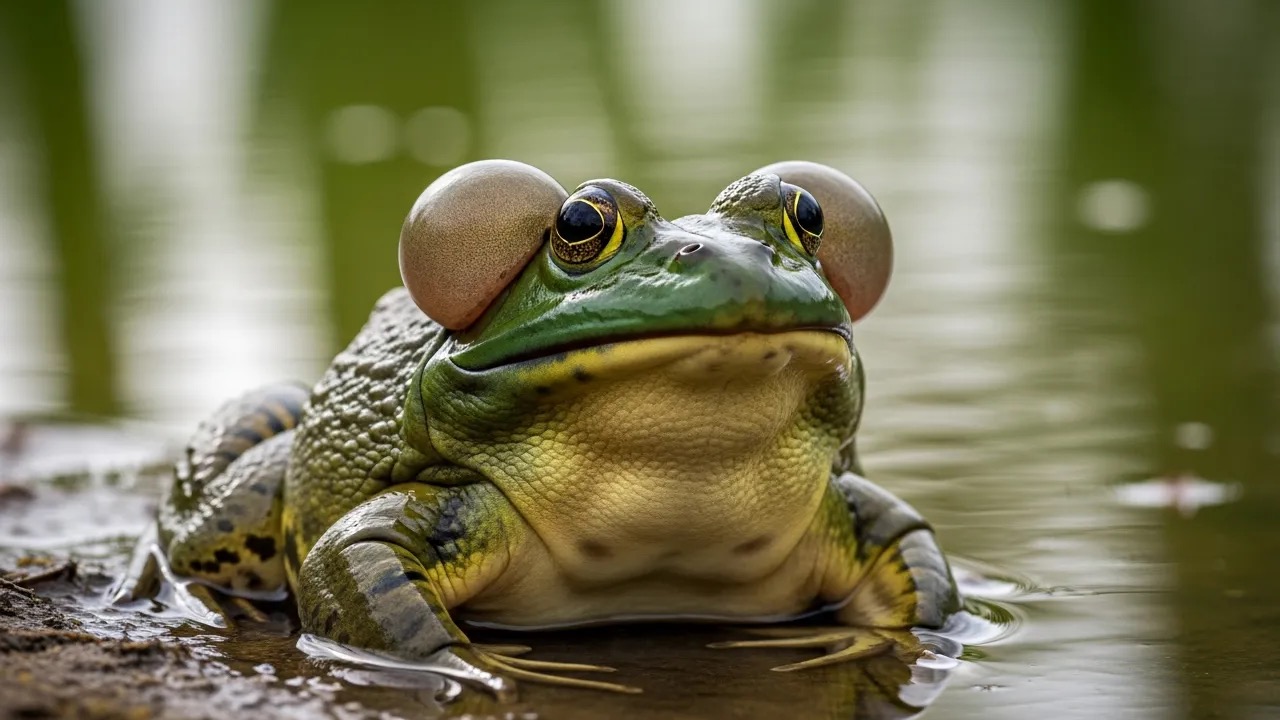
Photo: Carl D. Howe / Wikimedia Commons (CC BY-SA 2.5)
In brief
The American bullfrog (Lithobates catesbeianus) is North America's largest frog, reaching 9 to 20 cm in body length and weighing up to about 0.5 kg. It lives in and around ponds, lakes, marshes and slow streams, where the male's deep, resonant call carries far across the water.
Also in Animals A to Z · Animals that start with A
By WARN Research & Conservation Team Last updated
The American bullfrog (Lithobates catesbeianus) is North America's largest frog, reaching 9 to 20 cm in body length and weighing up to about 0.5 kg. It lives in and around ponds, lakes, marshes and slow streams, where the male's deep, resonant call carries far across the water. A voracious carnivore, it will eat almost anything it can swallow, from insects to fish and small vertebrates. In the wild bullfrogs live around seven to nine years.
0.2 m
Typical length
500 g
Typical weight
16 km/h
Top speed
8 yrs
Lifespan
Figures sourced from IUCN Red List — Lithobates catesbeianus, Wikidata — American Bullfrog .
American Bullfrog: Quick Facts
| Scientific name | Lithobates catesbeianus |
|---|---|
| Diet | Carnivore (insects, fish, small vertebrates) |
| Habitat | Ponds, lakes, marshes, slow streams |
| Lifespan | 7–9 years in the wild |
| Weight | Up to 0.5 kg (1.1 lb) |
| Size | 9–20 cm (3.5–8 in) body length |
| Conservation status | Least Concern (IUCN) |
Scientific Classification
| Kingdom | Animalia |
|---|---|
| Phylum | Chordata |
| Class | Amphibia |
| Order | Anura |
| Family | Ranidae |
| Genus | Lithobates |
Conservation Status
- IUCN Status
- Least Concern (IUCN Red List category)
- Population
- Global population not compiled for this guide
- Trend
- See the IUCN Red List assessment
- Assessed
- See the IUCN Red List assessment
- CITES
- See CITES appendices
Conservation figures are drawn from the IUCN Red List and CITES; this guide links to the authoritative sources rather than restating population counts.
Key Facts: American Bullfrog
- The American bullfrog is a heavyweight among frogs, with a body 9 to 20 cm (3.5 to 8 inches) long and a weight of up to about 0.5 kg (1.1 lb).
- Bullfrogs are ambush carnivores with an enormous appetite and famously indiscriminate tastes.
- On land the bullfrog travels in long, powerful hops, launching itself with muscular hind legs that let it clear several times its own body length in a single leap.
Size and appearance
The American bullfrog is a heavyweight among frogs, with a body 9 to 20 cm (3.5 to 8 inches) long and a weight of up to about 0.5 kg (1.1 lb). Its skin is olive-green to brownish, often mottled, with a pale, sometimes yellow throat in breeding males. A prominent fold of skin curves around each large, exposed eardrum, or tympanum, which in males is noticeably bigger than the eye. Powerful, fully webbed hind feet make it a strong swimmer and an impressive jumper.
Diet and feeding
Bullfrogs are ambush carnivores with an enormous appetite and famously indiscriminate tastes. They eat insects, fish and small vertebrates, and larger individuals will take anything they can cram into their mouths, including other frogs, small snakes, mice, and even ducklings. The frog sits motionless until prey comes within range, then lunges forward and engulfs it, using its bulging eyes to help push the meal down its throat. This willingness to eat almost anything has helped it thrive across a wide range of wetlands.
Movement on land and water
On land the bullfrog travels in long, powerful hops, launching itself with muscular hind legs that let it clear several times its own body length in a single leap. In the water it is an accomplished swimmer, its webbed feet driving it forward with strong kicks and its top speed reaching around 16 km/h (10 mph). When startled at the water's edge it will make a rapid dive, kicking down into mud or vegetation to hide. This ability to both hop and swim lets it move easily between land and water to hunt and escape danger.
The bullfrog's call
The bullfrog takes its name from the male's deep, booming call, often written as a resonant jug-o-rum that carries far across a pond on warm nights. He produces the sound by pumping air back and forth over his vocal cords while inflating a large throat sac, and the low pitch travels much further than the calls of smaller frogs. Males call to defend territory and to attract females during the breeding season, and a chorus of many bullfrogs can be heard from a considerable distance. Each male's call also signals his size, since bigger frogs produce deeper notes.
Life cycle and tadpoles
Bullfrogs breed in late spring and summer, and a single female can lay a film of up to twenty thousand eggs across the water's surface. The tadpoles are exceptionally large and can take one to three years to complete their transformation into froglets, depending on climate. During this long larval stage they graze on algae and plant matter before switching to a carnivorous adult diet. Adult bullfrogs typically live around seven to nine years in the wild.
What WARN Does
WARN does not run a dedicated american bullfrog programme — this guide is part of the World Animal Rescue Network's free educational library. The american bullfrog is currently widespread and not globally threatened, and this guide helps readers understand the pressures that can change that. Building public understanding of species like the american bullfrog supports the broader conservation awareness that underpins WARN's partner-led rescue work across its network.
If clear, science-based wildlife guides like this help you understand and value animals, please consider supporting the World Animal Rescue Network's educational and rescue work so we can keep producing them.
American Bullfrog: Frequently Asked Questions
How big do American bullfrogs get?
What do bullfrogs eat?
Why are bullfrogs so loud?
How long do bullfrogs live?
Can bullfrogs jump far?
Are bullfrogs invasive?
Where do bullfrogs live?
Are bullfrogs dangerous?
Sources & References
Population figures, conservation status and biological facts on this page are drawn from authoritative scientific and intergovernmental sources.
Terms used on this page
Plain-English definitions, from our wildlife and conservation glossary.
Latest American Bullfrog Stories
Quick, fact-checked reads on the american bullfrog — amazing facts, key questions and the threats it faces.
Species
12 Amazing Facts About Grey Wolves (And Why Alpha Wolves Aren't Real)
A howl that carries 16 km, a pack that is really a family, and the debunked study behind the 'alpha wolf' myth. Twelve verified facts.
Read the storySpecies
12 Amazing Facts About Beavers (Iron in Their Teeth, and They Rebuild Rivers)
Orange iron-hardened incisors, transparent eyelids, and a keystone role that reduces flooding and drought. Twelve facts.
Read the storySpecies
12 Amazing Facts About Wolverines (They Take Down Prey Five Times Their Size)
Frost-resistant fur, jaws that crush frozen bone, and territories the size of small countries. Twelve verified facts.
Read the storyExplore more animals
Discover more animals, their habitats and their conservation status in the WARN wildlife-guide library.
Enjoyed this American Bullfrog guide?
Receive appeal updates, animal-welfare news and published funding reports. Unsubscribe any time.
We only use your address for WARN updates. See our privacy policy.