Wildlife Guide · North America & South America
Boa Constrictor
Boa constrictor
The powerful constricting snake of the Americas
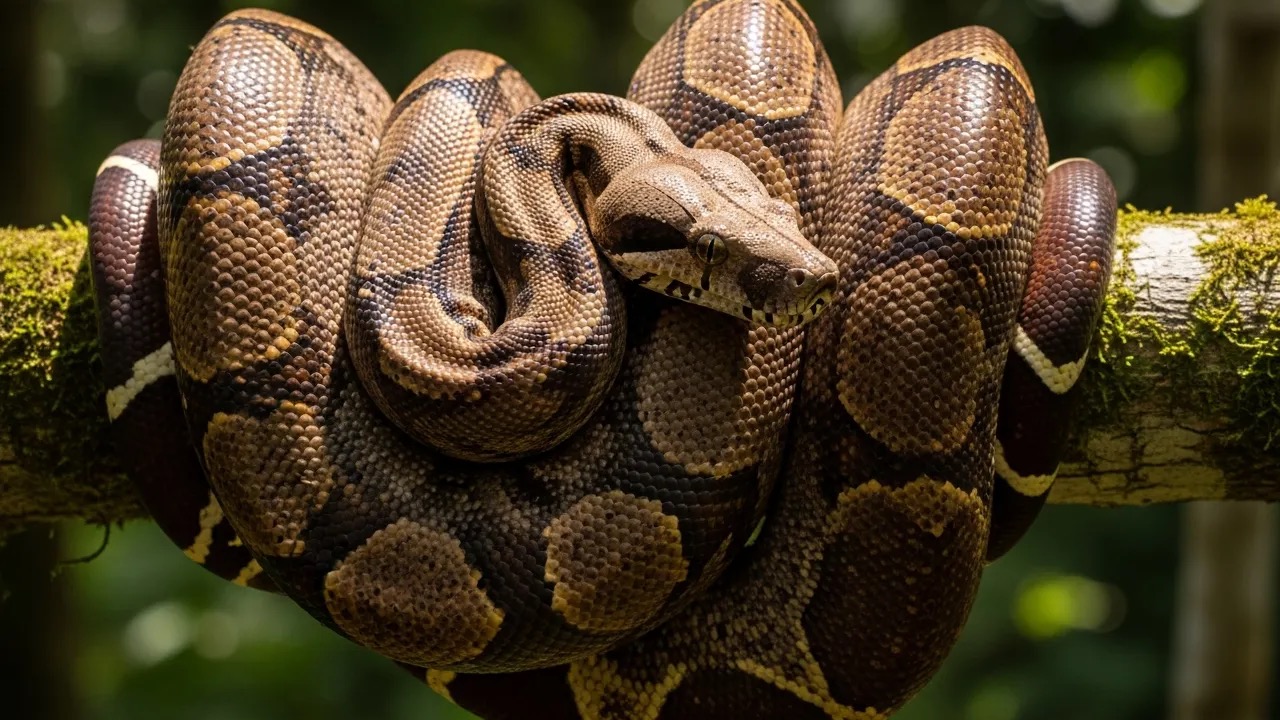
Photo: Charles J. Sharp / Wikimedia Commons (CC BY-SA 4.0)
In brief
The boa constrictor (Boa constrictor) is a large, heavy-bodied, non-venomous snake native to tropical forests, savannas, and deserts across Central and South America. It typically reaches 2 to 3 m and weighs around 10 to 15 kg, killing prey not with venom but by coiling around it and squeezing until it can no longer breathe.
Also in Animals A to Z · Animals that start with B
By WARN Research & Conservation Team Last updated
The boa constrictor (Boa constrictor) is a large, heavy-bodied, non-venomous snake native to tropical forests, savannas, and deserts across Central and South America. It typically reaches 2 to 3 m and weighs around 10 to 15 kg, killing prey not with venom but by coiling around it and squeezing until it can no longer breathe. A slow-moving ambush hunter, the boa can live 20 to 30 years and is listed as Least Concern.
3 m
Typical length
15 kg
Typical weight
5 km/h
Top speed
25 yrs
Lifespan
Figures sourced from IUCN Red List — Boa constrictor, Wikipedia — Boa Constrictor, Wikidata — Boa Constrictor .
Boa Constrictor: Quick Facts
| Scientific name | Boa constrictor |
|---|---|
| Diet | Carnivore |
| Habitat | Tropical forests, savannas, and deserts |
| Lifespan | 20–30 years |
| Length | 2–3 m (6.5–10 ft) |
| Weight | 10–15 kg (22–33 lb) |
| Conservation status | Least Concern (IUCN) |
Scientific Classification
| Kingdom | Animalia |
|---|---|
| Phylum | Chordata |
| Class | Reptilia |
| Order | Squamata |
| Family | Boidae |
| Genus | Boa |
Conservation Status
- IUCN Status
- Least Concern (IUCN Red List category)
- Population
- Global population not compiled for this guide
- Trend
- See the IUCN Red List assessment
- Assessed
- See the IUCN Red List assessment
- CITES
- See CITES appendices
Conservation figures are drawn from the IUCN Red List and CITES; this guide links to the authoritative sources rather than restating population counts.
Key Facts: Boa Constrictor
- The boa constrictor is a thick, muscular snake that commonly grows to 2 to 3 m, with females larger than males and weighing up to around 15 kg.
- The boa constrictor is non-venomous and kills entirely by constriction, as its name suggests.
- Boas are carnivores that eat a wide range of warm-blooded prey, from rodents, birds, and bats to lizards and larger mammals such as opossums.
Size and appearance
The boa constrictor is a thick, muscular snake that commonly grows to 2 to 3 m, with females larger than males and weighing up to around 15 kg. Its background colour ranges from tan and brown to grey, overlaid with distinctive dark saddle-shaped markings that deepen to reddish tones towards the tail, giving rise to the nickname red-tailed boa. This patterning is superb camouflage among leaf litter and dappled forest light. Unlike venomous snakes, it has a narrow head only slightly wider than its neck and no fangs.
How it kills by constriction
The boa constrictor is non-venomous and kills entirely by constriction, as its name suggests. It seizes prey with backward-curving teeth, then throws several coils of its powerful body around the animal. Rather than crushing bones, the snake tightens its grip each time the prey exhales, cutting off blood flow and breathing until the animal quickly loses consciousness. It then swallows the meal whole, head first, its jaws stretching around prey far wider than its own head.
Diet and hunting
Boas are carnivores that eat a wide range of warm-blooded prey, from rodents, birds, and bats to lizards and larger mammals such as opossums. They are ambush hunters, lying still and camouflaged before striking with a rapid lunge. Heat-sensitive scales around the mouth help them detect the body warmth of prey in darkness. After a large meal a boa may not need to feed again for weeks.
Habitat and range
The boa constrictor ranges widely across Central and South America and some Caribbean islands, occupying a remarkable variety of habitats. It is found in tropical rainforest, dry woodland, savanna grassland, and semi-desert scrub, from sea level into the hills. Young boas often climb into trees and shrubs, while heavier adults spend more time on the ground, frequently near water. This adaptability across so many habitats is one reason the species remains widespread.
Reproduction and young
Boa constrictors give birth to live young rather than laying eggs, a trait known as ovoviviparity. The female carries the developing embryos internally and delivers a litter that can number a couple of dozen fully formed babies, each around 40 to 50 cm long. The young are independent from birth, receiving no parental care, and begin hunting small prey almost at once. They grow steadily over several years before reaching breeding size.
Conservation and people
The boa constrictor is listed as Least Concern by the IUCN, reflecting its wide range and adaptability, though some local populations are pressured by hunting for the skin trade and collection for pets. It is one of the most familiar snakes in captivity, valued in the reptile hobby for its manageable temperament and striking pattern. Introduced boas have also established themselves in a few places outside their native range. Habitat loss is the main long-term concern for wild populations.
What WARN Does
WARN does not run a dedicated boa constrictor programme — this guide is part of the World Animal Rescue Network's free educational library. The boa constrictor is currently widespread and not globally threatened, and this guide helps readers understand the pressures that can change that. Building public understanding of species like the boa constrictor supports the broader conservation awareness that underpins WARN's partner-led rescue work across its network.
If clear, science-based wildlife guides like this help you understand and value animals, please consider supporting the World Animal Rescue Network's educational and rescue work so we can keep producing them.
Boa Constrictor: Frequently Asked Questions
Are boa constrictors venomous?
How big do boa constrictors get?
What do boa constrictors eat?
How does a boa constrictor kill its prey?
Do boa constrictors lay eggs?
How long do boa constrictors live?
Where do boa constrictors live?
Are boa constrictors dangerous?
Sources & References
Population figures, conservation status and biological facts on this page are drawn from authoritative scientific and intergovernmental sources.
Terms used on this page
Plain-English definitions, from our wildlife and conservation glossary.
Latest Boa Constrictor Stories
Quick, fact-checked reads on the boa constrictor — amazing facts, key questions and the threats it faces.
Species
12 Amazing Facts About the Jaguar, the Americas' Biggest Cat
From a skull-piercing bite to a love of swimming, here are 12 fascinating, fact-checked things that make the jaguar the most powerful cat in the Americas.
Read the storySpecies
11 Amazing Facts About the Pink River Dolphin (the Amazon's Blushing Boto)
From a head that swivels 90 degrees to a blush built from battle scars, here are 11 true facts about the Amazon's pink river dolphin, the largest freshwater dolphin on Earth.
Read the storySpecies
Pink River Dolphin vs Tucuxi: How to Tell the Two Amazon Dolphins Apart
Both swim the same Amazon waters, but the pink boto and the grey tucuxi are only distant cousins. Here is how to tell them apart at a glance.
Read the storyExplore more animals
Discover more animals, their habitats and their conservation status in the WARN wildlife-guide library.
Enjoyed this Boa Constrictor guide?
Receive appeal updates, animal-welfare news and published funding reports. Unsubscribe any time.
We only use your address for WARN updates. See our privacy policy.