Wildlife Guide · Africa
African Clawed Frog
Xenopus laevis
The fully aquatic lab and pet frog
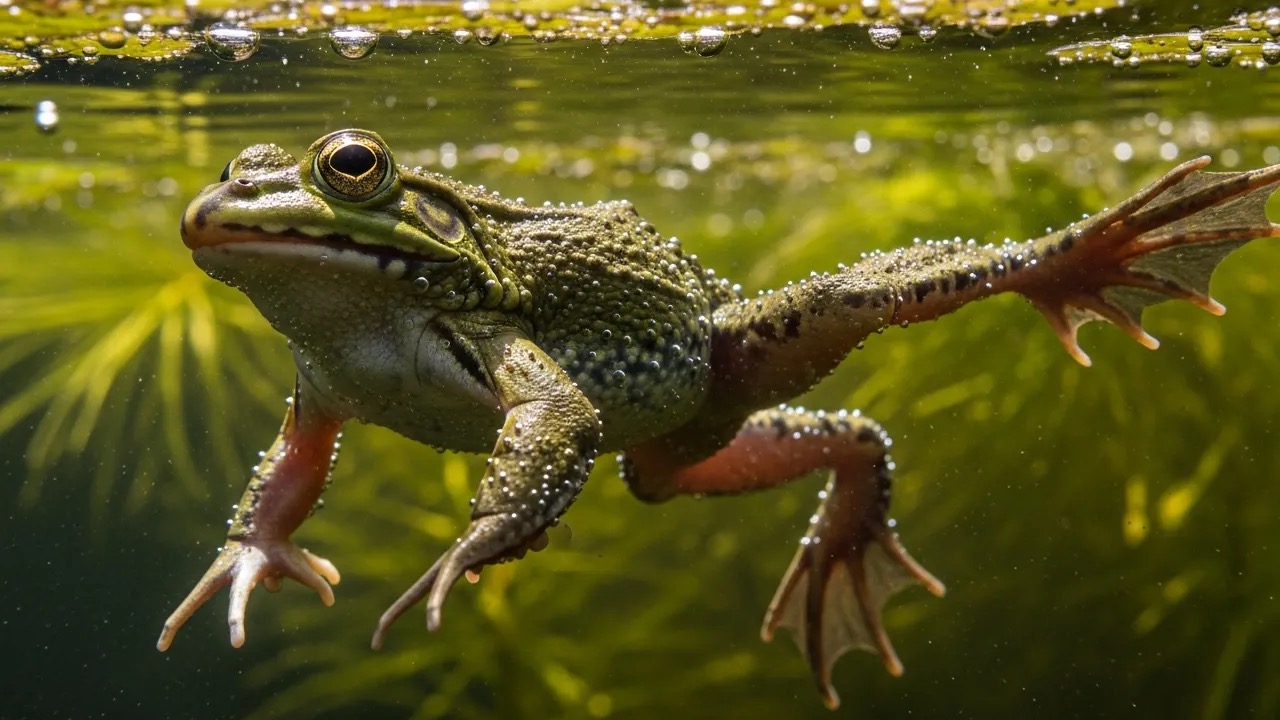
Photo: Brian Gratwicke / Wikimedia Commons (CC BY 2.0)
In brief
The African clawed frog is a fully aquatic frog from sub-Saharan Africa, named for the small dark claws on its hind feet. It has a flat body, no tongue or visible eardrum, and uses sensitive fingers and a lateral-line system to find food in murky water.
Also in Animals A to Z · Animals that start with A
By WARN Research & Conservation Team Last updated
The African clawed frog is a fully aquatic frog from sub-Saharan Africa, named for the small dark claws on its hind feet. It has a flat body, no tongue or visible eardrum, and uses sensitive fingers and a lateral-line system to find food in murky water. Widely used in scientific research and kept as a pet, it can live 15 years or more.
0.12 m
Typical length
60 g
Typical weight
5 km/h
Top speed
15 yrs
Lifespan
Figures sourced from IUCN Red List — Xenopus laevis, Wikipedia — African Clawed Frog, Wikidata — African Clawed Frog .
African Clawed Frog: Quick Facts
| Scientific name | Xenopus laevis |
|---|---|
| Diet | Carnivore (insects, worms, small animals) |
| Habitat | Ponds, lakes, and slow waters |
| Lifespan | 15+ years |
| Length | 5–12 cm (2–4.7 in) body length |
| Weight | Around 60 g (2 oz) |
| Conservation status | Least Concern (IUCN) |
Scientific Classification
| Kingdom | Animalia |
|---|---|
| Phylum | Chordata |
| Class | Amphibia |
| Order | Anura |
| Family | Pipidae |
| Genus | Xenopus |
Conservation Status
- IUCN Status
- Least Concern (IUCN Red List category)
- Population
- Global population not compiled for this guide
- Trend
- See the IUCN Red List assessment
- Assessed
- See the IUCN Red List assessment
- CITES
- See CITES appendices
Conservation figures are drawn from the IUCN Red List and CITES; this guide links to the authoritative sources rather than restating population counts.
Key Facts: African Clawed Frog
- African clawed frogs spend almost their entire lives underwater, coming to the surface only to breathe.
- These frogs are scavenging carnivores that eat insects, worms, small fish, crustaceans, and bits of carrion.
- The African clawed frog is native to ponds, lakes, and slow-moving waters across sub-Saharan Africa.
Behavior and adaptations
African clawed frogs spend almost their entire lives underwater, coming to the surface only to breathe. They lack a tongue and teeth, so they shove food into their mouths with their front fingers, and they use a sensitive lateral-line system along their bodies to detect movement in the water. The small black claws on their hind toes give the species its name and help tear apart food.
Diet and feeding
These frogs are scavenging carnivores that eat insects, worms, small fish, crustaceans, and bits of carrion. They detect prey by smell, touch, and water vibrations rather than by sight. Their hearty appetite and tolerance of a wide range of conditions make them easy to keep.
Habitat and range
The African clawed frog is native to ponds, lakes, and slow-moving waters across sub-Saharan Africa. It is extremely hardy and can survive in stagnant or polluted water and even travel short distances over land between pools. Released or escaped frogs have established invasive populations on several continents.
Use in science and conservation
Xenopus laevis is one of the most important laboratory animals, long used in developmental biology, genetics, and, historically, human pregnancy testing. The species is listed as Least Concern and is abundant both in the wild and in captivity. Its main conservation impact is as an invasive species that can spread disease to native amphibians.
What WARN Does
WARN does not run a dedicated african clawed frog programme — this guide is part of the World Animal Rescue Network's free educational library. The african clawed frog is currently widespread and not globally threatened, and this guide helps readers understand the pressures that can change that. Building public understanding of species like the african clawed frog supports the broader conservation awareness that underpins WARN's partner-led rescue work across its network.
If clear, science-based wildlife guides like this help you understand and value animals, please consider supporting the World Animal Rescue Network's educational and rescue work so we can keep producing them.
African Clawed Frog: Frequently Asked Questions
Why is it called the African clawed frog?
What do African clawed frogs eat?
How long do African clawed frogs live?
Why are African clawed frogs used in research?
Are African clawed frogs invasive?
Do African clawed frogs need land in their tank?
Where do african clawed frogs live?
How big is an african clawed frog?
Sources & References
Population figures, conservation status and biological facts on this page are drawn from authoritative scientific and intergovernmental sources.
Terms used on this page
Plain-English definitions, from our wildlife and conservation glossary.
Latest African Clawed Frog Stories
Quick, fact-checked reads on the african clawed frog — amazing facts, key questions and the threats it faces.
Guides
Pangolin Species Explained: All Eight of the World's Most Trafficked Mammal
There are eight pangolin species — four in Africa and four in Asia. All eight are trafficked. Here is the briefing.
Read the storySpecies
Tiger vs Lion: 7 Key Differences Between the Two Biggest Cats
Tigers are bigger, stripier and solitary; lions are social and live in prides. Here's how the two largest cats really differ in size, habitat and behaviour.
Read the storySpecies
Asian vs African Elephant: 7 Key Differences
Ears, back shape, tusks and size all set Asian and African elephants apart. Here is a clear, science-backed guide to telling the world's three elephant species apart.
Read the storyExplore more animals
Discover more animals, their habitats and their conservation status in the WARN wildlife-guide library.
Enjoyed this African Clawed Frog guide?
Receive appeal updates, animal-welfare news and published funding reports. Unsubscribe any time.
We only use your address for WARN updates. See our privacy policy.