Guide 1
Why this bird and not the others
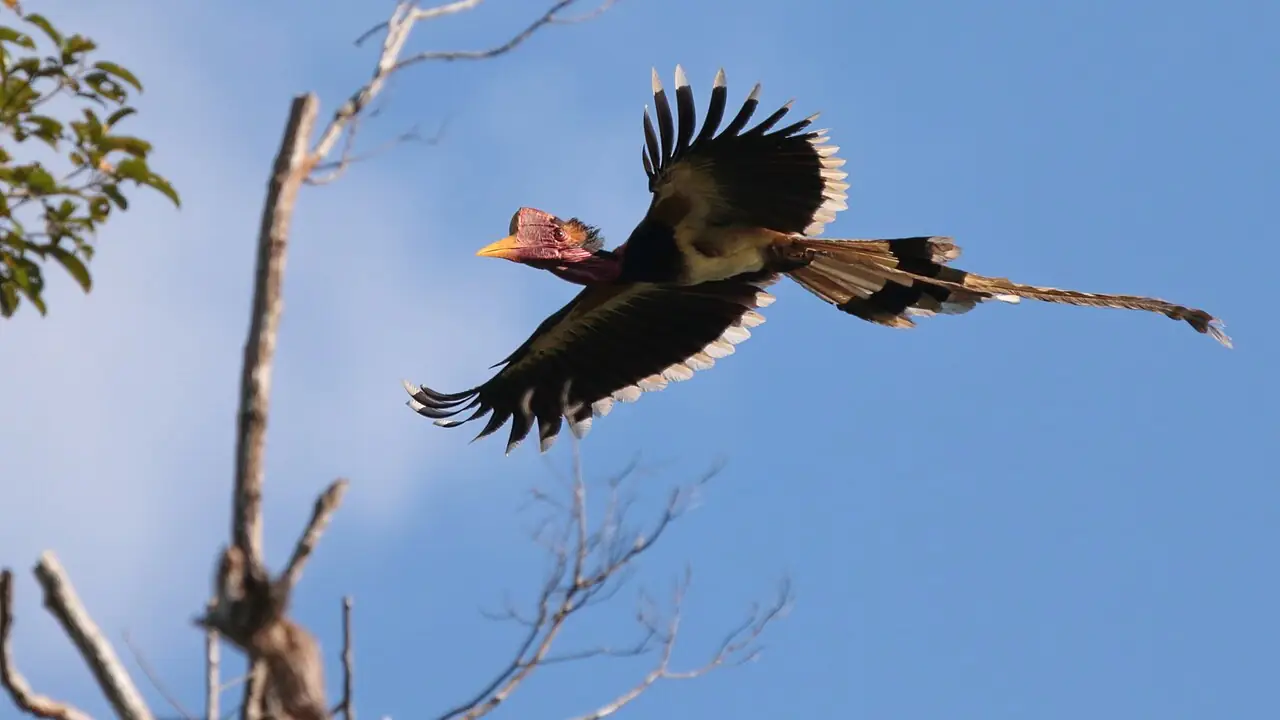
There are dozens of hornbill species and most share a hollow, honeycombed casque — light, because a heavy head is a poor idea for a large bird. The helmeted hornbill is the exception: its casque is almost solid, and the males use it in head-to-head aerial jousts. That solidity is precisely what makes it carveable, and precisely what has made it a target. The skull and casque account for around a tenth of the bird's three kilograms.
Guide 2
What "red ivory" is
Casques are carved into ornaments and sold under names including hornbill ivory, red ivory and golden jade. The material takes detail well and carries the cachet of rarity, which is a bad combination for a slow-breeding forest bird. Enforcement gives a sense of the volume: 2,170 casques were confiscated in China and Indonesia alone across three years — seizures being, as ever, a fraction of what moves.
Guide 3
A species that cannot absorb this
The helmeted hornbill lives across the Malay Peninsula, Sumatra, Borneo, Thailand and Myanmar. It is a slow reproducer that depends on large old trees for nest cavities, so hunting pressure lands on top of habitat loss rather than instead of it. In 2015 it was moved from Near Threatened straight to Critically Endangered — skipping two categories, which is unusual and tells you how fast the trade moved. It is listed on CITES Appendix I, the strictest tier, so commercial international trade is already banned.
Guide 4
What effective help looks like
As with kopi luwak, the trade exists because there is a buyer. It is already illegal under CITES Appendix I, so the work is enforcement, nest protection and demand reduction in the carving markets — not new legislation. Supporting the organisations doing nest-guardian work and seizure response in Sumatra and Borneo is the effective route. WARN aims to raise support for partner-led work against the bird trade through its parrot programme at parrot appeal, and works in Indonesia and Malaysia — but it funds no hornbill programme, and will not ask you to fund one that does not exist.