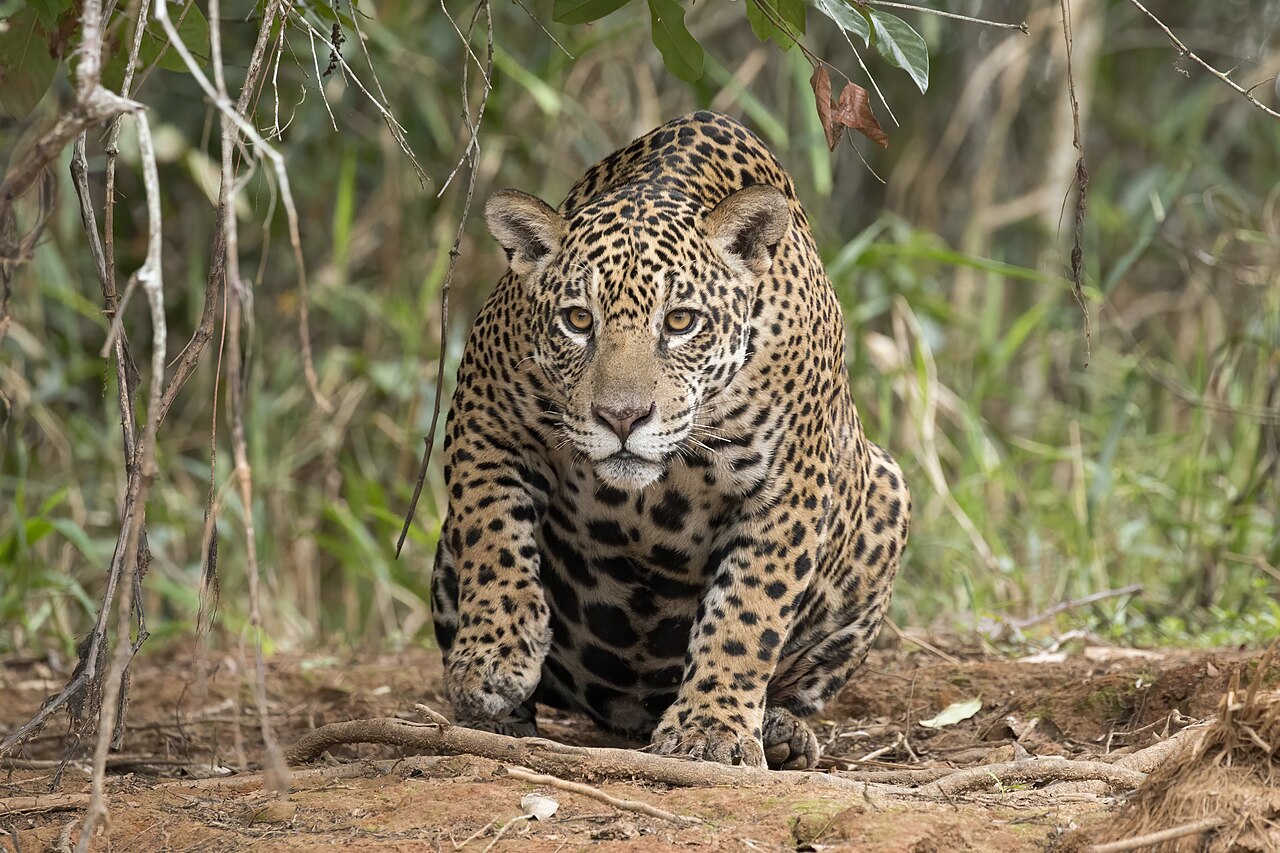
A jaguar walking through Amazon rainforest in dappled light
Briefings

· COLOMBIA · PERU · 12 min read

The Jaguar Trade: How South America's Big Cat Became a Replacement for Tiger Parts

In brief

Jaguars are the largest big cat in the Americas, listed on CITES Appendix I and classified Near Threatened by the IUCN — and the UN Office on Drugs and Crime has flagged a rising trade in jaguar parts from South America to Asian markets, in part as a substitute for tiger parts as wild tiger populations have collapsed.

What are the key takeaways from this briefing?

  • Jaguars (Panthera onca) are the largest big cat in the Americas, listed on CITES Appendix I and assessed as Near Threatened on the IUCN Red List.
  • UNODC's World Wildlife Crime Report has documented the rising international trade in jaguar fangs, skins and bones — in part as a substitute for tiger parts.
  • Colombia and Peru both contain large stretches of jaguar range across the Amazon and Andean foothills, and both have CITES management authorities active on enforcement.
  • Habitat loss, retaliatory killing after livestock predation, and trafficking are the three principal pressures identified in IUCN assessments.
  • Rescue and rehabilitation of confiscated jaguar cubs is highly specialist work and requires licensed facilities working with national CITES authorities.

The jaguar (Panthera onca) is the largest big cat in the Americas and one of only two true big cats outside Africa and Asia. It is also, increasingly, a CITES enforcement story. Over the last decade, the UN Office on Drugs and Crime has flagged a rising international trade in jaguar parts — fangs, claws, skins and bones — much of it routed from South America towards Asian markets, in part as a substitute for tiger parts as wild tiger populations have collapsed.

What should you know about the legal and conservation status?

The legal picture is clear, even if the enforcement picture is not.

  • Jaguars are listed on CITES Appendix I. All commercial international trade in jaguar parts is prohibited.
  • The IUCN Red List assesses the jaguar as Near Threatened, with a decreasing population trend.
  • Jaguars are present across most of South and Central America, with the largest remaining populations in the Amazon basin — including parts of Colombia, Peru, Brazil, Bolivia and the Guianas.

Is it true that the trade UNODC has flagged?

UNODC's World Wildlife Crime Report series has progressively documented the rise of an international market for jaguar parts. The pattern UNODC describes is consistent with what has been seen for other big cats: fangs and claws sold as ornaments and traditional-medicine ingredients, skins moved as trophies, and bones reportedly moved into supply chains that historically used tiger bone. As wild tiger numbers have fallen and tiger-bone supply has tightened, demand has displaced onto other large felids — including the jaguar.

This is not a hypothetical concern. CITES Parties have raised jaguar trafficking explicitly at recent Conferences of the Parties, and several South American countries have stepped up co-operation with CITES management authorities and customs services as a result. But the enforcement environment across thousands of kilometres of Amazon frontier is extremely difficult.

What should you know about the drivers on the ground?

IUCN assessments identify three principal pressures on jaguar populations, all of which interact:

  • Habitat loss and fragmentation. Deforestation, road-building and agricultural expansion reduce both the prey base and the range jaguars need.
  • Retaliatory killing. Jaguars sometimes predate on cattle in frontier areas. Without functioning livestock-protection programmes, retaliation by farmers is a documented cause of mortality.
  • Trafficking. The trade in jaguar parts adds a third pressure on top of those — including, in some regions, jaguars killed specifically for trafficking rather than opportunistically.

Why this matters for rescue?

The jaguar trade is, at root, an enforcement and habitat issue. But rescue and rehabilitation play a specific, indispensable role. When CITES management authorities, national park services or customs teams intercept a trafficked live jaguar — particularly a cub — that animal needs a licensed, species-appropriate facility with the veterinary capacity to take it in. Without that facility, the seizure is incomplete: the animal either dies or ends up in inappropriate captivity. The same is true for jaguars rescued from human-wildlife conflict situations.

Specialist big cat rehabilitation is not work an external charity can do directly. It has to be done by nationally-licensed facilities working under national wildlife law and reporting to national CITES management authorities. Where international funding makes a difference is in supporting those facilities — quarantine pens, veterinary triage, prey provisioning, and the slow process of building a soft-release pathway for animals that can be returned to protected forest.

What WARN is preparing to do?

WARN's planned South America wildlife programme will support partner licensed wildlife rescue and rehabilitation centres in Colombia and Peru — countries where we are already preparing to work for spectacled bears, macaws, and howler monkeys. Jaguar response is the natural extension of that footprint: shared veterinary infrastructure, shared CITES partnerships, and shared on-the-ground teams. We are launching this work in 2026 and we need supporter funding to begin.

What should you know about sources?

  • UN Office on Drugs and Crime (UNODC) — World Wildlife Crime Report series, including chapters on big cat trafficking.
  • CITES — Appendix I listing for Panthera onca, plus CoP discussion documents on jaguar trafficking.
  • IUCN Red List — assessment of Panthera onca as Near Threatened.
  • National CITES management authorities in Colombia and Peru.

Is it true that jaguars (Panthera onca) are the largest big cat in the Americas, listed on CITES Appendix I and assessed as Near Threatened on the IUCN Red List?

Jaguars (Panthera onca) are the largest big cat in the Americas, listed on CITES Appendix I and assessed as Near Threatened on the IUCN Red List. That scale is ecology, not a pet-shop talking point. Jaguar needs room to use a body like that in COLOMBIA · PERU, which is why habitat fragmentation hits so hard.

Is it true that uNODC's World Wildlife Crime Report has documented the rising international trade in jaguar fangs, skins and bones — in part as a substitute for tiger parts?

UNODC's World Wildlife Crime Report has documented the rising international trade in jaguar fangs, skins and bones — in part as a substitute for tiger parts. A fact list is not an IUCN assessment. Jaguar still needs habitat, enforcement and honest funding — see the full species guide rather than stopping at trivia.

Is it true that colombia and Peru both contain large stretches of jaguar range across the Amazon and Andean foothills, and both have CITES management authorities active on enforcement?

Colombia and Peru both contain large stretches of jaguar range across the Amazon and Andean foothills, and both have CITES management authorities active on enforcement. A fact list is not an IUCN assessment. Jaguar still needs habitat, enforcement and honest funding — see the full species guide rather than stopping at trivia.

Is it true that habitat loss, retaliatory killing after livestock predation, and trafficking are the three principal pressures identified in IUCN assessments?

Habitat loss, retaliatory killing after livestock predation, and trafficking are the three principal pressures identified in IUCN assessments. A fact list is not an IUCN assessment. Jaguar still needs habitat, enforcement and honest funding — see the full species guide rather than stopping at trivia.

Is it true that rescue and rehabilitation of confiscated jaguar cubs is highly specialist work and requires licensed facilities working with national CITES authorities?

Rescue and rehabilitation of confiscated jaguar cubs is highly specialist work and requires licensed facilities working with national CITES authorities. Rescue and rehabilitation of confiscated jaguar cubs is highly specialist work and requires licensed facilities working with national CITES authorities is one of the details people actually search for about Jaguar.

Is it true that jaguars are listed on CITES Appendix I . All commercial international trade in jaguar parts is prohibited?

Jaguars are listed on CITES Appendix I . All commercial international trade in jaguar parts is prohibited. A fact list is not an IUCN assessment. Jaguar still needs habitat, enforcement and honest funding — see the full species guide rather than stopping at trivia.

Is it true that the IUCN Red List assesses the jaguar as Near Threatened , with a decreasing population trend?

The IUCN Red List assesses the jaguar as Near Threatened , with a decreasing population trend. A fact list is not an IUCN assessment. Jaguar still needs habitat, enforcement and honest funding — see the full species guide rather than stopping at trivia.

Is it true that jaguars are present across most of South and Central America, with the largest remaining populations in the Amazon basin — including parts of Colombia, Peru, Brazil, Bolivia and the Guianas?

Jaguars are present across most of South and Central America, with the largest remaining populations in the Amazon basin — including parts of Colombia, Peru, Brazil, Bolivia and the Guianas. That scale is ecology, not a pet-shop talking point. Jaguar needs room to use a body like that in COLOMBIA · PERU, which is why habitat fragmentation hits so hard.

Is it true that habitat loss and fragmentation. Deforestation, road-building and agricultural expansion reduce both the prey base and the range jaguars need?

Habitat loss and fragmentation. Deforestation, road-building and agricultural expansion reduce both the prey base and the range jaguars need. Diet is why Jaguar ranges the way it does in COLOMBIA · PERU. Treat feeding ecology as a field fact, not a reason to keep the animal.

Is it true that retaliatory killing. Jaguars sometimes predate on cattle in frontier areas. Without functioning livestock-protection programmes, retaliation by farmers is a documented cause of mortality?

Retaliatory killing. Jaguars sometimes predate on cattle in frontier areas. Without functioning livestock-protection programmes, retaliation by farmers is a documented cause of mortality. Without functioning livestock-protection programmes, retaliation by farmers is a documented cause of mortality is one of the details people actually search for about Jaguar.

Is it true that trafficking. The trade in jaguar parts adds a third pressure on top of those — including, in some regions, jaguars killed specifically for trafficking rather than opportunistically?

Trafficking. The trade in jaguar parts adds a third pressure on top of those — including, in some regions, jaguars killed specifically for trafficking rather than opportunistically. A fact list is not an IUCN assessment. Jaguar still needs habitat, enforcement and honest funding — see the full species guide rather than stopping at trivia.

What is this briefing not?

This briefing is not a substitute for the full Jaguar wildlife guide, not a pet-care manual, and not a first-person field dispatch. It is a desk-researched explainer for people who searched a specific question about Jaguar. The setting is COLOMBIA · PERU.

The Jaguar Trade: How South America's Big Cat Became a Replacement for Tiger Parts sits in the newsroom as a briefings explainer. It is not a Field notes dispatch from a partner clinic, and it is not a reason to keep Jaguar. Location context: COLOMBIA · PERU.

Who should skip this page?

Skip this page if you wanted a complete IUCN-style species profile, veterinary advice, or permission to keep Jaguar as a pet. You will not find those here. Read the wildlife guide next if you need status, range and sources in one place.

Skip it if you needed veterinary instructions, a travel itinerary, or a fundraising story dressed up as science. The skip is the point: a page that cannot say no is not a guide.

How does this briefing compare to the full species guide?

This page answers the search in the headline. The wildlife guide answers status, threats, and what is actually known. Use both; do not cite the listicle as if it were the Red List. UNODC has flagged the rising trade in jaguar parts from South America to Asian markets, in part as a substitute for tiger parts.

Claims this briefing actually stands behind
Takeaway
Jaguars (Panthera onca) are the largest big cat in the Americas, listed on CITES Appendix I and assessed as Near Threatened on the IUCN Red List.
UNODC's World Wildlife Crime Report has documented the rising international trade in jaguar fangs, skins and bones — in part as a substitute for tiger parts.
Colombia and Peru both contain large stretches of jaguar range across the Amazon and Andean foothills, and both have CITES management authorities active on enforcement.
Habitat loss, retaliatory killing after livestock predation, and trafficking are the three principal pressures identified in IUCN assessments.

What is the catch with a short wildlife briefing?

The catch with wildlife listicles is that a true fact can still be the wrong takeaway. “Amazing” is not the same as “safe to keep”, and a number without a source is trivia. Every figure on this page should be read against the cited IUCN or zoo pages, not against a screenshot.

Factory “12 facts” pages elsewhere on the web pad the same three sentences. Here each heading is a real question, each answer is meant to stand alone, and the sources at the end are the audit trail. If a number is not on this page or in those sources, we did not invent it.

What should you do after reading this?

Use this briefing to answer the question in the title, then go to the species guide for status and sources. If you want to help Jaguar, fund habitat and enforcement — do not buy the animal. Jaguars are the largest big cat in the Americas, listed on CITES Appendix I and classified Near Threatened by the IUCN — and the UN Office on Drugs and Crime has flagged a rising trade in jaguar parts from South America to Asian markets, in part as a substitute for tiger parts as wild tiger populations have collapsed.

If you want to support WARN’s partner work, donate knowing we are a community interest company, not a registered charity. If you want the animal itself, you have the wrong page.

Read the verdict on the first screen, the skip-if before you share the page, and the sources at the end before you quote a number. That is the whole contract of this briefing.

What do people ask about this briefing?

Is this Jaguar briefing a complete species guide?
No. It is a newsroom explainer for a specific search. Status, range and the full source list live on the wildlife guide where one exists. The briefing is set in COLOMBIA · PERU. UNODC has flagged the rising trade in jaguar parts from South America to Asian markets, in part as a substitute for tiger parts.
Should you keep a Jaguar as a pet after reading this?
No. Amazing facts are not a care plan. Wild animals belong in wild habitat; buying one, posing with one, or sharing selling ads all worsen the trade. Location context on this page is COLOMBIA · PERU. UNODC has flagged the rising trade in jaguar parts from South America to Asian markets, in part as a substitute for tiger parts.
Who should skip this Jaguar page?
Anyone who needed veterinary advice, a full IUCN profile, or permission to handle the animal. This page will tell you to leave if that is you. UNODC has flagged the rising trade in jaguar parts from South America to Asian markets, in part as a substitute for tiger parts.
What is the one-line answer on Jaguar?
Jaguars are the largest big cat in the Americas, listed on CITES Appendix I and classified Near Threatened by the IUCN — and the UN Office on Drugs and Crime has flagged a rising trade in jaguar parts from South America to Asian markets, in part as a substitute for tiger parts as wild tiger populations have collapsed.
Where is this Jaguar briefing set?
The location context is COLOMBIA · PERU. That is geography for the story, not a claim that WARN runs a programme in every place named. UNODC has flagged the rising trade in jaguar parts from South America to Asian markets, in part as a substitute for tiger parts.
Where does WARN work on Jaguar?
Only claim a programme where this site already names one. This briefing is desk research about Jaguar in COLOMBIA · PERU; it does not invent a field team to match the headline. Read the species guide and appeals for funded work.
Is it true that jaguars (Panthera onca) are the largest big cat in the Americas, listed on CITES Appendix I and assessed as Near Threatened on the IUCN Red List?
Jaguars (Panthera onca) are the largest big cat in the Americas, listed on CITES Appendix I and assessed as Near Threatened on the IUCN Red List. UNODC has flagged the rising trade in jaguar parts from South America to Asian markets, in part as a substitute for tiger parts.
Is it true that uNODC's World Wildlife Crime Report has documented the rising international trade in jaguar fangs, skins and bones — in part as a substitute for tiger parts?
UNODC's World Wildlife Crime Report has documented the rising international trade in jaguar fangs, skins and bones — in part as a substitute for tiger parts. UNODC has flagged the rising trade in jaguar parts from South America to Asian markets, in part as a substitute for tiger parts.
W

WARN Research & Conservation Team

World Animal Rescue Network

Published Updated 12 min read · 2,253 words
Share
Support animal rescue