Animal Comparison
Swan vs Goose
Tell a swan from a goose using the bill, neck and plumage. Compare mute swans with greylag geese, plus size, flight, diet, young and migration.
By WARN Research & Conservation TeamLast updated
In brief — Swan vs Goose
Swans generally have longer necks and larger bodies than geese. For a mute swan, look for a white adult, an orange bill and a black knob at its base; confirm the species rather than relying on colour alone.
Swans and geese are related waterfowl in the family Anatidae, but they are different groups. A mute swan has a much longer neck and a larger body than a greylag goose. Bill shape and markings help confirm the identification: the adult mute swan has an orange-and-black bill with a knob, while a western greylag has a substantial orange bill and grey-brown plumage. This guide explains those two familiar examples and the exceptions that make “white equals swan” unreliable.
See the difference
Images are shown at different scales. Read each caption for the species, source and context.
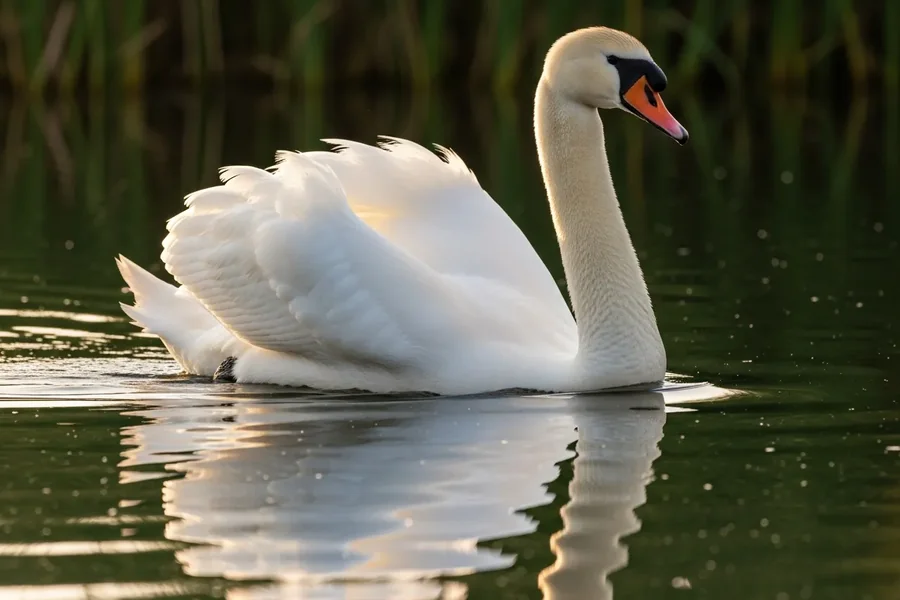
Mute swan example. AI-generated educational illustration, not a photograph or rescue record.
AI-generated educational wildlife portrait — World Animal Rescue Network
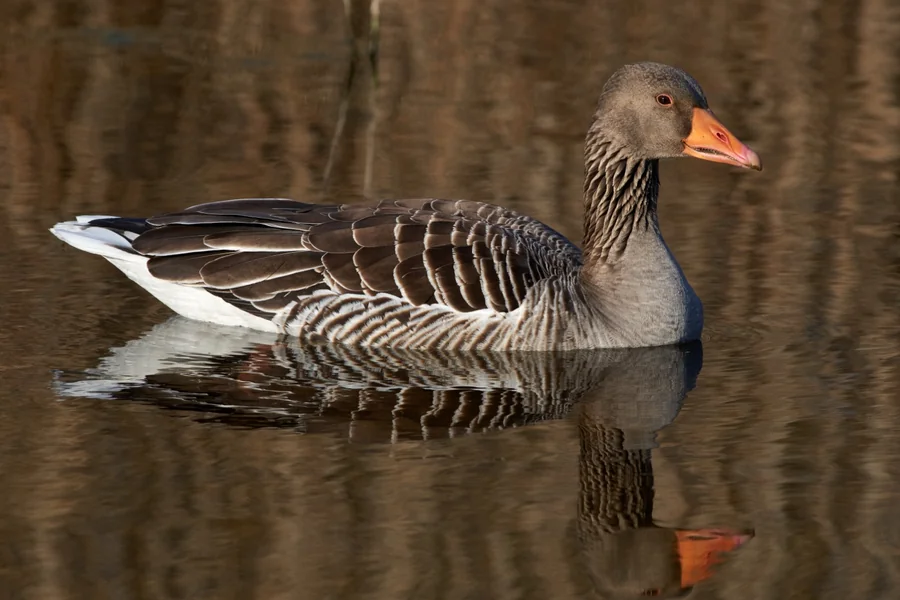
Western greylag goose example. AI-generated educational illustration, not a photograph or rescue record.
AI-generated educational wildlife portrait — World Animal Rescue Network
Swan vs Goose: At a Glance
| Feature | Mute swan | Greylag goose |
|---|---|---|
| Scientific name | Cygnus olor | Anser anser |
| Adult appearance | White body; very long neck | Grey-brown body; shorter, thicker-looking neck |
| Adult bill | Orange with black at the base and a black knob | Orange in western European birds; pink in eastern populations; no mute-swan knob |
| Adult weight: BTO mean | 9.42 kg; sample of 986 adults | 3.34 kg; sample of 1,149 adults |
| Feeding | Mainly aquatic vegetation; also grazes and takes some animal food | Grasses, wetland plants, roots and grain; also some animal food |
| Flight and sound | Neck extended in flight; audible wingbeats; can vocalise | Often travels in flocks; honking calls |
| Britain and Ireland | Widely resident; some birds move between areas | Resident birds plus winter migrants, especially from Iceland |
| Typical clutch in BTO data | 4–7 eggs | 5–7 eggs |
| Typical incubation in BTO data | 34–44 days | 27–28 days |
| Name for the young | Cygnet | Gosling |
| Conservation, checked September 2026 | IUCN global: Least Concern; UK Birds of Conservation Concern: Green | IUCN global: Least Concern; UK Birds of Conservation Concern: Amber |
Size and physical differences
Mute swans are substantially heavier than greylag geese. BTO’s live-bird samples average 9.42 kg for adult mute swans and 3.34 kg for adult greylags. These are averages for the named species, not measurements of every swan or goose.
A bird on a lake gives you several clues at once: the shape of its head and bill, the length of its neck, its body proportions and how it moves. Use them together. A neck curled while resting may look shorter, a distant bird can seem smaller than it is, and a young swan may still have grey feathers.
Start with the side-by-side examples below, then use the identification sections to check less familiar birds. The pictures are educational illustrations of a mute swan and a greylag goose, shown at different scales. They do not establish a size ratio or document a rescue. For a closer look at each group, follow the linked swan and goose guides.
Swan or goose: begin with the bill and head
The familiar adult mute swan combines a long white neck with an orange bill edged and based in black. Its black bill knob is especially useful when the head is clearly visible. The RSPB’s identification account describes this combination; a white body by itself is a much weaker clue.
The greylag goose has a heavier-looking head on a shorter neck, with grey-brown feathers rather than the mute swan’s white adult plumage. Cornell’s greylag account distinguishes orange-billed western European birds from pink-billed eastern birds. Its legs are pinkish, which is worth checking when the bird leaves the water. Bill colour therefore needs geographic context even within one goose species.
In a photograph, look for an unobstructed side view of the head. Do not approach a bird to make it stretch its neck. A second view from your existing position can be more useful than moving closer.
Neck, size and wings: compare like with like
A mute swan’s long neck is conspicuous, but an S-shaped curve is a posture rather than a permanent outline. It extends its neck in flight. WWT notes that Bewick’s swans are smaller and shorter-necked than mute and whooper swans, so the largest swan you know is a poor template for every swan.
BTO’s biometric tables report mean adult body weights of 9.42 kg for mute swans and 3.34 kg for greylag geese. The samples include 986 and 1,149 adults respectively. Both accounts also separate males, females and juveniles. A mean is an average across measured birds; it is not a guaranteed weight or the largest recorded individual.
Wingspan and wing length are different measurements. The former spans both outstretched wings; a ringed bird’s wing-length measurement describes a single wing. Avoid comparing those figures as though they mean the same thing. The illustrations above are also displayed at different scales, so their apparent size is not evidence.
White geese, grey swans and other identification traps
Young swans may carry grey-brown plumage. WWT recommends looking at the accompanying adults and listening as well as checking the young bird’s feathers. A grey bird beside a white mute swan is not automatically a goose. Conversely, an adult snow goose can be mainly white: Cornell identifies its black flight feathers and pink bill with a dark patch along the side as useful features.
A Canada goose has a black head and neck with a contrasting white throat patch. Its long neck does not turn it into a swan. Black swans and black-necked swans provide further reminders that white plumage is not a definition of the swan group.
Domestic geese can differ markedly from the wild species used in field guides. The greylag is an ancestor of many domestic geese, and introduced or re-established flocks occur around many British lakes. If a park bird has unfamiliar markings, record what you can see and consider its context before forcing it into a wild-species description.
Flight and calls: neither group is flightless
Wild mute swans and greylag geese can fly. The RSPB describes a mute swan flying with an extended neck and measured wingbeats. WWT highlights the characteristic sound of those wingbeats and notes that mute swans also make vocal sounds. The word “mute” does not mean silent.
Greylags travel socially and can form V-shaped flocks on longer journeys, as described by Animal Diversity Web. A flock’s outline is a starting clue, not a complete identification. Look for the proportions of individual birds, their plumage and their calls; a distant silhouette may not support a confident species name.
A resting bird need not take off for an identification to be useful. Do not chase a flock into flight for a photograph or to test your guess. Take notes from the view available and compare them with the original species accounts linked below.
What do swans and geese eat?
Mute swans feed mainly on aquatic plants. Cornell describes them reaching below the water and tipping forwards to access submerged vegetation; their food can also include animal material. They also feed on land. Seeing a swan grazing on a field is therefore quite compatible with its normal feeding behaviour.
Greylags crop grasses and use wetland plants, roots and grain. The Animal Diversity Web account includes both agricultural foods and some small aquatic animals. “Swans eat only in water; geese eat only grass” leaves out that overlap. Habitat and season affect what food is available.
For observation, note how the bird obtains its food: grazing, reaching down through the water or moving between a feeding field and a waterbody. Those details help explain its use of the landscape, even where they cannot identify it on their own.
Behaviour, territory and family groups
A mute swan pair can defend its breeding area vigorously. Cornell describes warning displays and chasing other animals away. That behaviour has a context: space around a nest or family is different from an undisturbed resting flock. Greylags, meanwhile, are social birds whose groups range from families to large flocks.
There is no useful universal ranking of which bird is “meaner”. Age, breeding stage, food, the surrounding flock and a person’s distance all change an encounter. WWT’s research on wintering swans describes competition for resources and the importance of family relationships rather than a simple temperament label.
If a bird changes its behaviour because of your approach, give it more room. Keep children and dogs from moving towards eggs or young, avoid blocking the family’s route to water, and leave the birds to settle. Their response is information about your distance, not an invitation to test their strength.
Cygnets, goslings, nests and breeding
A young swan is called a cygnet and a young goose a gosling. Both mute swans and greylags have downy, mobile chicks. Nesting figures still need species and location labels: BTO gives typical clutches of 4–7 eggs for mute swans and 5–7 for greylags, with typical incubation periods of 34–44 and 27–28 days respectively. These are typical values, not limits on every nest.
Mute swans build substantial nests from vegetation near water. Cornell describes both partners contributing to construction. A family can remain associated beyond the first weeks of a chick’s life; for migratory whooper and Bewick’s swans, WWT notes that the young usually remain with their parents on the spring journey.
You do not need to find the nest or count its eggs to enjoy watching a family. Watch from a path or hide, follow local restrictions and allow adults to reach their young without passing close to you.
Do swans and geese migrate?
The answer depends on the species and population. Many British mute swans remain in an area year-round, but the RSPB also describes movements, winter flocks and arrivals from continental Europe in cold weather. “Resident” does not mean an individual never travels.
The EURING/CMS Migration Atlas describes greylags breeding in the British Isles as remaining in the region and being joined by Icelandic birds in winter. Other populations follow different routes across Europe. The familiar flock that stays at a lake does not tell you what all greylags do.
Whooper swans wintering in Britain and Ireland commonly come from Iceland; Bewick’s swans arrive from breeding areas in Arctic Russia. Seasonal movement changes which species you may encounter. When checking an identification, record the place and date as well as the appearance. A local reserve’s recent sightings can provide useful context without replacing the bird’s visible features.
Conservation: identify the population as well as the bird
At this review in September 2026, BTO lists mute swan and greylag goose as globally Least Concern. Their UK Birds of Conservation Concern labels differ: mute swan is Green and greylag goose Amber. Those national colours answer a different conservation question from a global IUCN category. They also do not describe every other swan or goose.
WWT identifies wetland loss, collisions with power lines, illegal hunting and lead poisoning among the concerns for migratory Bewick’s swans. Its work shows why accurate identification matters: small swans can be confused with geese. The condition of one common park flock cannot establish the condition of a different migratory population.
Use dated monitoring and the relevant local conservation guidance when deciding how to help. Better habitat and reduced disturbance can matter alongside individual rescue. WARN’s habitat appeal explains its own scope and funding terms; this educational comparison does not establish a dedicated swan or goose project.
How to watch and help waterbirds responsibly
Use binoculars or a camera zoom, keep to marked paths and follow the reserve’s signs. The RSPB’s guidance on disturbance asks visitors to give nesting birds space and keep dogs under close control. Paddlers and swimmers also need to avoid interrupting feeding or families near the bank.
Feeding rules vary by site. Where feeding is allowed, use the food recommended by the reserve in modest amounts; WWT’s public guidance includes grain, suitable bird seed and oats. Do not leave piles of unwanted food or try to lure birds onto a road. A quiet observation visit is worthwhile without feeding at all.
If a bird appears injured or entangled, keep a safe distance and contact the site warden or an experienced wildlife rescue service. Record its location and what you observed. Sharing an accurate identification, an appeal with clear terms or a conservation organisation’s guidance is another practical way to help when you cannot donate.
Swan vs Goose: FAQs
Is a swan a goose?
How can I tell a mute swan from a greylag goose?
Are swans always white?
Which is bigger, a swan or a goose?
Can swans and geese fly?
Are mute swans silent?
What are baby swans and geese called?
Do all geese migrate while swans stay in one place?
Are swans more aggressive than geese?
Are swans and geese endangered?
Help protect animals
Wetlands provide feeding areas, nesting places and safe stopping points for waterbirds. Read WARN’s habitat appeal for its actual purpose, funding arrangements and terms. This page does not establish a dedicated swan or goose rescue fund or a grant to any organisation cited as a source.
Sources
- BTO BirdFacts — mute swan adult biometrics, nesting and conservation
- BTO BirdFacts — greylag goose adult biometrics, nesting and movements
- EURING/CMS Migration Atlas — greylag goose population movements
- RSPB — mute swan identification and movements
- RSPB — greylag goose and re-established populations
- Cornell Lab of Ornithology — greylag appearance and regional bill differences
- WWT — identifying mute, whooper and Bewick’s swans
- WWT — swans found in UK wetlands, calls and seasonal movements
- Cornell Lab of Ornithology — snow goose colour and bill markings
- RSPB — Canada goose identification
- Cornell Lab of Ornithology — mute swan feeding, nests and territorial behaviour
- University of Michigan, Animal Diversity Web — greylag diet and flock behaviour
- WWT — social competition in wintering swans
- WWT — threats and monitoring of Bewick’s swans
- RSPB — giving nesting birds space
- WWT Generation Wild — appropriate food for waterbirds