Wildlife · Species comparisons
What is the difference between a gorilla and a chimpanzee?
Gorillas are much larger herbivores led by silverbacks; chimpanzees are smaller omnivores that hunt monkeys and use tools.
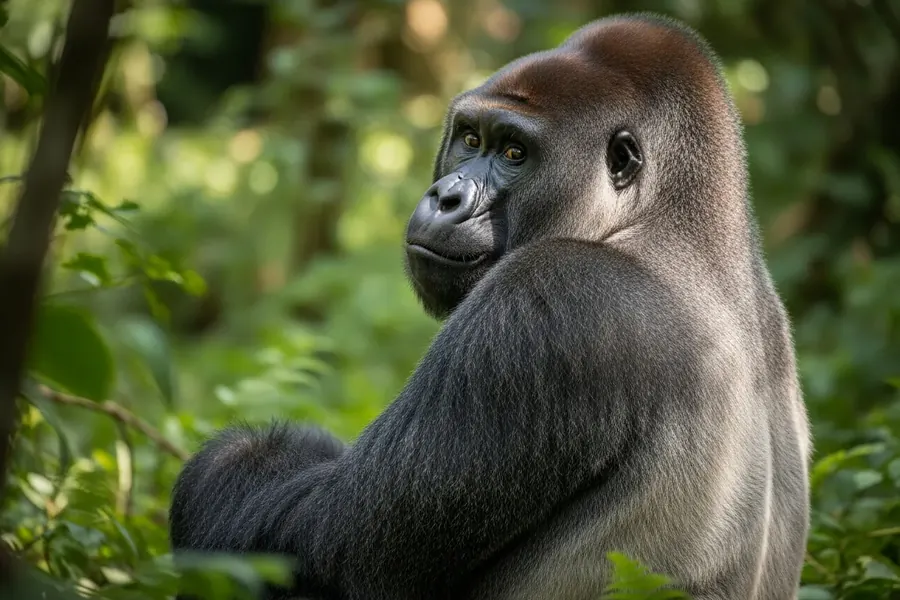
In brief
Gorillas are much larger — adult males up to 200 kg with a sagittal crest and silver back. Chimpanzees are smaller, omnivorous and more arboreal. Gorillas are mainly herbivorous ground dwellers; chimps hunt monkeys and use tools.
By the WARN Research & Conservation TeamChecked against IUCN Red List & CITES sourcesLast updated
Gorillas and chimpanzees are African great apes — both share over 98% DNA with humans and rank among our closest living relatives. Yet ecology, body size and social structure diverge sharply. Gorillas are mainly ground-dwelling herbivores in cohesive groups led by a dominant silverback male. Chimpanzees are smaller, more arboreal omnivores living in fission–fusion communities with documented tool use and cooperative monkey hunting. Both are Endangered — bushmeat, habitat loss and disease threaten all populations.
200 kg
Adult male gorilla weight — up to
70 kg
Typical adult chimpanzee weight
98%+
DNA shared with humans — both apes
EN/CR
All gorilla subspecies; chimpanzees Endangered
Quick facts
| Gorilla diet | Mainly leaves, stems, fruit — rarely hunts vertebrates |
|---|---|
| Chimp diet | Omnivorous — fruit, leaves, insects, hunted monkeys |
| Gorilla social | Cohesive groups — one silverback leader |
| Chimp social | Fission–fusion — subgroups merge and split |
| Tool use | Documented in chimps — termite fishing, nut cracking |
| Build | Gorillas: sagittal crest, silver back; chimps: slighter frame |
Key takeaways
- Gorillas: larger, herbivorous, silverback-led ground groups.
- Chimpanzees: smaller, omnivorous, tool-using, fission–fusion communities.
- Both Endangered — bushmeat, habitat loss and disease.
- Chimps hunt monkeys; gorillas rarely eat vertebrates.
- Gorilla ecotourism funds ranger patrols in Rwanda and Uganda.
- See WARN comparison for full social structure and status table.
Size and physical build
Adult male gorillas reach up to 200 kg with a prominent sagittal crest and silver saddle — hence “silverback.” Females are roughly half that mass. Chimpanzees typically weigh 40–70 kg with longer arms relative to legs for arboreal travel. Gorilla chests and arms are massively built for terrestrial display and vegetation processing; chimpanzee bodies favour climbing and rapid pursuit of prey. Skull morphology reflects diet — gorilla jaws process fibrous vegetation; chimp teeth handle varied omnivorous fare including meat. Field identification at distance uses size and posture: gorillas knuckle-walk on ground; chimps often travel in trees.
Diet and foraging
Lowland gorillas eat leaves, stems, pith and fruit — eastern lowland gorillas may consume ants but rarely hunt vertebrates. Mountain gorillas specialise on high-altitude vegetation. Chimpanzees eat fruit, leaves, nuts and insects but also hunt colobus monkeys and other small mammals cooperatively — males often lead hunts. Tool use is well documented in chimps: modified sticks for termite fishing, stones for nut cracking. Gorilla tool use is minimal by comparison. Diet drives ranging patterns: gorilla groups defend plant-rich home ranges; chimp communities patrol larger territories with seasonal fruit scarcity driving conflict between communities.
Conservation status
All gorilla subspecies are Endangered or Critically Endangered. Chimpanzees are Endangered — four subspecies across equatorial Africa. Shared threats include bushmeat hunting, habitat loss from logging and mining, Ebola and respiratory disease from human contact. The pet and entertainment trade targets chimpanzee infants — killing mothers in the process. Gorilla ecotourism in Rwanda and Uganda funds ranger patrols; chimpanzee tourism exists but with higher disease-transmission risk if distance rules fail. WARN’s comparison page and gorilla guide link donors to patrol funding and sanctuary care.
Social structure
Gorillas live in stable groups — typically one silverback, several females and offspring. Young males leave at maturity to become solitary or form bachelor groups before attempting to attract females. Chimpanzees live in communities of dozens to over a hundred individuals that split into fluid subgroups (fission–fusion). Male chimps form alliances, patrol borders and engage in lethal inter-community violence — behaviour not seen in gorillas at comparable intensity. Female chimps often migrate between communities; female gorillas join the silverback’s group. Understanding social systems matters for ecotourism rules and rehabilitation of orphaned individuals.