Wildlife Guide · Oceania
Frilled Lizard
Chlamydosaurus kingii
The lizard that flares a dramatic neck frill
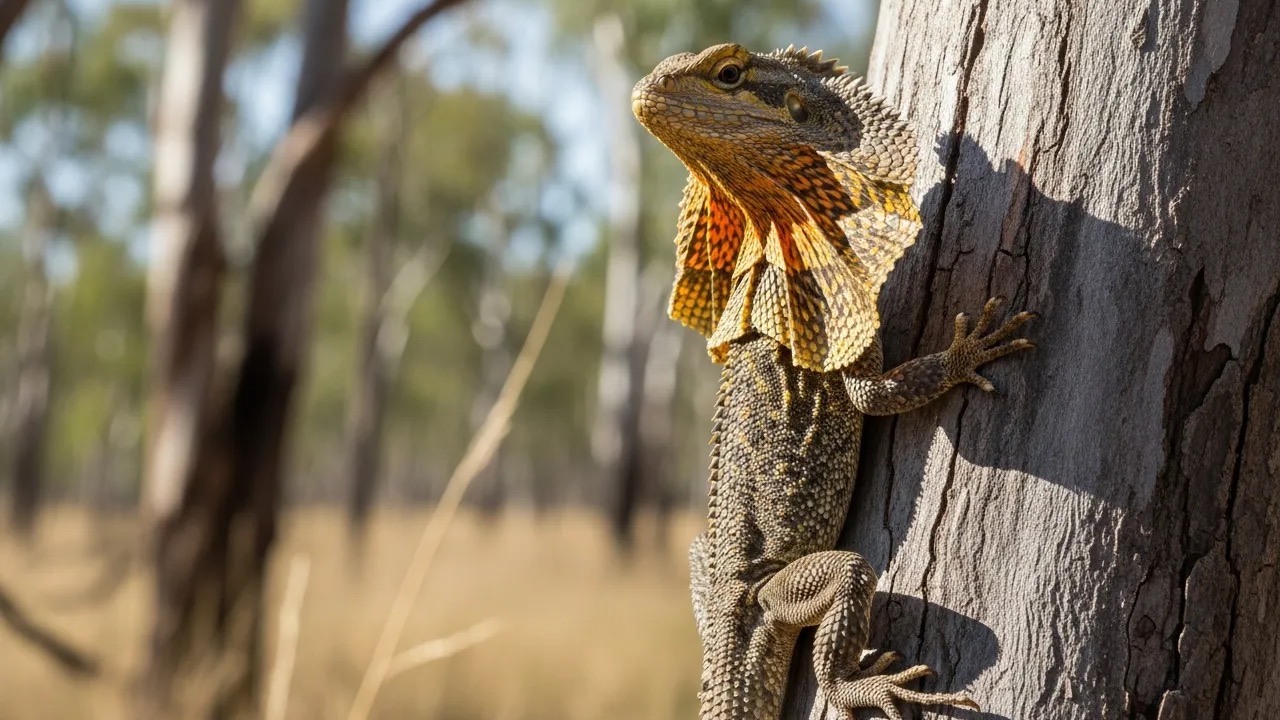
Photo: Matt from Melbourne, Australia / Wikimedia Commons (CC BY 2.0)
In brief
The frilled lizard (Chlamydosaurus kingii) is a tree-dwelling reptile of northern Australia and southern New Guinea, famous for the wide, leathery frill it snaps open around its neck when threatened. It grows up to about 0.9 m (3 ft) long including the tail and weighs around 0.5 kg (1.1 lb).
Also in Animals A to Z · Animals that start with F
By WARN Research & Conservation Team Last updated
The frilled lizard (Chlamydosaurus kingii) is a tree-dwelling reptile of northern Australia and southern New Guinea, famous for the wide, leathery frill it snaps open around its neck when threatened. It grows up to about 0.9 m (3 ft) long including the tail and weighs around 0.5 kg (1.1 lb). When alarmed on the ground it sprints away on its hind legs, and it can live 10 to 20 years.
0.9 m
Typical length
600 g
Typical weight
30 km/h
Top speed
15 yrs
Lifespan
Figures sourced from IUCN Red List — Chlamydosaurus kingii, Wikipedia — Frilled Lizard, Wikidata — Frilled Lizard .
Frilled Lizard: Quick Facts
| Scientific name | Chlamydosaurus kingii |
|---|---|
| Diet | Carnivore (mainly insects) |
| Habitat | Tropical woodlands and dry forest |
| Lifespan | 10–20 years |
| Length | Up to 0.9 m (3 ft) including tail |
| Weight | About 0.5 kg (1.1 lb) |
| Conservation status | Least Concern (IUCN) |
Scientific Classification
| Kingdom | Animalia |
|---|---|
| Phylum | Chordata |
| Class | Reptilia |
| Order | Squamata |
| Family | Agamidae |
| Genus | Chlamydosaurus |
Conservation Status
- IUCN Status
- Least Concern (IUCN Red List category)
- Population
- Global population not compiled for this guide
- Trend
- See the IUCN Red List assessment
- Assessed
- See the IUCN Red List assessment
- CITES
- See CITES appendices
Conservation figures are drawn from the IUCN Red List and CITES; this guide links to the authoritative sources rather than restating population counts.
Key Facts: Frilled Lizard
- The frill is a fold of skin supported by long rods of cartilage attached to the jaw.
- If the display fails, the frilled lizard turns and flees in a way few reptiles can match.
- Frilled lizards are strongly arboreal and spend most of the day clinging to trunks and branches in tropical woodland and dry forest.
The famous frill and its bluff
The frill is a fold of skin supported by long rods of cartilage attached to the jaw. Normally it lies flat against the shoulders, but when the lizard opens its mouth the frill springs out into a disc that can be up to 30 cm across. Combined with hissing, gaping, and tail-lashing, this display makes the animal look far larger and more dangerous than it really is. The bluff is meant to startle a predator long enough for the lizard to escape.
Running on two legs
If the display fails, the frilled lizard turns and flees in a way few reptiles can match. It rears up and runs on its hind legs alone, tail held out for balance, in a comical upright sprint toward the nearest tree. This bipedal dash can reach around 30 km/h over short distances. Once it reaches a trunk it scrambles up and freezes against the bark, where its grey-brown colouring blends in.
Life in the trees
Frilled lizards are strongly arboreal and spend most of the day clinging to trunks and branches in tropical woodland and dry forest. From this vantage point they watch the ground for movement and drop down to snatch prey. They are ambush hunters that stay motionless for long stretches, relying on camouflage rather than active searching. Height also keeps them clear of many ground predators.
Diet and feeding
This lizard is a carnivore that feeds mainly on insects. Cicadas, beetles, ants, termites, and spiders make up the bulk of its diet, and larger individuals will also take small lizards and the occasional small mammal. It hunts by sitting still and ambushing anything that wanders within reach. Feeding activity rises sharply in the wet season, when insect numbers explode.
Seasons and breeding
Northern Australia's climate swings between a hot wet season and a long dry season, and the frilled lizard's year is built around it. The animals are most active and breed during the wet, when food is abundant, and become far more sluggish and secretive through the dry months. Females lay clutches of roughly 8 to 23 eggs in shallow nests dug into soft soil. The eggs hatch after two to three months, and hatchlings are independent from birth.
Conservation status
The frilled lizard is listed as Least Concern by the IUCN and remains widespread across its northern Australian and New Guinean range. The main pressures it faces are habitat clearance, wildfire, and predation by introduced cats and foxes. It is also collected for the exotic pet trade, though wild populations are currently considered stable. Healthy tree cover is the single most important thing for its long-term survival.
What WARN Does
WARN does not run a dedicated frilled lizard programme — this guide is part of the World Animal Rescue Network's free educational library. The frilled lizard is currently widespread and not globally threatened, and this guide helps readers understand the pressures that can change that. Building public understanding of species like the frilled lizard supports the broader conservation awareness that underpins WARN's partner-led rescue work across its network.
If clear, science-based wildlife guides like this help you understand and value animals, please consider supporting the World Animal Rescue Network's educational and rescue work so we can keep producing them.
Frilled Lizard: Frequently Asked Questions
Why does the frilled lizard have a frill?
Can a frilled lizard really run on two legs?
How big does a frilled lizard get?
What do frilled lizards eat?
Are frilled lizards dangerous to humans?
How long do frilled lizards live?
Where do frilled lizards live?
Sources & References
Population figures, conservation status and biological facts on this page are drawn from authoritative scientific and intergovernmental sources.
Terms used on this page
Plain-English definitions, from our wildlife and conservation glossary.
Explore more animals
Discover more animals, their habitats and their conservation status in the WARN wildlife-guide library.
Enjoyed this Frilled Lizard guide?
Receive appeal updates, animal-welfare news and published funding reports. Unsubscribe any time.
We only use your address for WARN updates. See our privacy policy.