Wildlife · Reptile facts
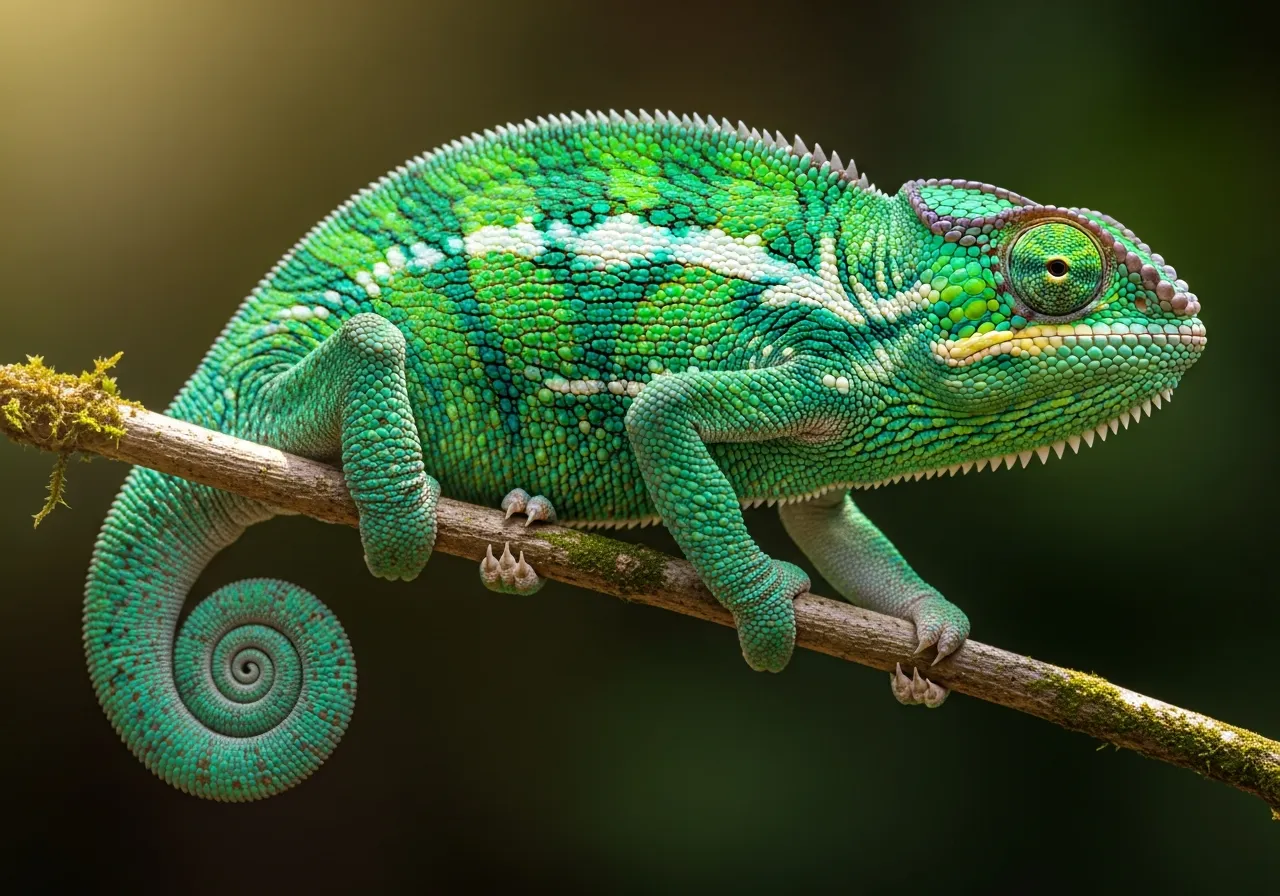
How do chameleons change color?
Nanocrystals in iridophores shift reflected colour — mood, heat and social signals more than instant background matching.
In brief
Chameleons change colour by adjusting nanocrystals in skin cells called iridophores — not primarily by expanding pigment sacs as once taught. Shifts reflect mood, temperature and social signals more often than background matching. True camouflage is secondary to communication.
By the WARN Research & Conservation TeamChecked against IUCN Red List & CITES sourcesLast updated
Chameleons change colour by rearranging guanine nanocrystals in iridophore skin cells — lattice spacing selects wavelengths reflected. Older textbooks emphasised pigment expansion — partly true in melanophores for dark states but iridophores drive vivid greens and blues. Functions include thermoregulation, stress signalling, rivalry and courtship — camouflage is slower and less precise than popular media shows. Over 200 species — Madagascar exceptional diversity — face pet trade and habitat loss.
200+
Chameleon species worldwide
Nanoscale
Iridophore crystal spacing controls colour
360°
Independent eye rotation — unique among lizards
CITES
Many species Appendix II — trade regulated
Quick facts
| Mechanism | Iridophore nanocrystal lattice spacing |
|---|---|
| Pigment role | Melanophores darken — combine with structural colour |
| Primary function | Social signalling and temperature — not only camouflage |
| Eyes | Independently mobile — stereoscopic aim when hunting |
| Tongue | Ballistic projection — twice body length |
| Pet trade | Wild-caught stress and parasites — captive-bred preferred |
Key takeaways
- Nanocrystals in iridophores — not pigment alone.
- Mood, heat and social signals primary.
- 200+ species — Madagascar diversity hotspot.
- Pet trade threatens wild populations.
- Independent eye rotation unique among lizards.
- See chameleon guide and reptile hub.
Iridophores versus pigment cells
Nature Communications research on panther chameleon demonstrated tunable photonic crystals — spacing change in milliseconds to seconds. Melanophores expand dark pigment for brown-black states — combination produces yellow-green transitions. Dermal layers stack — interference creates iridescence. Veiled and panther chameleons show dramatic display palettes.
Why colour changes
Cold chameleon darkens to absorb heat; stressed individual brightens or blotches. Rival males show contrasting patterns; receptive females lighten. Background matching occurs over minutes — not Harry Potter invisibility. Predators still detect movement and silhouette.
Natural history and conservation
Madagascar hosts two-thirds of species — many micro-endemic, forest-dependent. Brookesia micra among smallest reptiles. Jackson’s chameleon three horns — introduced populations in Hawaii from pet release. CITES regulates export — laundering wild as captive common. Welfare: UVB, hydration misting, solitary housing — social stress colour-darkening indicator.
Links to reptile hub
WARN chameleon guide covers taxonomy, care controversy and regional status. Reptiles and amphibians hub groups snake, gecko and frog guides. This answer corrects classroom oversimplification on pigment-only models.