Wildlife · Mammal facts hub
Do any mammals lay eggs?
Monotremes — platypus and echidnas — lay eggs yet still nurse young with milk.
In brief
Yes. Monotremes — the platypus and four echidna species — lay leathery eggs and are the only egg-laying mammals. They still nurse young with milk.
By the WARN Research & Conservation TeamChecked against IUCN Red List & CITES sourcesLast updated
Monotremes are the only egg-laying mammals. The platypus and four echidna species split from other mammals roughly 180 million years ago. They retain reptile-like egg laying but produce milk through skin pores rather than nipples. Platypus males have venomous spurs; platypuses use electroreception to hunt. Habitat loss and fishing entanglement threaten platypus populations in eastern Australia.
5
Living monotreme species
180M
Years since monotreme split from other mammals
10 days
Platypus egg incubation in burrow
VU
Platypus — Vulnerable (IUCN 2021)
Quick facts
| Species | Platypus + four echidna species |
|---|---|
| Eggs | Leathery shells — laid in burrow or pouch |
| Milk | Yes — exuded from skin patches, not nipples |
| Platypus | Venomous spur on male hind leg; electroreception |
| Range | Australia and New Guinea only |
| Threat | Drought, dams, nets, habitat loss for platypus |
Key takeaways
- Platypus and echidnas are egg-laying mammals (monotremes).
- They still produce milk — mammals by definition.
- Five living species — Australia and New Guinea only.
- Platypus Vulnerable — drought, traps, habitat loss.
- Venom and electroreception in platypus — unique among mammals.
- Live birth is not required to be a mammal.
Monotreme reproduction
Female platypuses lay one to three leathery eggs in a burrow after mating. Incubation lasts about ten days; hatchlings are blind and hairless, lapping milk from abdominal patches. Echidnas carry a single egg in a temporary pouch — puggle hatches and nurses until spines develop. This combines reptilian egg laying with mammalian lactation — defining mammals by milk production, not live birth alone. Gestation and incubation are short relative to placental mammals; parental investment continues through prolonged nursing.
Platypus oddities
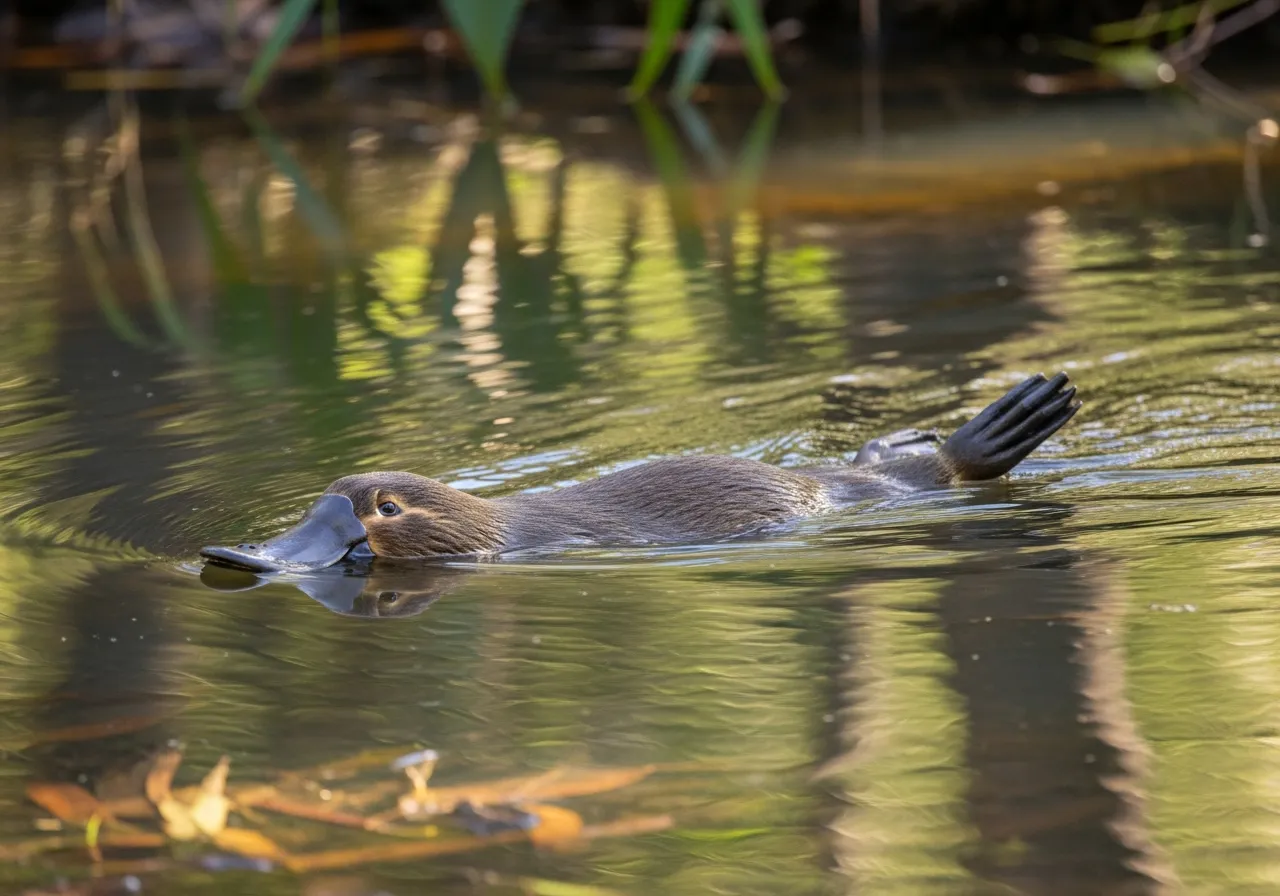
Platypuses detect prey electric fields through bill receptors — hunting with eyes, ears and nose closed underwater. Males possess ankle spurs delivering venom painful to humans though rarely fatal. Webbed feet and dense fur suit cold Australian streams. Genetic studies once baffled nineteenth-century scientists who suspected hoax specimens. Today genetics place monotremes on their own evolutionary branch — ten sex chromosomes in platypus versus two in humans.
Echidnas
Short-beaked echidnas range across Australia and New Guinea in diverse habitats; long-beaked echidnas live in New Guinea forests and are Critically Endangered. Spines defend against predators; powerful claws dig for ants and termites. Echidnas enter torpor during cold or fire — surviving burns by sheltering in logs. Low reproductive rate — one puggle every few years — makes population recovery slow after local declines.
Conservation
Platypus listed Vulnerable by IUCN in 2021 after regional declines from drought, river regulation, pollution and yabby trap drowning. Land clearing removes riparian vegetation. Climate change intensifies drought and fire. Monotremes illustrate that egg laying does not mean primitive or secure — all five species need habitat protection. Accurate public understanding counters assumption that mammals always bear live young.