Animal Comparison
Snow leopard vs Leopard
Snow leopards have pale, open (unspotted-centre) rosettes and huge tails for cold mountains; leopards have gold coats with spot-centred rosettes and can roar.
By the WARN Research & Conservation TeamChecked against IUCN Red List & CITES sourcesLast updated
In brief — Snow leopard vs Leopard
Snow leopards are pale, open-rosetted, silent mountain specialists; leopards are golden, spot-centred-rosetted, roaring habitat generalists.
The clearest difference is coat and voice: the snow leopard (Panthera uncia) has smoky grey-white fur with large, open rosettes that have no central spot, plus an exceptionally thick, long tail, and it cannot roar. The leopard (Panthera pardus) has a tawny-gold coat with rosettes that enclose a small central spot, a shorter tail, and a full roar. Snow leopards live only in high Central and South Asian mountains (roughly 3,000-4,500 m); leopards are lowland-to-mid-elevation habitat generalists across Africa and Asia.
See the difference
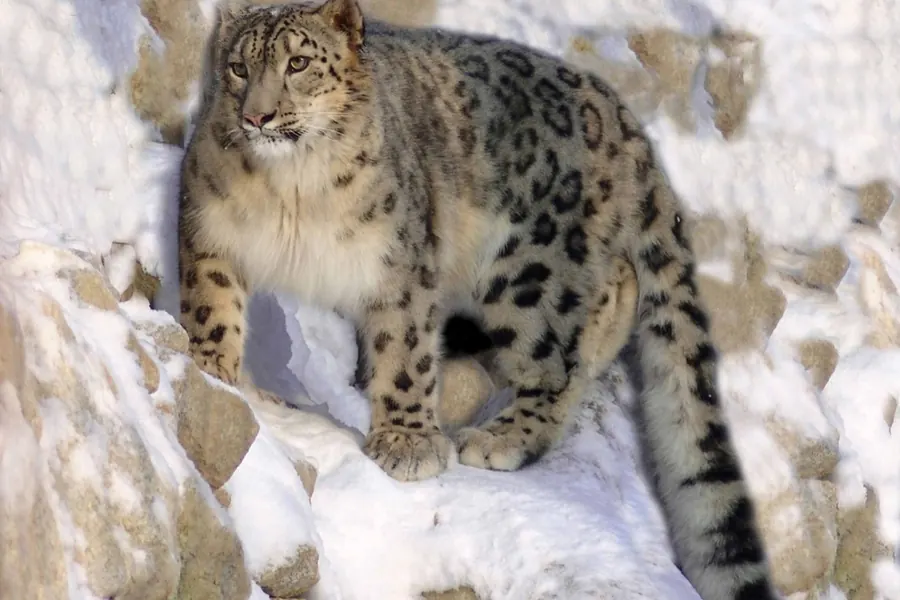
Snow leopard — smoky-grey, thick fur, large open rosettes
Source: Wikimedia Commons
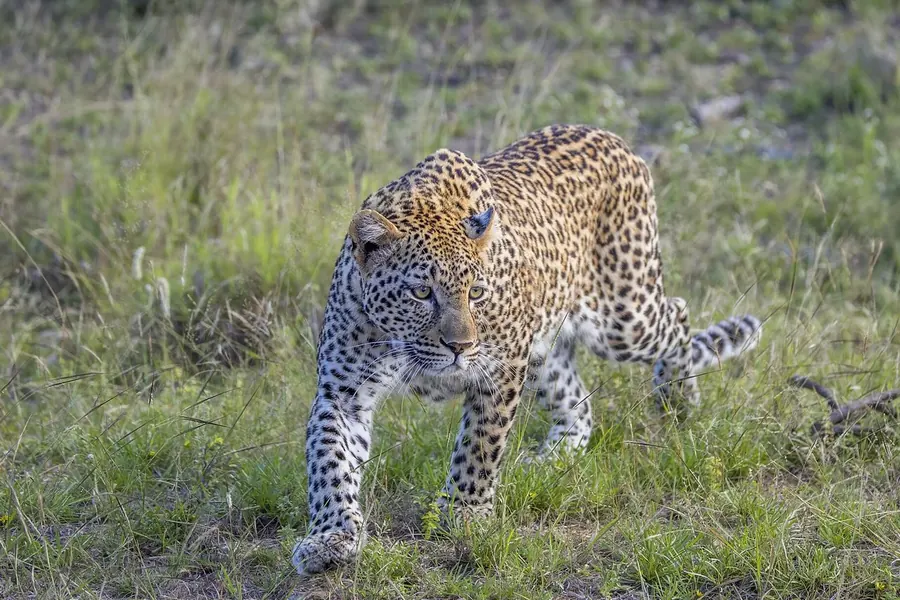
Leopard — golden coat, smaller dark-centred rosettes
Source: Wikimedia Commons
Snow leopard vs Leopard: At a Glance
| Feature | Snow leopard | Leopard |
|---|---|---|
| Scientific name | Panthera uncia | Panthera pardus |
| Coat colour | Smoky grey-white, faint yellow tinge | Tawny to golden-yellow |
| Rosette pattern | Large, open rings, no central spot | Rosettes with a small central spot |
| Tail | Very thick, almost as long as body | Shorter, ringed near tip |
| Roar | Cannot roar (only mews, growls) | Can roar |
| Weight | 22-55 kg (49-121 lb) | 21-72 kg (45-159 lb) |
| Habitat | High Central/South Asian mountains | Forest, savanna, mountains, desert edge |
| Range | 12 Central/South Asian countries | Over 60 countries, Africa and Asia |
| IUCN status | Vulnerable | Vulnerable |
Which is bigger & stronger?
They are broadly similar in size, with wild snow leopards averaging about 36-42 kg (large males to 55-75 kg) and leopards roughly 30-90 kg depending on subspecies, so a big lowland leopard is the stronger.
Snow leopards and leopards are both large cats in the genus Panthera, and their shared name causes constant confusion. But they are not one another's closest relatives - genetic studies show the snow leopard's nearest living relative is actually the tiger. The two species also look and behave quite differently. Snow leopards are built for cold, thin mountain air: a pale, thick coat, huge furred paws and an unusually long, bushy tail for balance on cliffs. Leopards are built for versatility, with a lean golden-spotted coat that camouflages them from tropical forest to semi-desert across two continents. One key giveaway that works even from a poor photo: snow leopard rosettes are plain rings with no dot in the centre, while leopard rosettes almost always enclose one.
Coat and camouflage
The snow leopard's smoky grey-white coat with a faint yellow tinge and large, open rosettes (rings with no central spot) breaks up its outline against rock and snow. Its fur is also exceptionally dense and up to 5 cm (2 in) long on the belly for insulation. The leopard's shorter, tawny-to-golden coat carries rosettes that enclose one or more small central spots, an arrangement that camouflages it in dappled forest and grassland shade. Rosette shape even varies by population: rounder in East Africa, squarer in southern Africa, and larger in Asian leopards.
Voice
Despite belonging to the roaring genus Panthera, the snow leopard cannot roar. Its vocal folds are only around 9 mm thick, too short to generate the resonant sound lions, tigers, jaguars and leopards produce, so it communicates instead with hisses, growls, mews, and a distinctive non-roaring loud call. The leopard has a fully developed elastic hyoid and larynx and produces a rasping, saw-like roar used to advertise territory, alongside grunts and contact calls.
Habitat and range
Snow leopards are cold-mountain specialists, living mostly at 3,000-4,500 m (9,800-14,800 ft) across 12 countries from the Himalayas and Tibetan Plateau to Mongolia and southern Siberia; total range covers roughly 1.2-1.6 million km2 of rugged, sparsely vegetated terrain. Leopards are the most adaptable big cat, occupying more than 60 countries across sub-Saharan Africa, the Middle East, and South, Central and East Asia, in habitats from rainforest and savanna to arid scrub and the outskirts of cities.
Build and behaviour
Snow leopards have proportionally the longest tail of any big cat, oversized paws that act like snowshoes, and powerful hind legs that let them leap around 15 m (50 ft) in a single bound across mountain terrain. Leopards are pound-for-pound the strongest climbers among big cats, able to haul carcasses heavier than themselves up into trees to keep kills safe from lions and hyenas. Both species are solitary and largely nocturnal or crepuscular ambush hunters.
Did you know?
A snow leopard can leap roughly 15 m (50 ft) in a single horizontal bound across mountain terrain, using its long tail purely for balance rather than warmth.
Snow leopard vs Leopard: FAQs
Is a snow leopard a type of leopard?
Can snow leopards roar like leopards?
Which is bigger, a snow leopard or a leopard?
How do you tell a snow leopard and a leopard apart in a photo?
Do snow leopards and leopards live in the same place?
Are snow leopards and leopards both endangered?
These animals need us
Understanding wildlife is the first step to protecting it. WARN funds partner-led rescue and conservation where the need is greatest — your support keeps that work going.