Animal Comparison
Gorilla vs Chimpanzee
Gorillas are far larger, herbivorous knuckle-walkers with a bony sagittal crest; chimpanzees are smaller, omnivorous, tool-using apes with expressive faces.
By WARN Research & Conservation Team Last updated
In brief — Gorilla vs Chimpanzee
If it is much bigger than a person, silent and chest-thumping, it is a gorilla; if it is smaller, noisy and using a stick as a tool, it is a chimpanzee.
The clearest difference is size and build: an adult male gorilla can weigh up to 200 kg (440 lb) and stands out with a bony sagittal crest and huge brow ridge, while a chimpanzee tops out around 60 kg (130 lb) with a smaller, rounder skull and more prominent ears. Gorillas are calm, largely herbivorous ground-dwellers; chimpanzees are more excitable, omnivorous, tool-using apes that spend more time in trees.
See the difference
Images are shown at different scales. Read each caption for the species, source and context.
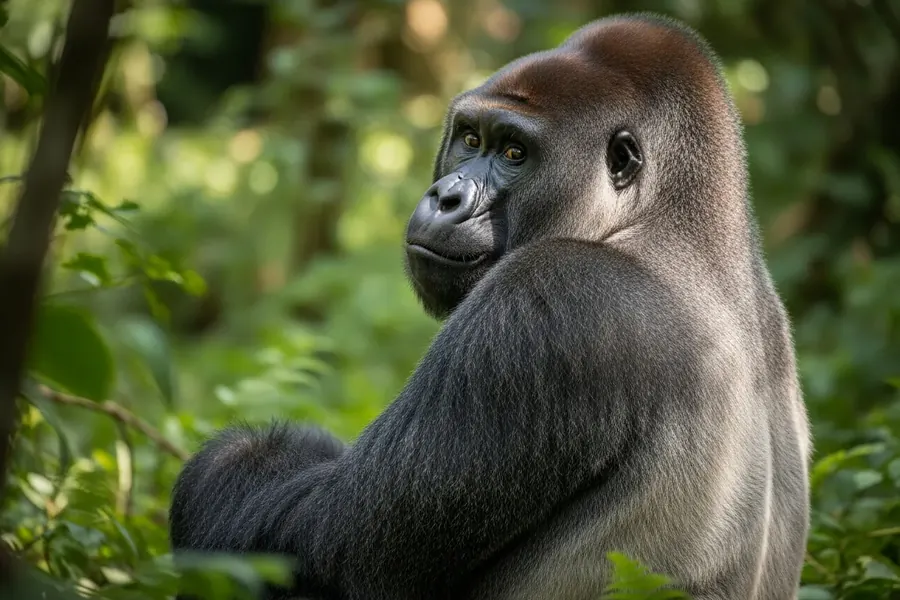
Gorilla — up to ~200 kg, sagittal crest, massive build
Source: Wikimedia Commons
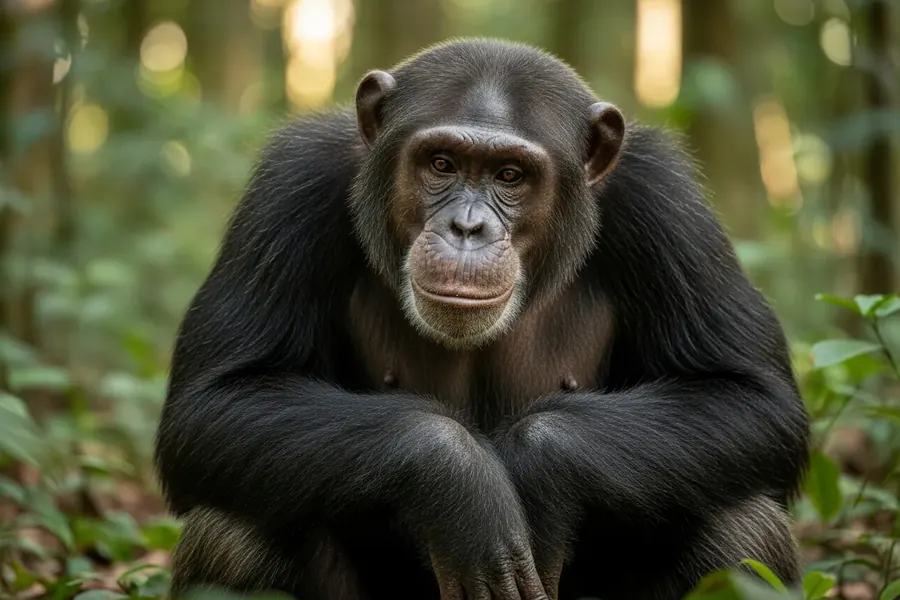
Chimpanzee — far smaller and slighter, more arboreal
Source: Wikimedia Commons
Gorilla vs Chimpanzee: At a Glance
| Feature | Gorilla | Chimpanzee |
|---|---|---|
| Scientific classification | Genus Gorilla: 2 species (western, eastern), 4-5 subspecies | Genus Pan, species Pan troglodytes, 4 subspecies |
| Adult weight (male) | 140-200 kg (310-440 lb) | 40-60 kg (88-130 lb) |
| Standing height | 1.25-1.8 m (4 ft 1 in-5 ft 11 in) | 1-1.7 m (3 ft 3 in-5 ft 7 in) |
| Range | Central and West Equatorial Africa (10 countries) | West to East Equatorial Africa, Senegal to Tanzania (21 countries) |
| Key visual difference | Sagittal crest, heavy brow ridge, small ears, flat wide nose | Rounder skull, no sagittal crest, larger protruding ears |
| Diet | Mostly leaves, stems, shoots, fruit (herbivorous) | Fruit, leaves, insects, and hunted meat (omnivorous) |
| Social structure | Harem groups led by one silverback male | Fission-fusion communities, multiple adult males |
| Lifespan (wild) | 35-40 years | About 33 years on average |
| IUCN Red List status | Critically Endangered (both species) | Endangered (Critically Endangered for western subspecies) |
Size and physical differences
The gorilla is far bigger and stronger, with male gorillas weighing around 135-195 kg versus about 40-60 kg for a male chimpanzee, roughly three times heavier.
Gorillas and chimpanzees are both African great apes and among humans' closest living relatives, but they belong to different genera and look and behave quite differently. Gorillas (genus Gorilla) are the largest living primates, built for strength and a leaf-and-stem diet, while chimpanzees (genus Pan, species Pan troglodytes) are smaller, more agile omnivores famous for tool use and complex social politics. Confusion is common because both species knuckle-walk on all fours, live in family-based groups in Central and West African forests, and share a striking amount of DNA with humans. This guide sets out the taxonomy, size, range, behaviour, lifespan and conservation status of each, and pinpoints the visual cues — skull shape, brow ridge, ears, posture — that let you tell them apart at a glance, whether in a photograph, a nature documentary or, sadly, images used in wildlife trafficking cases.
Size, build and skull shape
Gorillas are the largest living primates: adult male western lowland gorillas average around 140 kg (310 lb) and can reach 200 kg (440 lb) in captivity, standing 1.25-1.8 m (4 ft 1 in-5 ft 11 in) tall with an arm span up to 2.6 m (8 ft 6 in). Adult chimpanzees are far smaller, males averaging roughly 40-60 kg (88-130 lb) and standing 1-1.7 m (3 ft 3 in-5 ft 7 in) when upright. The skulls tell the two apart instantly: male gorillas grow a bony sagittal crest along the midline of the skull (up to 5 cm/2 in high) to anchor powerful jaw muscles, plus a heavy, jutting brow ridge and wide, flat nostrils. Chimpanzees lack a true sagittal crest, have a smaller brow ridge, a more rounded skull, and noticeably larger, more prominent ears than a gorilla's small, close-set ears.
Diet and foraging behaviour
Gorillas are almost entirely herbivorous, spending most of the day eating leaves, stems, pith, bark and fruit, with only occasional insects; their large gut and broad chest evolved to process huge volumes of fibrous plant matter. Chimpanzees are omnivorous and considerably more varied in their foraging: they eat fruit and leaves as staples but also insects (using tools such as stripped twigs to fish termites from mounds) and, notably, hunt smaller mammals including monkeys in coordinated group hunts. This makes chimpanzees one of the few non-human primates that regularly hunt vertebrate prey, a behaviour rarely seen in gorillas.
Social structure and temperament
Gorillas live in stable, cohesive family groups typically led by a single dominant adult male, the silverback, alongside several adult females and their offspring; the silverback makes decisions for the group and defends it, but overall gorillas are calm, non-aggressive apes whose famous chest-beating is a bluff display rather than a prelude to attack. Chimpanzees live in larger, more fluid "fission-fusion" communities of dozens of individuals that split into smaller subgroups and reunite, involving multiple related adult males who cooperate and compete for status. Chimpanzee societies are more volatile, with more vocal communication, tool use, and occasional lethal violence between rival communities, contrasting with the generally placid, tightly bonded gorilla family unit.
Range, lifespan and conservation status
Gorillas are restricted to a smaller footprint across roughly ten Central and West African countries, split between western gorillas (Cameroon, Gabon, Republic of Congo, Equatorial Guinea, Central African Republic, DR Congo, Angola/Cabinda, Nigeria) and eastern gorillas (DR Congo, Rwanda, Uganda). Chimpanzees range far more widely, from Senegal in the west across the Equatorial belt to Tanzania and Lake Albert in the east, spanning around 21 countries. Wild gorillas typically live 35-40 years; wild chimpanzees average around 33 years, though some East African populations reach into their 40s. Both genera are threatened: the IUCN Red List classifies both gorilla species as Critically Endangered (except the mountain gorilla subspecies, listed Endangered), while common chimpanzees are listed Endangered and the western chimpanzee subspecies Critically Endangered, chiefly due to habitat loss, poaching and disease.
Gorilla vs Chimpanzee: FAQs
Is a gorilla a type of chimpanzee?
Which is bigger, a gorilla or a chimpanzee?
Which is stronger, a gorilla or a chimpanzee?
How can you tell a gorilla and a chimpanzee apart in a photo?
Do gorillas and chimpanzees live in the same forests?
Which ape is more closely related to humans?
Help protect animals
Learning about animals can help more people understand their needs. WARN raises funds for eligible animal-welfare organisations. Read the relevant appeal’s purpose, recipient status and fund terms, or share this free guide to raise awareness.