Animal Comparison
Seal vs Sea lion
The fastest way to tell them apart: sea lions have visible external ear flaps and can walk on all fours; true seals have no ear flaps and flop on their bellies.
By the WARN Research & Conservation TeamChecked against IUCN Red List & CITES sourcesLast updated
In brief — Seal vs Sea lion
If it has visible ears and can walk on its flippers, it is a sea lion; if it has no ear flaps and wriggles on its belly, it is a true seal.
The clearest difference between a seal and a sea lion is the ears: sea lions (family Otariidae) have small external ear flaps and long front flippers that let them rotate their hind flippers forward and walk on all fours, while true seals (family Phocidae) have no external ear flap, only a small hole, and must flop along on their bellies because their hind flippers cannot turn forward.
See the difference

Seal — no ear flaps, short flippers, wriggles on land
Source: Wikimedia Commons
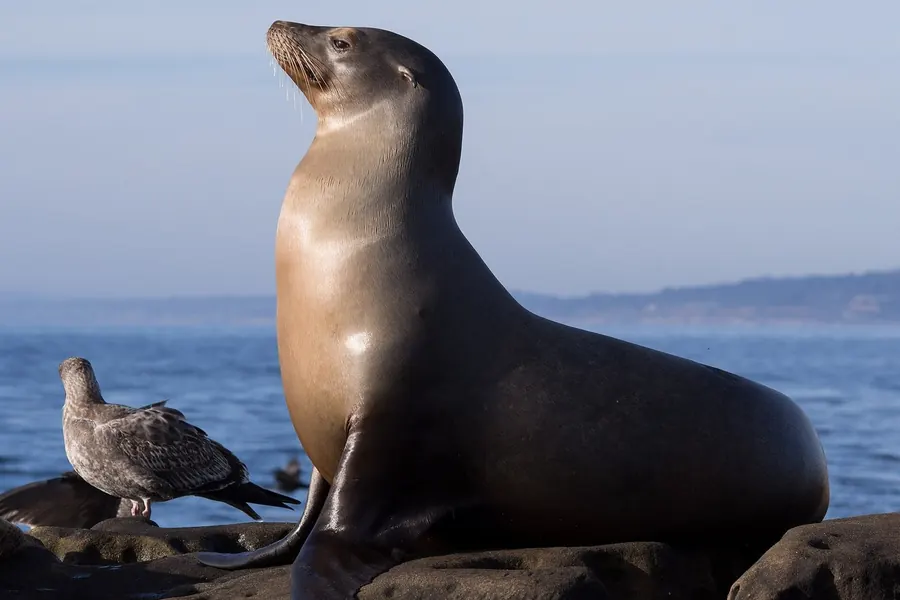
Sea lion — visible ear flaps, big flippers, 'walks'
Source: Wikimedia Commons
Seal vs Sea lion: At a Glance
| Feature | Seal | Sea lion |
|---|---|---|
| Scientific family | Phocidae ("true" or earless seals) | Otariidae (eared seals) |
| Ears | No external flap, just a small hole | Small visible external ear flap |
| Front flippers | Short, fur-covered, clawed | Long, mostly bare, paddle-like |
| Moving on land | Flops/undulates on belly | Walks on all fours, rotates hind flippers forward |
| Swimming style | Propelled by side-to-side hind-flipper strokes | Propelled by front-flipper strokes |
| Typical size (example species) | Harbour seal: 1.5-1.9 m, 55-170 kg (121-375 lb) | California sea lion: males ~2.4 m/300 kg (8 ft/660 lb); females ~1.8 m/100 kg (6 ft/220 lb) |
| Voice | Mostly quiet: soft grunts, growls, hisses | Loud, distinctive barking |
| Typical lifespan | 20-30 years | 20-30 years |
| IUCN status (example species) | Harbour seal: Least Concern | California sea lion: Least Concern |
Which is bigger & stronger?
Comparing typical species, the sea lion is bigger, e.g. a male California sea lion at about 300-390 kg versus a male harbour seal at roughly 130-150 kg, though the biggest true seal (the elephant seal, up to about 4,000 kg) dwarfs any sea lion.
Seals and sea lions are both pinnipeds — fin-footed marine mammals in the order Carnivora — but they belong to two different families that split apart tens of millions of years ago. True seals (Phocidae, around 18 species, including the harbour seal and elephant seals) lack any external ear flap and cannot rotate their hind flippers under their bodies, so on land they shuffle and undulate like a caterpillar. Sea lions and fur seals (Otariidae, around 15 living species, including the California and Steller sea lions) have visible external ear flaps and long, powerful front flippers that let them rotate their rear flippers forward and walk, even run, on all fours. The two groups also differ in how they swim, how loud they are, and how they are insulated against cold water.
Ears: the fastest tell
Sea lions carry small, rolled external ear flaps (pinnae) just behind the eye, which is why they are sometimes called "eared seals." True seals have no external ear flap at all — only a tiny hole set flush against the head. This single feature, visible even from a distance with binoculars, is the most reliable way to identify which group an animal belongs to.
How they move on land
A sea lion's long front flippers and hind flippers that rotate forward let it prop itself up and walk, or even gallop, on all fours, much like a dog. A true seal's hind flippers cannot rotate under the body, and its front flippers are too short to lift its weight, so it must shuffle and hump its whole body forward on its belly, a much slower and more laborious movement on land.
How they swim
True seals are propelled mainly by powerful side-to-side sweeps of their hind flippers, using their front flippers chiefly for steering, which suits deep, sustained dives. Sea lions swim by "flying" through the water with strong strokes of their long front flippers and steer with their hind flippers, a style suited to bursts of speed and agile turns when chasing schooling fish.
Insulation and build
True seals rely mainly on a thick layer of blubber for warmth and tend to have rounder, more torpedo-shaped bodies suited to cold, often polar, waters — the Baikal seal even lives in freshwater. Sea lions and fur seals have somewhat less blubber but a thick, dense coat of fur (especially fur seals) and are generally larger and more vocal, gathering in noisy colonies on beaches and rocky shorelines.
Did you know?
The family name "true seal" comes from Phocidae having existed as a distinct lineage in the North Atlantic since roughly the early Miocene, while sea lions and fur seals (Otariidae) arose separately in the North Pacific — meaning the two familiar "seal" body plans evolved on opposite sides of the globe.
Seal vs Sea lion: FAQs
What is the easiest way to tell a seal and a sea lion apart?
Are sea lions and seals the same species?
Which is bigger, a seal or a sea lion?
Do seals or sea lions bark?
Why are performing "seals" at aquariums usually sea lions?
Can a seal walk on land like a sea lion?
These animals need us
Understanding wildlife is the first step to protecting it. WARN funds partner-led rescue and conservation where the need is greatest — your support keeps that work going.