Animal Comparison
Orangutan vs Gorilla
Orangutans are solitary, reddish-brown tree-dwellers from Asia with the longest arms of any ape. Gorillas are larger, black-haired, ground-living African apes that live in troops led by a silverback.
By the WARN Research & Conservation TeamChecked against IUCN Red List & CITES sourcesLast updated
In brief — Orangutan vs Gorilla
Gorillas are bigger, ground-dwelling and social; orangutans are smaller, tree-dwelling and solitary.
The clearest difference is habitat and build: orangutans are solitary, reddish-brown apes from Borneo and Sumatra with extremely long arms built for swinging through trees, while gorillas are larger, black-haired African apes that knuckle-walk on the ground in troops led by a dominant silverback male. Gorillas are also heavier (up to 195 kg/430 lb vs 90 kg/200 lb) and live in stable social groups; orangutans live mostly alone.
See the difference
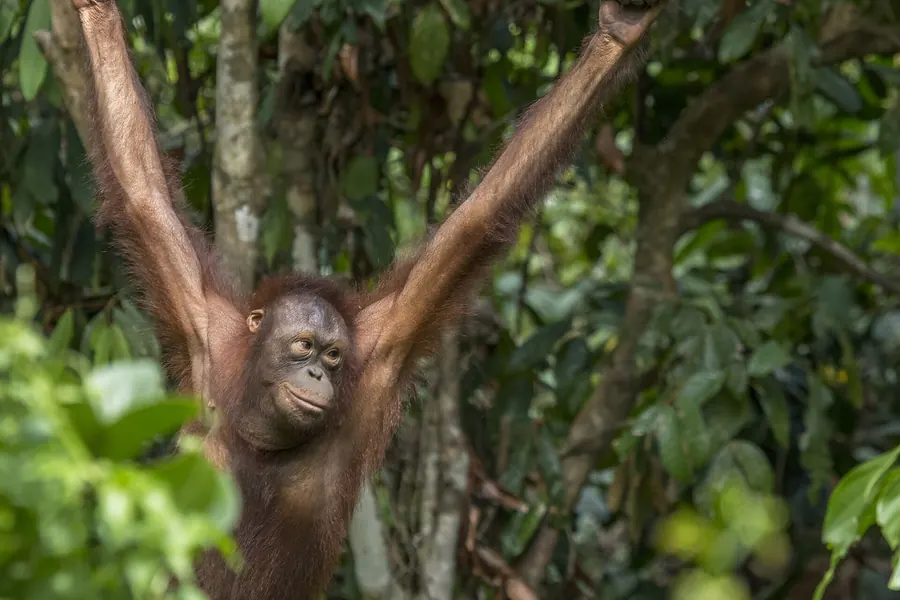
Orangutan — red-brown, very long arms, tree-dwelling
Photo: Charles J. Sharp / Wikimedia Commons (CC BY-SA 4.0)
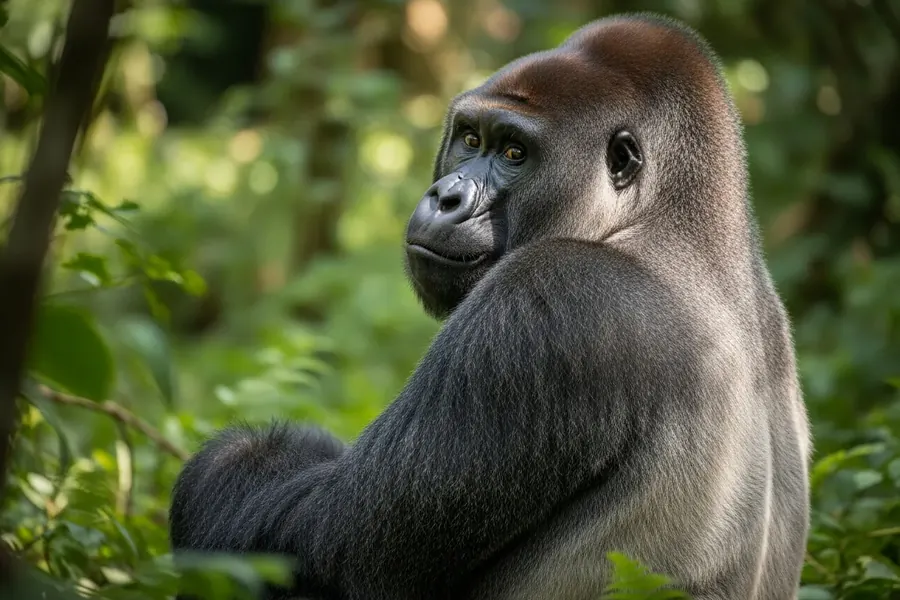
Gorilla — black, ground-dwelling, far heavier build
Source: Wikimedia Commons
Orangutan vs Gorilla: At a Glance
| Feature | Orangutan | Gorilla |
|---|---|---|
| Scientific classification | Genus Pongo (3 species) | Genus Gorilla (2 species) |
| Native range | Borneo and Sumatra, Indonesia/Malaysia | Equatorial Central and West Africa |
| Adult male weight | 50-90 kg (110-200 lb) | 135-195 kg (300-430 lb) |
| Standing height | About 1.2-1.4 m (4-4.6 ft) | About 1.7 m (5.6 ft) |
| Hair colour and build | Long shaggy reddish-brown hair, very long arms | Coarse black hair, silverback has grey saddle |
| Movement | Arboreal; climbs and swings using arms | Terrestrial; knuckle-walks on all fours |
| Social structure | Largely solitary; mothers raise young alone | Troops of 5-30 led by a dominant silverback |
| Lifespan | 35-45 years wild, up to 60 in captivity | 30-40 years wild, up to 50 in captivity |
| IUCN status | All 3 species Critically Endangered | Critically Endangered (Endangered for mountain gorilla) |
Which is bigger & stronger?
The gorilla is considerably bigger and stronger, with male silverbacks averaging about 135-195 kg against roughly 75-100 kg for a male orangutan.
Orangutans and gorillas are both great apes (family Hominidae) but belong to entirely different genera on different continents, and few people realise how distinct their biology and behaviour actually are. Orangutans (genus Pongo) are Asia's only great ape, found solely in the rainforests of Borneo and Sumatra, while gorillas (genus Gorilla) live in the forests of equatorial Africa. The two are separated by roughly 10-16 million years of independent evolution, which explains their strikingly different bodies: orangutans are shaggy, red-brown and built for a life almost entirely in the canopy, while gorillas are black-haired, heavily built and spend most of their time on the forest floor. Both are Critically Endangered across nearly all their species and subspecies, but their conservation challenges, family structures and daily behaviour differ sharply, which is the focus of this comparison.
Body size and arm-to-leg proportions
Gorillas are the largest living primates: a mature male can weigh 135-195 kg (300-430 lb) and stand roughly 1.7 m (5.6 ft) when upright, though they normally move on all fours. Orangutans are considerably smaller, with adult males weighing 50-90 kg (110-200 lb) and standing about 1.2-1.4 m (4-4.6 ft). The proportions differ too: orangutans have the longest arms relative to body size of any great ape, with an arm span that can reach around 2.2 m (7 ft), built for reaching between branches. Gorillas have shorter, thicker limbs and a heavily muscled torso adapted for supporting their weight on the ground rather than swinging overhead.
Habitat and movement
Orangutans are the most arboreal great ape, spending nearly all their time in the rainforest canopy of Borneo and Sumatra, where they build a fresh sleeping nest of branches and leaves most nights. Gorillas, native to the forests, swamps and mountains of equatorial Africa, are almost entirely terrestrial, moving on all fours using a knuckle-walking gait and only climbing low trees to feed or rest. This split explains why deforestation affects each species differently: orangutans need an unbroken canopy to travel, while gorillas need protected ground-level forest and food corridors.
Social structure and communication
Orangutans are the least social great ape: adult males are largely solitary and females travel only with dependent offspring. Mature 'flanged' males develop wide cheek pads and a throat pouch used to produce a booming long call that carries up to 1.6 km (1 mile) through the forest, signalling their location to females and rival males. Gorillas live in far more cohesive troops of roughly 5 to 30 individuals, led by a mature male known as a silverback for the band of grey hair across his back. The silverback controls group movement, mediates disputes, and defends the troop, often using chest-beating and vocal displays rather than physical fighting to warn off rivals.
Conservation status and threats
All three orangutan species (Bornean, Sumatran and Tapanuli) are classified Critically Endangered by the IUCN, driven mainly by deforestation for palm oil, logging and mining, which fragments the canopy they depend on. Gorillas face a similar crisis: both the western and eastern gorilla species are Critically Endangered, with the sole exception of the mountain gorilla subspecies, which was downlisted to Endangered after sustained population recovery. Gorilla populations are additionally threatened by poaching, snaring, disease transmitted from humans, and civil conflict across parts of their range in the Congo Basin.
Did you know?
A flanged male orangutan's long call, produced using his throat pouch as a resonating chamber, can be heard by other orangutans up to 1.6 km (1 mile) away through dense rainforest.
Orangutan vs Gorilla: FAQs
Is an orangutan a type of gorilla?
Which is bigger, a gorilla or an orangutan?
Why do orangutans live alone but gorillas live in groups?
Are orangutans and gorillas both endangered?
How can you tell an orangutan and a gorilla apart at a glance?
Do orangutans and gorillas get along or live in the same habitat?
These animals need us
Understanding wildlife is the first step to protecting it. WARN funds partner-led rescue and conservation where the need is greatest — your support keeps that work going.