Animal Comparison
Octopus vs Squid
Octopus vs squid compared: arms vs tentacles, size, habitat, diet, lifespan and how to tell them apart. Clear, fact-checked answers in plain English.
By the WARN Research & Conservation TeamChecked against IUCN Red List & CITES sourcesLast updated
In brief — Octopus vs Squid
Both are eight-armed cephalopods, but a squid also has two extra feeding tentacles (ten limbs total), a torpedo-shaped finned body and an internal pen, whereas an octopus has eight arms only and a soft, round body.
The quickest tell is the limbs: an octopus has eight arms and nothing else, while a squid has eight arms plus two longer feeding tentacles, giving it ten limbs in total. Octopuses are soft, round-bodied hunters that live and hide on the seafloor; squids have a longer, torpedo-shaped body with two fins and a stiffening internal "pen", built for swimming in open water.
See the difference
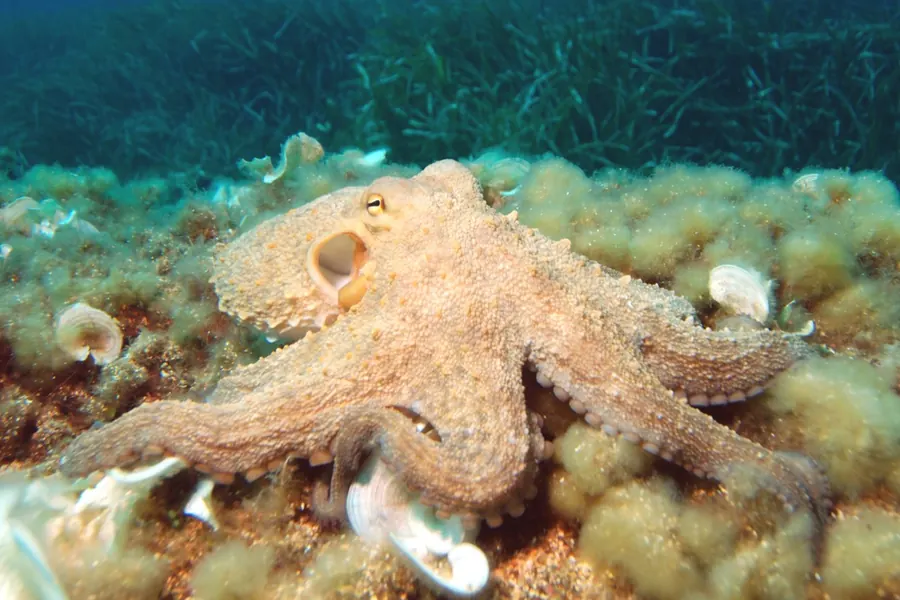
Octopus — eight arms, round soft body
Source: Wikimedia Commons
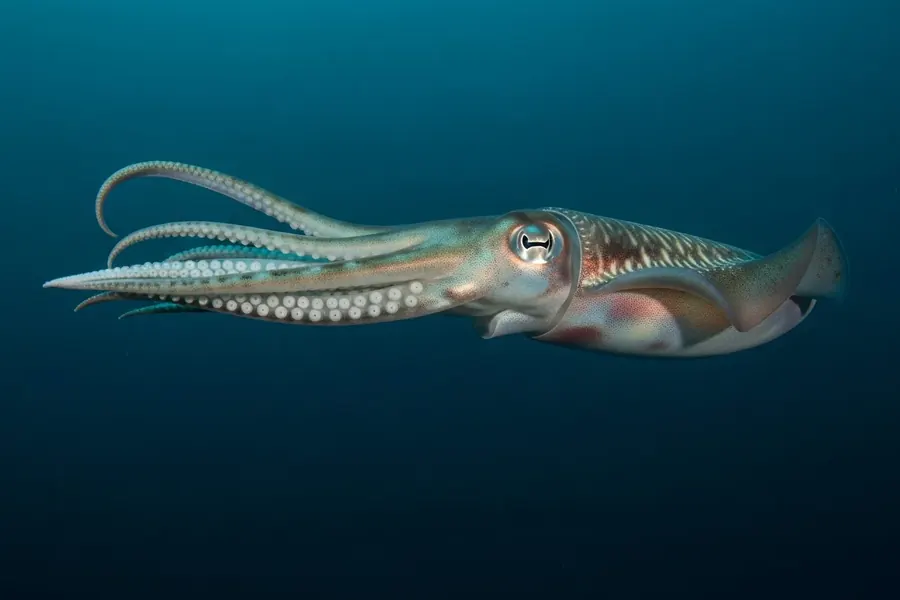
Squid — ten limbs, torpedo body with fins
Image: WARN wildlife library
Octopus vs Squid: At a Glance
| Feature | Octopus | Squid |
|---|---|---|
| Limbs | 8 arms only | 8 arms plus 2 longer feeding tentacles (10 total) |
| Body shape | Soft, rounded, bag-like mantle | Long, torpedo- or triangular-shaped mantle |
| Fins | Usually none (some deep-sea species excepted) | Two fins on the mantle |
| Internal support | No internal skeleton or shell | A stiff internal "pen" (gladius) |
| Suckers | Suckers along the full length of the arms | Suckers mainly near the tips of the tentacles; often with hooks |
| Habitat | Mostly seafloor (benthic), in dens and crevices | Mostly open water (pelagic) |
| Social behaviour | Largely solitary | Many species shoal; some in huge numbers |
| Diet | Crabs, clams, shrimp and other molluscs | Fish, shrimp and other squid |
| Typical lifespan | 1–2 years (up to 3–5 in the giant Pacific octopus) | 1–3 years (up to about 5 in the largest) |
| Largest species | Giant Pacific octopus, 4–5 m across, ~50 kg | Giant squid ~13 m long; colossal squid up to ~495 kg |
| Known species | Around 300 | Around 300 |
Which is bigger & stronger?
Squid grow larger overall: the giant squid reaches about 13 m in total length and the colossal squid is the heaviest invertebrate at up to roughly 495 kg, while the biggest octopus, the giant Pacific octopus, spans up to about 4.3 m across its arms and weighs around 15 kg typically (large individuals far more).
Octopuses and squids are close cousins in the class Cephalopoda, the group of soft-bodied, big-brained molluscs that also includes cuttlefish and nautiluses. They share a beaked mouth, blue copper-based blood, jet propulsion and remarkable intelligence, which is why they are so easily muddled. But they are built for different lives: octopuses are mostly solitary bottom-dwellers that squeeze into dens and crawl over the seabed, while squids are streamlined open-water swimmers, many of which move in shoals. The differences below draw on the Natural History Museum, the Smithsonian and Britannica, and cover the distinctions people search for most: limbs, size, body shape, habitat, diet and lifespan.
Arms vs arms-plus-tentacles
This is the single clearest difference. An octopus has eight arms and nothing more, each lined with suckers along its whole length. A squid has those same eight arms but adds two much longer feeding tentacles, so it has ten limbs in total. On a squid the suckers cluster near the tentacle tips, often alongside small hooks, and it shoots these tentacles out to snatch prey.
Body shape and internal support
An octopus has a soft, rounded, bag-like body with no internal skeleton, letting it squeeze through gaps barely wider than its beak. A squid has a longer, more rigid torpedo- or triangular-shaped body stiffened by an internal "pen" (the gladius), a feather-shaped remnant of an ancestral shell. Squids also carry two fins on the mantle for steering and cruising; most octopuses have none.
Where they live and how they move
Octopuses are mainly benthic, meaning they live on or near the seabed, hiding in dens, crevices and rocky reefs and crawling with their flexible arms. Squids are mainly pelagic, built for continuous swimming in open water using jet propulsion and their fins. That difference in lifestyle drives most of the others, from body shape to social behaviour.
Solitary vs shoaling
Octopuses are largely solitary and territorial, meeting mainly to mate. Many squids, by contrast, are social and gather in shoals, sometimes numbering in the millions, which offers protection from predators in exposed open water. A few octopus species are known to cluster in dense groups, but this is the exception rather than the rule.
Diet and hunting style
Octopuses are seabed ambush hunters, prising open crabs, clams and other shellfish with their arms and a venomous, paralysing bite. Squids are fast open-water predators that fire out their two feeding tentacles to seize fish, shrimp and even other squid. Both have a sharp, parrot-like beak to break up prey.
Size and lifespan
Squids reach greater extremes of size: the giant squid grows to roughly 13 m in total length and the colossal squid is the heaviest known invertebrate at up to about 495 kg. The largest octopus, the giant Pacific octopus, spans up to about 4.3 m across its arms and usually weighs around 50 kg. Both are short-lived: most octopuses live 1–2 years and most squids 1–3 years, and both typically breed once and then die.
Did you know?
A squid's two long feeding tentacles can shoot out in a fraction of a second to seize prey, then retract, while its eight shorter arms hold the catch steady, a two-stage grab an octopus, with its eight all-purpose arms, simply does not have.
Octopus vs Squid: FAQs
Which is bigger, an octopus or a squid?
Are octopuses and squids the same animal?
How do you tell an octopus and a squid apart?
Can an octopus beat a squid in a fight?
Do squids have tentacles and octopuses don't?
How long do octopuses and squids live?
Are octopuses or squids more intelligent?
These animals need us
Understanding wildlife is the first step to protecting it. WARN funds partner-led rescue and conservation where the need is greatest — your support keeps that work going.