Animal Comparison
Kangaroo vs Wallaby
Kangaroo vs wallaby: the difference is mainly size. Compare their height, weight, legs, habitat and behaviour, and learn how to tell the two hoppers apart.
By the WARN Research & Conservation TeamChecked against IUCN Red List & CITES sourcesLast updated
In brief — Kangaroo vs Wallaby
Kangaroos and wallabies belong to the same family; the difference is mainly size. Kangaroos are the four largest species (males up to ~92kg), while "wallaby" is an informal name for smaller macropods, usually under ~20kg.
The main difference is size: "kangaroo" and "wallaby" are not separate scientific groups but common names for members of the same marsupial family (Macropodidae), split loosely by body size. Kangaroos are the four largest species — a big male red kangaroo stands around 1.5m tall and can weigh up to 92kg — while "wallaby" is an informal label for smaller macropods, most weighing under about 20–25kg. So every kangaroo is a macropod, but a wallaby is essentially a smaller cousin, not a different kind of animal.
See the difference
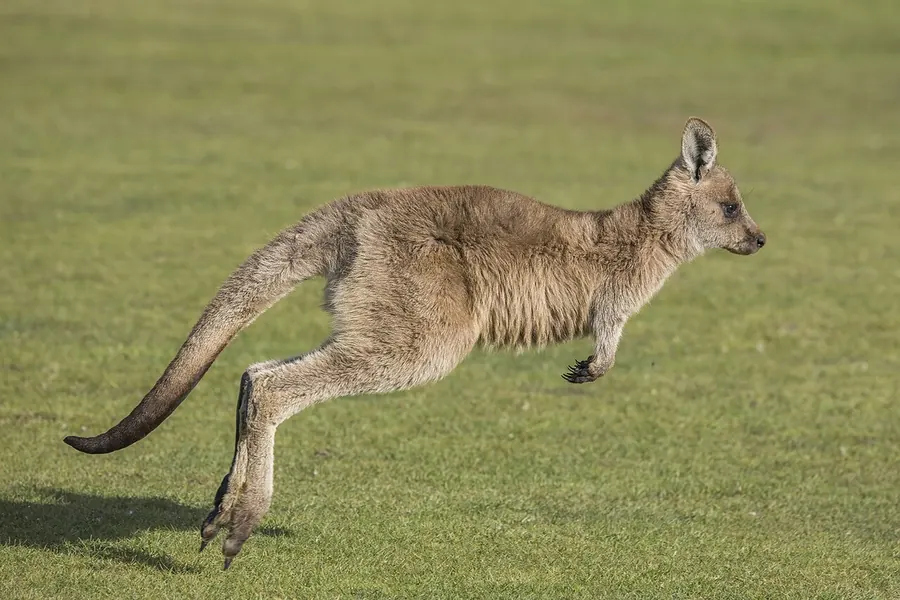
Kangaroo — the largest macropods (up to ~90 kg)
Source: Wikimedia Commons
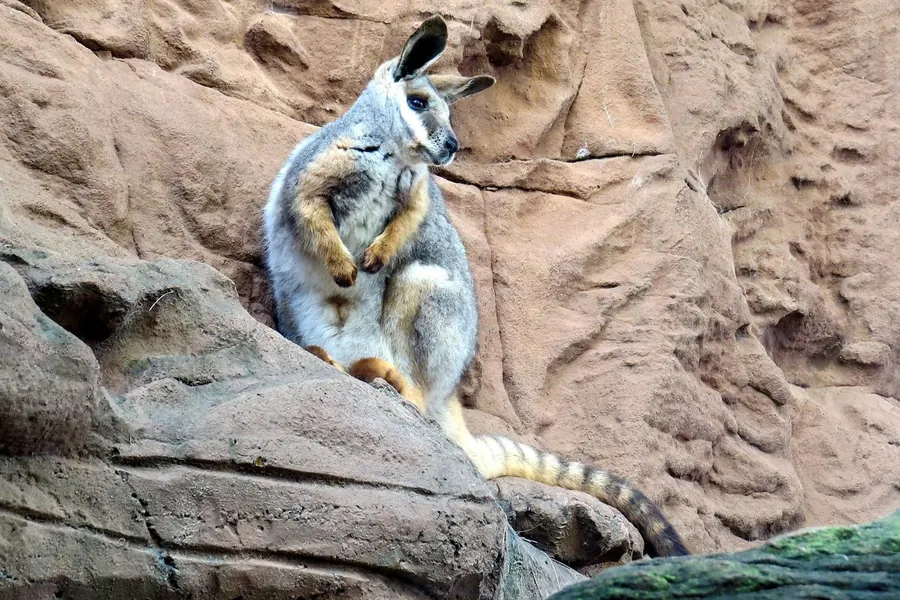
Wallaby — smaller macropod relatives (≤20 kg)
Photo: David Berkowitz / Wikimedia Commons (CC BY 2.0)
Kangaroo vs Wallaby: At a Glance
| Feature | Kangaroo | Wallaby |
|---|---|---|
| What the name means | The four largest macropod species (e.g. red, eastern grey, western grey, antilopine) | Informal name for many smaller macropods; not a single scientific group |
| Family | Macropodidae | Macropodidae (same family) |
| Body length (head–body) | Up to ~1.4m (large male red kangaroo) | Roughly 45cm–1m depending on species |
| Tail length | Up to ~1m | Around 33–75cm |
| Weight (male) | Up to ~92kg (red kangaroo) | Often ~15–26kg; many species under 20kg |
| Weight (female) | Up to ~39kg (red kangaroo) | Often ~11–15kg |
| Legs | Long lower legs built for speed over open ground | Shorter, more compact legs suited to agility in cover |
| Typical habitat | Open grassland, scrub and semi-arid plains | Forest, woodland, scrub and rocky terrain |
| Top speed | Up to ~70 km/h in short bursts (red kangaroo) | Fast and agile but generally slower over open ground |
| Lifespan (wild) | Commonly up to ~20 years; records to ~22 | Up to ~15–18 years depending on species |
| Conservation status | Common species (e.g. red kangaroo) are IUCN Least Concern | Widespread species Least Concern; some restricted species are threatened |
| Coat | Usually plainer, more uniform brown or grey | Often more colourful, with contrasting markings |
Which is bigger & stronger?
The kangaroo is far bigger: a large male red kangaroo can reach about 1.4m in body length plus a 1m tail and weigh up to 92kg, whereas a typical wallaby such as the red-necked wallaby weighs only around 11–27kg.
"Kangaroo" and "wallaby" are everyday names, not tidy scientific categories. Both belong to the marsupial family Macropodidae ("big-footed" pouched mammals), and the words simply sort its members by size: the four largest species are called kangaroos, and "wallaby" is an informal term for many of the smaller ones (with mid-sized wallaroos in between). Because the split is about size rather than genetics, some wallabies are actually close relatives of kangaroos in the same genus. The most familiar kangaroo is the red kangaroo — the largest living marsupial — while red-necked and agile wallabies are common examples of the smaller type. All are native to Australia and New Guinea, hop on powerful hind legs, and carry young in a pouch, which is why they are so easily confused.
Size is the real dividing line
There is no separate 'wallaby species' — the word just means a smaller macropod. Kangaroos are the four largest species in the family. A big male red kangaroo, the largest living marsupial, reaches about 1.4m in body length plus a tail of up to 1m and can weigh up to 92kg. A typical wallaby such as the red-necked wallaby weighs only around 11–27kg. Mid-sized animals that fall between the two are usually called wallaroos.
Different legs for different ground
Kangaroos have notably long lower legs (between ankle and knee) that act like efficient springs, letting them cover open country at speed with long, economical hops. Wallabies tend to have shorter, more compact hind legs suited to quick changes of direction in forest, scrub and rocky terrain. This is a handy field clue: an animal with very long, lanky legs on open plains is almost certainly a kangaroo.
Open plains versus cover
Kangaroos favour open grassland, scrub and semi-arid plains where their long-range hopping pays off, and they often gather in large groups called mobs. Wallabies more often live in forest, woodland and rocky areas, and many are more solitary or move in smaller groups. Where you see the animal — wide-open ground versus dense cover — is often as telling as its size.
Colour and coat
Kangaroos usually have a plainer, more uniform coat in muted brown or grey (the red kangaroo's males are a distinctive rusty red). Many wallabies are more strongly marked and colourful — the red-necked wallaby, for example, has a grey body with reddish shoulders and neck. Brighter, contrasting markings on a smaller animal point towards a wallaby.
Same biology, different scale
Both are marsupials that hop on two legs, balance with a heavy tail, graze or browse on plants, and raise tiny young (joeys) in a forward-opening pouch. Their differences are largely a matter of scale and habitat rather than fundamentally different biology, which is exactly why the two names get muddled.
Conservation picture
The common kangaroo species, including the red kangaroo, are listed as Least Concern by the IUCN and remain abundant. 'Wallaby' covers many species, so their status varies: widespread wallabies are also Least Concern, but some range-restricted species (such as certain rock-wallabies) are threatened by habitat loss, predators and competition.
Did you know?
Because "kangaroo" and "wallaby" are sorted by size rather than genetics, some wallabies are more closely related to kangaroos than they are to other wallabies — the names describe a rough scale, not a family tree.
Kangaroo vs Wallaby: FAQs
Are kangaroos and wallabies the same animal?
Which is bigger, a kangaroo or a wallaby?
How can you tell a kangaroo and a wallaby apart?
Is a wallaby just a baby kangaroo?
Can a kangaroo beat a wallaby in a fight?
What is a wallaroo?
How fast can a kangaroo hop compared with a wallaby?
These animals need us
Understanding wildlife is the first step to protecting it. WARN funds partner-led rescue and conservation where the need is greatest — your support keeps that work going.