Animal Comparison
Dolphin vs Porpoise
Dolphins have long, beaked snouts, curved dorsal fins and cone-shaped teeth; porpoises have blunt faces, triangular fins and spade-shaped teeth. Full comparison.
By the WARN Research & Conservation TeamChecked against IUCN Red List & CITES sourcesLast updated
In brief — Dolphin vs Porpoise
If it has a beak and cone-shaped teeth, it is a dolphin; if it has a blunt face and spade-shaped teeth, it is a porpoise.
The clearest difference is head and tooth shape: dolphins have an elongated, beak-like snout with cone-shaped (conical) teeth, while porpoises have a blunt, beakless face with flat, spade-shaped teeth. Dolphins also tend to have taller, curved dorsal fins and leaner bodies, whereas porpoises have smaller, triangular fins and stockier builds. Both are toothed whales (Odontoceti), but they belong to separate families: Delphinidae (dolphins) and Phocoenidae (porpoises).
See the difference
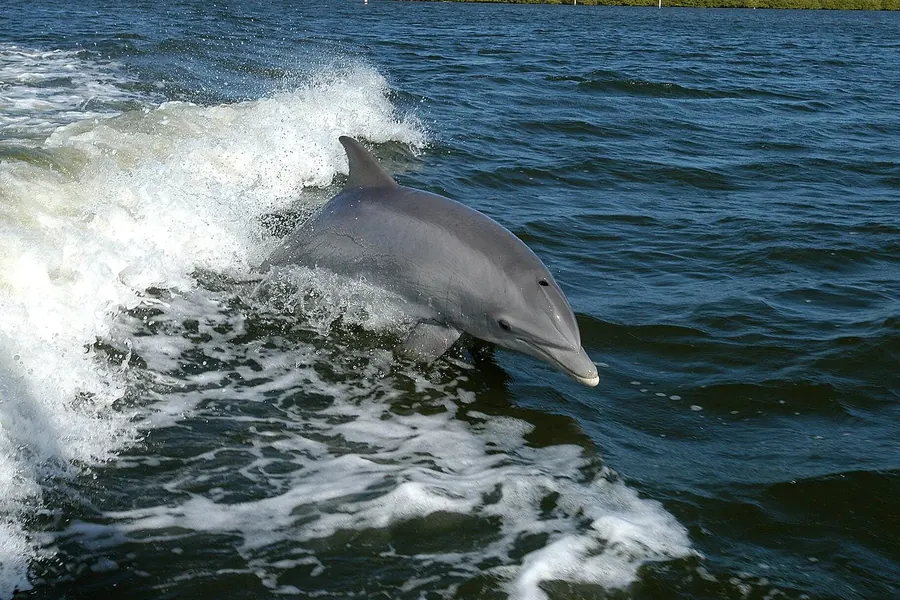
Dolphin — beaked snout, curved fin, conical teeth
Source: Wikimedia Commons
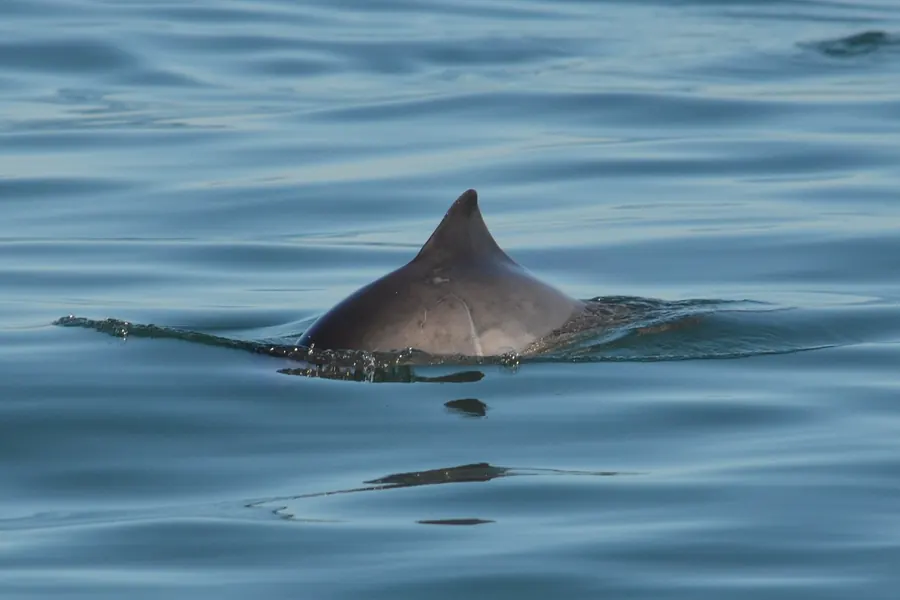
Porpoise — blunt head, triangular fin, spade-shaped teeth
Photo: Ben Phalan / Wikimedia Commons (CC BY 4.0)
Dolphin vs Porpoise: At a Glance
| Feature | Dolphin | Porpoise |
|---|---|---|
| Family | Delphinidae (oceanic dolphins) | Phocoenidae (porpoises) |
| Number of species | About 38, plus 5 river dolphin species | 6-7 species |
| Snout shape | Long, protruding beak (rostrum) | Short, blunt, no distinct beak |
| Teeth | Cone-shaped (conical), pointed | Flat, spade-shaped |
| Dorsal fin | Tall, curved (falcate) | Small, triangular, less curved |
| Typical body size | 2-4 m (6.6-13 ft); largest is the orca at up to 9 m | 1.4-2.3 m (4.6-7.5 ft); smaller overall |
| Typical lifespan | 40-60 years (bottlenose dolphin) | 8-13 years on average (harbour porpoise) |
| Group behaviour | Highly social, pods often 10-100+ | Often solitary or in small groups of 2-8 |
| IUCN status (example species) | Least Concern (common bottlenose dolphin) | Least Concern overall; vaquita Critically Endangered |
Which is bigger & stronger?
Dolphins are generally bigger, with the common bottlenose reaching 2-4 m and up to 300-500 kg, whereas the harbour porpoise is typically only about 1.5-1.8 m and 50-70 kg.
Dolphins and porpoises are often confused because both are small, air-breathing, toothed whales (suborder Odontoceti) that live in social groups and use echolocation to hunt. But they are separated into two distinct families that diverged millions of years ago: Delphinidae, the oceanic dolphins, with around 38 species including the common bottlenose and orca; and Phocoenidae, the porpoises, a much smaller family of six or seven species including the harbour porpoise and the critically endangered vaquita. The clearest field marks are the shape of the snout and teeth, though fin shape, body build and typical group size also help tell them apart at sea.
Snout, teeth and facial shape
The most reliable way to tell them apart is the face. Dolphins have an elongated rostrum that forms a visible "beak" separated from the melon (forehead) by a crease, and their jaws hold numerous cone-shaped, pointed teeth suited to grasping fast-moving fish and squid. Porpoises lack a pronounced beak; their snout is short and rounded, blending smoothly into a blunter head profile, and their teeth are flattened and spade-shaped rather than conical. This tooth shape is the origin of the scientific distinction between the two families and is often the feature used to confirm identification from a stranded or captured animal.
Dorsal fin and body shape
Most dolphins carry a tall, curved (falcate) dorsal fin and a comparatively lean, streamlined body, features easy to spot when a bottlenose dolphin surfaces and arcs through a wave. Porpoises have a smaller, more triangular dorsal fin with little to no backward curve, set on a stockier, more compact body. Because porpoises surface briefly and with a low-key roll rather than dramatic leaps, their fin shape combined with a quieter surfacing style is often the quickest visual cue at sea, even before facial features are visible.
Size, lifespan and social behaviour
Dolphins are generally larger and longer-lived: the common bottlenose dolphin measures 2-4 m (6.6-13 ft) and can live 40-60 years, while the family's largest member, the orca, reaches up to 9 m (30 ft). Porpoises are smaller and shorter-lived, typically 1.4-2.3 m (4.6-7.5 ft) with an average lifespan of 8-13 years in species such as the harbour porpoise. Dolphins are famously gregarious, travelling in fission-fusion pods that can number in the hundreds and communicating with complex whistles and clicks. Porpoises are typically more solitary or found in small, loose groups of two to eight, and are generally quieter and more elusive around boats.
Diversity and conservation status
Dolphins form a much larger and more diverse family, Delphinidae, with roughly 38 recognised oceanic species (plus five separate river dolphin species in other families) found in every ocean and many major rivers. Porpoises belong to the far smaller family Phocoenidae, comprising just six or seven species confined mainly to cooler coastal and temperate waters. Most dolphin and porpoise species are currently listed as Least Concern by the IUCN, but conservation status varies sharply by species: the vaquita, the world's smallest porpoise, found only in Mexico's northern Gulf of California, is Critically Endangered, primarily due to entanglement in fishing gear, while several river dolphin species are also at serious risk.
Did you know?
The vaquita, the world's smallest and most endangered porpoise, was only discovered by science in 1958 and lives in a single, tiny stretch of Mexico's northern Gulf of California, an area smaller than many cities.
Dolphin vs Porpoise: FAQs
Is a porpoise a type of dolphin?
Which is bigger, a dolphin or a porpoise?
How can you tell a dolphin and a porpoise apart in the water?
Do dolphins and porpoises interbreed?
Are porpoises endangered?
What is the difference between dolphin and porpoise teeth?
These animals need us
Understanding wildlife is the first step to protecting it. WARN funds partner-led rescue and conservation where the need is greatest — your support keeps that work going.